Showing posts with label SocialAttributes. Show all posts

Saturday, April 4, 2015

NPC Social Talents (Warhammer Cards I Forgot To Blog, Part 2)

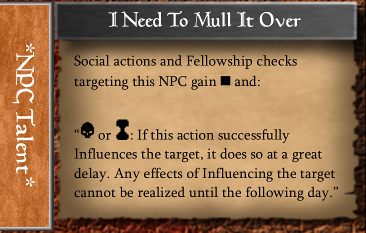
Here's a big batch of Social Talent Cards for NPCs in Warhammer Fantasy 3rd Edition.

NPCs don't typically have Talent Slots in the game. Some of the Organization and Nemesis cards do, but I don't recommend restricting yourself (as GM) to only those frameworks. Adding one NPC Social Talent to any given NPC won't break anything, and will feel about on par with the Talent options that PCs have. NPCs that are meant to be a major social obstacle, such as jaded nobles, might have 2 or even 3 Social Talents, but this should be fairly rare just to keep it in line with the limitations players face re: Talents.

These cards are intended to "spice up" Social Encounters in Warhammer 3rd, helping to bring a little depth and variation to your social conflicts. Feel free to print these for your personal use, and please let me know if you find them helpful.


Several of those cards alter the difficulty of certain social skill rolls, such as the one that raises the difficulty of Charm and Guile while simultaneously lowering the difficulty of Leadership checks. The idea there is to mix things up a bit so the PCs can't just rely on a single skill for every situation. When I ran these, I tended to keep the cards hidden because as GM I like to be mysterious. In retrospect, though, it's probably better to point those cards out to the PCs early in the scene, to encourage them to swap tactics. Otherwise, you'll find the same high-Fellowship character attempting to power through using the same Skill again and again, and they'll completely miss your attempt at adding depth to the scene. My recommendation now is that you read the card out loud to the players the first time (in any scene) where the card is modifying a die roll. Preserving a sense of mystery is all well and good, but you need to give the players enough data for them to make meaningful decisions at least starting with the second attempt to influence any given NPC.

Some of the Talents are designed to slow down Social Encounters or discourage the PCs from ganging up en masse and overwhelming the NPCs by sheer volume of low-quality die rolls. Those are especially good cards to use if there's only one NPC in a scene, as otherwise the rules as written favor the brute-force approach to group Charm checks.

The cards above were made with the Strange Eons program. I've got a few dozen more (non-Social) NPC Talents sitting around on my hard drive, and hopefully I'll find time to post them soon. Of course, I said the same thing about these Social Talents way back in February, so who knows how long it will take me to get around to it.


Tuesday, February 24, 2015

Social Actions (Warhammer Cards I Forgot to Blog, Part 1)

I made these cards for my Warhammer Campaign (that wrapped up two months ago). I apparently forgot to post them to the web at all. Oops.

I thought about them today because of a thread over in the Fantasy Flight Forums about how to encourage players to actually invest in Social Actions.

So, here's a number of new Social Actions for Warhammer 3rd Edition. Feel free to use these in your game. None of them have been tested much at all, because these were made available very late in the campaign, at a point where the PCs had become very accustomed to solving things violently. I think I'll just post them here alphabetically:


"A Second Of Doubt" is a Social Action in name only. Really, it's just a way to penalize one NPC's initiative roll, and/or buy your whole party a moment to get into position. There's nothing here that stops you from using it in physical combat, though green side is just a little better in Social encounters than either side is in an actual fight.


"Evil Eye" lies somewhere between Social Action and Hedge Magic. It's a quick way to bury someone in Stress and Shame. It inflicts the Ill-Fortune Condition, which if memory serves correctly can be very potent should the social conflict later devolve into actual physical battle. The double-chaos-star line is rather disastrous, so you need to be very pick about choosing targets with a low Willpower. The action itself uses Willpower, so it may be appealing to characters other than those typically making the social checks in your group.


"Hidden Mean Streak" relies on a variety of Condition cards to do its dirty work. It's for characters that are normally very Charming and noble, but who can unleash unexpected temper when pushed too far. The Reckless and Conservative sides of the card play very differently.


"Holier Than Thou", like "Evil Eye", lets you influence the target with your Willpower, and the Thunderstruck condition softens them up should the situation later devolve into combat. It doesn't deliver quite the beating that "Evil Eye" does, but the downsides of a bad roll aren't nearly as dangerous, either.


"Muse" is unlikely to see much use by PCs, but it was kind of a fun idea to try to model in-game. You'd need a pretty unusual campaign for it to be worth the XP. It's stronger when being used on an NPC, since rarely do you want to Influence a fellow PC. The bonus dice are fairly low, but most of the time you'll also be able to add 1 or 2 Fortune dice for the "Assist" manoeuvre, and they'd certainly stack with this.


"Shift The Blame" lets you redirect trouble so that your rivals go down in your sinking ship. It's actually pretty potent, but requires just the right situation to use. If the social encounter has some mook support for the villain, this is a good way to break them up. And since it's a reaction, it doesn't stop you from engaging in more shenanigans in your own turn as well.


"This Could Get Ugly" is a Strength-based Intimidation check that drains A/C/E from NPCs and breaks up Henchman groups on a good roll. I made it specifically to address the way that the existing Intimidation actions (like "Fear Me") were unlikely to actually reduce the effectiveness of packs of mooks. The majority of the power lies in the comet effects, to make it worth spending your XP on yellow dice in Intimidate.


"Unwanted Attention" is an aggressive use of Charm to "out" someone that's up to no good. It's meant to be a way to apply pressure to suspected villains. It's a contested check against their Skullduggery, so experienced criminals will resist it better than common street thugs or misbehaving noblemen.


The Reaction cards above are just guesses at an appropriate power level, because there's few Social reactions to use as a template or guide.

The normal Social Actions in the above are pretty well balanced against existing Social actions like "Flirt" (not "Inspiring Words" which is arguably over-powered with it's area-effects and low difficulty).  I did this big number crunching about the relative value of various effects at a variety of different triggering (1 boon, 2 boons, 1 comet, etc) levels. I wanted cards that were good, but not out of line with most of the official Social actions.

The red sides of the cards are (more often than not) a little "better on paper" than the green sides to compensate for the green dice generating better boon/bane results than the red dice do.

I had a few more Social Action ideas I'd sketched out but didn't make cards for. I just glanced over the text file where I did all the math on trying to balance them, but I don't feel the others were close enough to done to be worth sharing here.  At the time I'd planned to come back to them later, but today my math notes like daunting and I'm not even GMing the game any more. So, "don't hold your breath" is what I'm saying.

But this did remind me of a whole lot more cards I made (not just for Social Encounters, but mostly NPC-only cards), that I've never posted here. If I find time in the near future, I'll stick them up on the blog.


Tuesday, May 13, 2014

Opposed to Proposed Opposed

There's a fairly common house-rule for "Opposed Checks" in Warhammer FRP 3rd that I decided long ago not to use in my campaign. It keeps coming up, because the official rule for opposed checks in the game is a little clunky and rewards whichever party acts first. (My Stealth vs your Observation is usually a better die pool for me than your Observation vs my Stealth would be.)

The proposed opposed check house-rule is:
valvorik, on 13 May 2014 - 04:43 AM, said:A variant opposed check rule floating around has been to use "challenge dice equal to opposing stat -2", so sneaking past Int 6 is 4 challenge dice.
So if your character's Intelligence is 3, all Stealth checks against them would be vs 1 Purple die. If your Int is 2 or less, there's no purple dice on those rolls. 

(What follows is a slightly revised version of something I posted at FFG's Warhammer FRP forums. I'm cross-posting it here largely to preserve the math that went into it.)

I know a lot of GMs use that as a house-rule, but I don’t feel it improves the odds (or game experience) in most situations. The only thing I particularly like about that rule is that it’s simple and requires no chart-referencing or division at the table top.  That alone is almost enough for me to adopt it, but in the end I decided against it after running the math on how it affects the odds of common rolls.

(As a reminder: PCs can have stats from 2 to 6, but no higher than 5 at character creation. NPCs can have stats below or above that range, but it's somewhat rare. That's why my table starts with 2 and ends with 6, but has opposed values of 1 to 7.)

Opposed Stats    | original success rate    | house-rule success rate

2 opposed by 1     44%             75%
2 opposed by 2     25%             75%
2 opposed by 3     14%             44%
2 opposed by 4      8%              25%
2 opposed by 5      8%              14%
2 opposed by 6      8%               8%
2 opposed by 7      8%               4%

3 opposed by 1     88%             88%
3 opposed by 2     59%             88%
3 opposed by 3     38%             59%
3 opposed by 4     24%             38%
3 opposed by 5     24%             24%
3 opposed by 6     14%             14%
3 opposed by 7     14%              9%

4 opposed by 1     94%             94%
4 opposed by 2     72%             94%
4 opposed by 3     72%             72%
4 opposed by 4     51%             51%
4 opposed by 5     37%             37%
4 opposed by 6     37%             23%
4 opposed by 7     37%             14%

5 opposed by 1     97%             97%
5 opposed by 2     97%             97%
5 opposed by 3     81%             81%
5 opposed by 4     81%             63%
5 opposed by 5     63%             46%
5 opposed by 6     46%             32%
5 opposed by 7     46%             21%

6 opposed by 1     98%             98%
6 opposed by 2     98%             98%
6 opposed by 3     88%             88%
6 opposed by 4     88%             72%
6 opposed by 5     88%             56%
6 opposed by 6     72%             42%
6 opposed by 7     56%             30%

Which stats benefit from this house-rule?  I find I don't like the answers to that question.

A “2” in something is now much better at offense, and only weaker at defense when being targeted by someone with a low-to-middling stat. I think that’s overall an improvement for anyone with a “2”, especially PCs. This is because it’s rare that an NPC will target you with an opposed check using a stat that the NPC has a 3 or lower in. Sure, a soldier or goblin will often attack you with Str 3, but that will be vs Target Defense, not vs your dump stat. A hypothetical min-maxed PC with a Fellowship of 2 has a 44% chance of talking his way past the city-watch using this house-rule, where the original rules would have that success rate down at a punishing 14%. PCs with a 2 in Agi, Int or Fel will hardly every suffer for it, and this makes that even more true. So I kinda prefer the original rules, just because they’re harder on munchkins.

Average PCs, making fairly typical checks, won’t see much of a difference. They’ll be a little better at affecting people far below them in stats, and a little worse at affecting those who greatly outclass them. Neither is going to happen often enough to make a big impact. 3 vs 3 gets easier, and that's the only mid-range roll with a major change that's likely to come up often at all. In my experience, PCs with a 3 in a stat are pretty reluctant to use it (even if it's not an opposed check), and there's almost always someone else in the party who can fill that niche better. I see neither gain nor loss from this house-rule for this segment of characters.

At the other end of the spectrum, high stats (5 or above) become much less effective against other high-stat characters when using this house-rule. If you’ve got a 5 in something, your active/aggressive use of that stat suffers, but oddly enough your passive/defensive (opposing) use of that stat gets a big bump. That might actually work really well if you’re using ever “player-facing” mechanic you can, as it avoids the problem built-in to WFRP3 where if the players make all the rolls their success rates are much higher than if the GM grabs the dice more often. It's also a benefit if your scenario is relying on a lot of mystery plots, as it protects your Black Cowls and Moriartys a bit from players just spam-Intuition-ing every NPC. Henchmen and average-or-below flunkies will still get broken or revealed by Str 5 Intimidate or Int 5 Intuition checks, but at least the Big Bad can stand in the same room as the PCs without being immediately outed by the wizard/scholar/verenean in the party. The chance of scoring a chaos star while making those Int checks is greatly increased, which helps make spamming them much less attractive.

That last bit is a strong benefit to the game, but it comes at the cost of downgrading many of the best Social Actions and non-combat spells when used against above-average targets. “Influence the Target” takes a nose-dive under this rule, at least when the target is a nobleman with a high Fellowship (who, I should mention, already gets numerous social-encounter benefits for being a nobleman such as increased Shame soak, bonus boon-lines, and minimum Social initiative). The lower success rate further pushes the GM towards ignoring the rules for Shame Thresholds and Progress Trackers in favor of single-roll social encounters just to keep the plot moving (a pressure that GMs feel already with the core system and the overly-long trackers in some of the published expansions). While the total change isn't game-breaking, I really don't like that it only penalizes characters whose focus is outside of combat.

TL;DR: The common House-rule (opposed checks use Purple = opposed stat -2) is a good match for Mystery plots with competent villains, and is better the more you have PCs roll instead of NPCs. The downside is that it rewards min-maxed and combat-focused characters, and devalues Social actions.

Tuesday, July 5, 2011

A good GM can save a bad system.

A good GM can save a bad system. I played several new (for me) RPGS this weekend at the Emerald City Game Fest, and I had a ton of fun. In spite of the mechanics. These games had ridiculous off-kilter mechanics, but the GMs kept the games rolling and provided more than enough color to overcome the flaws in the systems.

The first game was octaNe. The scenario was a riff on Big Trouble In Little China, and I gather that's not the usual setting for the game, but it was a lot of fun. Towards the end, the silliness meter cranked up higher than it goes in Big Trouble In Little China (and that's saying something, isn't it?). Ranma and Sailor Moon both showed up in the final scene, a couple PCs got replaced by their evil twins, things just got... odd.

All of which certainly justifies using some light-weight system (instead of, say, Feng Shui, or d20). Yet, I can't say I cared for octaNe. The mechanics were very unbalanced. The pregen I was playing had a Daring rating of 2, and (since the other pregens didn't) that meant I almost always acted first, almost always succeeded at every task, and ended every conflict with more plot points than I started with.

I can't imagine building any sort of dramatic tension in this system, given that on any die roll the PCs have at least a 71% chance of winning... the whole conflict. Because I was going first every round, I was constantly having to reign myself in, force myself to leave something for the other PCs to fight (or do). It was not easy.

I feel particularly bad for one of the players in our group whose best stat was Magic. Magic goes last each round, _and_ you have to pay plot points to activate it. In theory this is somehow compensated for by being broadly applicable and open-ended, but given the level of narrative freedom that any of the other stats already has, I can't imagine how that could possibly compensate for such drawbacks.

To add insult to injury, his second best stat was Charm... which sits in the middle of the initiative order. Ever try to make a social roll in the middle of the round, _after_ you comrades have already killed half the enemies? Oh, sure, on a success the rules let you narrate a sudden peaceful resolution, but it will rarely pass the disbelief test. "After you ambush and behead most of them, I convince the survivors that there are non-violent solutions to our disagreement." Sure.

Painfully bad system. I think the exact same scenario would have been far, far better with Wu Shu, Risus, PDQ, 3:16, F#, or any of a dozen other "fast and fun" systems. I can't think of any reason why I would want to use octaNe's system. Admittedly, I've never read the rulebook, so maybe there's something I'm missing here... but I doubt it.

Honestly, I'd rather just have everyone roll a single die at the start of a conflict and highest roll narrates how the entire conflict wraps up. It'd honestly be better balanced. As it was, I'd always go first, and nearly always had the freedom to end the entire encounter on that one roll, so spreading that around to the other PCs would have had to be an improvement. I have never, ever in my decades of gaming experience, had to fight so hard to keep myself from abusing a system. The flaws in octaNe are so obvious and horrid, it's amazing it ever made it into print (and even more amazing that there are supplements and expansions out there).

And yet we had fun. The GM did a few really interesting things outside of combat that really saved the game from its own conflict resolution system. His previous plays of the system had indicated that there'd be a plethora of plot points sitting unused, so he came up with a way to make them meaningful. He got these really fancy chinese envelopes and stuffed them with "fortunes". Clues, plot hints, solutions to puzzles, revelations of background info, and some real game-changers like "your character is actually a ghost". So, between scenes, we cashed in excess points for clues, and they really helped coax us along several possible plotlines. He also prepped color photos of all the locations alluded to in the clues (and many of the villains), so there was plenty of instant flavor and atmosphere, and a sense that we were "on the right path" even though it was free-form. Without these clever structural cues being available, I imagine our narrative freedom would have imploded the plot before the end of the second conflict scene. Well done, Mr. GM! I may just have to steal your red envelopes for my own future campaigns.

Tuesday, June 21, 2011

Black Crusade / Broken Chains / Free RPG Day

This past Saturday was Free RPG Day, and my local game store asked me to run a demo in their store of one of the free modules they'd be giving away. Sounded like fun, so I signed up to run the introductory scenario "Broken Chains" for the upcoming "Black Crusade" RPG.

Before I dive in to what I thought of Broken Chains and Black Crusade, I'd like to take a moment to thank Greenlake Games. They were really invested in the whole Free RPG Day concept. They had tons of product to give away, and packed gaming tables into every square foot of space they had available. They were especially nice to us GMs. I walked home with a stack of freebie adventures, a commemorative d6, and a coupon for 25% off my next purchase and a free Iron Die. Very cool of them.

Now on to Broken Chains and Black Crusade...  
  • SPOILER WARNING - Plot points of the adventure (as well as mechanics of the game) are discussed below. Read at your own risk.
Black Crusade is the next iteration of the ongoing Warhammer 40k RPG. This version is from the point-of-view of renegades of Chaos. 40k has always had a thing for anti-heroes. One of the major conceits of the setting is a "damned if you do, damned if you don't" perspective, where the agents of the Emperor do horrible things in the name of saving mankind from itself. Black Crusade focuses more closely on that aspect of the setting, by having the players take on the role of the legions of Chaos. The PCs in this game are the very demon-worshiping psychic psychotic heretics the rest of the game line is trying to save humanity from.

Black Crusade uses mechanics adapted from Dark Heresy, Rogue Trader, and Deathwatch (the three other 40k RPGs currently in print), which in turn use mechanics adapted from the 2nd Edition of the Warhammer Fantasy RPG. Now, personally, I would have preferred it had it used 3rd Ed Warhammer's rules, because I love the dice and it plays fast and easy. 2nd Ed is a bit clunkier and old-school-ier, and not nearly as familiar to me these days. 2nd Ed is grittier, but certainly not easier.

The demo version reduced the mechanical complexity a little in various places, and I very intentionally played fast and light with the system myself. I cheated the initiative system a little, skimped on the die modifiers, and kept the combats short. Several of my players were clearly interested in taking it the other direction, however, and would have been happy to use the full system with all of it's many combat modifiers and special actions. In retrospect, I wish I'd anticipated that and spent some time refamiliarizing myself with the options available to them, as it may have enhanced the gaming experience for more than half the table. That said, I think everyone had fun, and at the end of the night I got thanks and hand shakes from strangers, so I don't think it bombed by any stretch of the imagination.

It's worth noting that this is a very lethal system. We actually only ended up with 1 PC getting hit at all during the game, but despite his thick Space Marine armour and his genetically uplifted Toughness stat, that single hit ate up about 80% of his hit points. Most of the PCs would have died from that blow, and it came as a surprise attack from ambush so it's not like anyone could really avoid it.

This brings up a few related issues I have with the game system.

I'm not certain the game concept is particularly well-suited to the high lethality nature of the mechanics. One can argue that in Dark Heresy or Rogue Trader, much of the crux of the game is in avoiding gun battles. It's a dark, deadly world and the PCs should try to manipulate situations so that they don't end up fighting except when they have a strong advantage (or no other options). They've got the authority and power to push people around a bit, and should be engaging in as many social conflicts as physical ones. Death Watch (the space-marine version of the 40k RPG) certainly features less talking and more action, but the PCs are compensated with power armor, heavy weapons, and redundant bio-engineered organs. Black Crusade features a mix of PC types - armoured Chaos Marines, wild demon-possessed Psykers, and social-oriented Apostate Heretics.  The gap between the combat-focused and social-focused PCs is pretty wide, and quite quickly lethal. As renegades, you lack the support and authority to leverage conflicts away from combat. And if the party has even one Blood-God-worshiping berserker in its ranks, the squishier characters aren't gonna have much luck avoiding fights.

The adventure did include some special threats intended to challenge the parties heavy-hitters, but as mentioned above my first die roll of such nearly vaporized the toughest PC. There's a steep curve to figuring out system balance and encounter design given this PC mix, and any mis-step is likely to result in quick character turn-over. So while I appreciate that some efforts were taken to address this in the adventure, I really found the system far too lethal and unforgiving for my tastes. What's more, there just wasn't any justification within the adventure for including the non-beefy PCs. 3 out of 6 characters were geared for combat, and 3 out of 6 were decidely not. Of those 3 non-combatants, only 1 really ever had anything to do in the adventure as written, and the other two completely lacked a moment to shine.

Now it may be that that particular gripe is well addressed and balanced in the main rulebook. I'm not sure how, given what I saw in the Broken Chains intro adventure, but it's possible. I imagine doing so would probably take some high-end social and support powers, but such powers just weren't evidenced in the sample characters provided with the adventure. The closest I saw in this adventure was a character who had the ability to add +1 degree of success to all her successful social rolls. This sounds impressive on some abstract level, but as near as I could tell it did nothing in the adventure. There really wasn't any point in the scenario where you needed a particular level of social success, and the abbreviated start-up rules didn't offer any suggestions of what the in-character difference was, either. The difficulty chart was of no help, either, merely telling me that a "challenging" roll was +0 and a "very difficult" social roll was at -30.

This was further complicated by environmental factors around the first likely scene in the scenario where a social roll was going to be of use. The PCs wake up in a derelict spaceship that's been drifting for generations; most of the people they meet are half-mad cannibals who attack on sight. The first NPC they meet who actually has any clues to what's going on is down in the bilges. He lives in the sewers of the ship, hip-deep in noxious sludge and dedicated to the God of Plagues. My players looked at the entry point to his lair, and the three socially-competent characters decided to wait outside. The  combat-specialist PCs, being Marines, were equipped with full environmental suites in their power armour. So the three beefy kill-happy PCs marched into the muck, and engaged in a "don't ask, just kill" policy. The NPC with all the info is non-human, disgusting, murderous,  and yet a push-over that "in no way is supposed to be a challenging fight". The PCs got the thing they new they needed from him and ripped him apart (long before any mention could be made of him knowing roughly what had happened on the ship in past 200 years and who had woken them from suspended animation or why).

Even had the PCs tried to get info out of him, a lucky Intimidation roll would have done it just fine, so again the Marine characters are all you really need. This is, sadly, a recurring theme of the adventure. I guess you need the fallen Tech Priest character for the first scene or two as well, but once the PCs have all their equipment back (they start unarmed), everything after that can be solved with nothing but brute force. Given this as the "introduction" to the game, I don't have a lot of faith that the finished product will feature mechanics or advice intended to make the squishy human / social characters viable.

For that matter, I gotta say, I don't feel this adventure was a particularly good introduction to the game. Don't get me wrong, I actually think it's great way to start a campaign, just lousy at it's role as a one-shot introduction to the setting.

Here's the plot: The PCs wake up from suspended animation in a prison ship, having missed the riot by 200 years. They have to battle generations of prion-infected cannibal savages, a couple of creepy demons, automated defense systems gone haywire, and eventually the team of Inquisitors who were also woke up about the same time as themselves at the opposite end of the ship. There's some mystery stuff going on in the background, but if you don't have time to explore the vessel in its entirety, that won't really matter. Eventually, the PCs make it to the bridge and battle the Inquisitor. Assuming they win, they can pilot the ship to the Screaming Vortex (or some other Renegade gathering) and gain a buttload of Infamy Points for "capturing" a mile-long Imperial ship. It's a great place to start a campaign, and early success will reward the players with a huge creepy ghost ship that can serve as a long-term plot device or setting. Other than a lack of balance for the squishy humans, it sounds and plays great.

Problem is, it gives you absolutely no feel for what the session of Black Crusade is likely to be like. I imagine very few sessions will start with the PCs waking up in a prison. The likely enemies of the PCs, Imperial troopers and citizens, are almost absent from the scenario. Part of the charm of Black Crusade is presumably going to be that you get to play the rebels and renegades, but that streak of rebellion was almost entirely non-existent in this scenario. It didn't feel like you were playing the "bad guys" either - every NPC they met was more depraved and less civilized than even the PC berserker.  There are two demons in the scenario, but no appreciable word count is spent on any sort of Faustian deals that would have illustrated that the "heroes" of this adventure are supposedly in bed with Chaos.

So there was lots of genericly 40k-ish theme and flavor, but nothing about the Broken Chains adventure made it feel particularly "Black Crusade"-ish. While reading (and later GMing) this adventure, the thought that crossed my mind was that everything but the first and last scenes could have been run identically for a group of loyalist Imperial PCs in Dark Heresy or Rogue Trader. Have the PCs be Inquistor Crane and his Acolytes, and make the encounter at the end be against a group of Chaos Marines who escaped from the hold, and everything in-between could be identical. In fact, I kind of suspect this adventure was first written (or at least brainstormed) as Dark Heresy scenario, and then converted to Black Crusade as an afterthought when it was realized that the marketing opportunity known as Free RPG Day would fall just a month or so before the Black Crusade release date.

I still enjoyed it (a lot, actually), but I don't feel it gave me any particular insight into what a typical session (or campaign) of Black Crusade will be like. Which means that as an introductory adventure to the upcoming game, it probably fails. As a generic starter-seed for a slightly atypical campaign of any of the four 40k RPGs, though, it's a success. Enough of a success, actually, that I regret running it as a one-shot. I kinda wish I'd hand-picked a play group and used a slightly expanded and modified version to start up a campaign of something. In our one-shot, we didn't get anywhere near the end of the adventure, but we did see enough of the ship that I couldn't reuse the concepts in another campaign without having to dream up a whole new ship and scenario. Whatch ya gonna do?

Friday, September 18, 2009

Lego Batman at GwenCon

My favorite game at GwenCon this year was Lego Batman. It had a great balance of goofiness and challenge, played wonderfully with tropes and expectations, and was just a delight to dive into.

The setting was a city that had outlawed superheroes. The Comedian was dead. Sounds familiar, right?

Except this city was Gotham, and The Comedian was a former sidekick of The Joker, a sidekick who'd gone on to become a hero of his own. The Joker, you see, was one of the outlawed Superheroes. We were all playing characters mostly known for being villains that Batman battles against - but in this alternate reality, we were the heroes. Our backstories were just a little different to fit that as well - they paralleled various superhero backgrounds. I was The Joker. My parents had been killed on our way home from the circus as a child, so I grew up to become a crime fighter, wearing a costume styled after the most terrifying thing I knew - circus clowns. I didn't get to read the other PCs backstories, but bits came out. The Penguin developed his super powers after being bitten by a radioactive penguin, etc.

The Comedian was dead, having seemingly been drained by a vampire bat, then thrown off his balcony. So I loaded up my clown car full of the old superhero gang, and started the investigation. Much hamming-it-up ensued. Before the night was over, the Bat had also kidnapped my current sidekick Eddie "The Riddler" Nigma. Our attempts at a rescue were nearly blown by the psychotic showboating of a Scarecrow that clearly had elements of Rorshach in him.

Not that I can complain about psychotic showboating. At the scene of the crime, where the police rushed to the decision that The Comedian had killed himself, I did a little psycho showboating of my own. A pretty lengthy performance, the Joker wearing a little black pillbox hat and black veil, wailing like a bereaved widow. Eventually, when the police wouldn't do anything, I took matters into my own joy-buzzer-laden hands. "The mask is it's own protection", I told them, and then got in Commissioner Gordon's face. In fact, with a few good Taunt and Intimidate rolls to back it up, I managed to make the good commissioner pee his pants on Gotham TV.

Mechanics either were True 20, or were based on True 20. I haven't read True 20 in years, so I'm not sure how modified it was. But it was fast and simple, easy to grok and worked really well despite the frequency of opposed rolls. I just may have to go take another look at True 20, 'cause this was pretty sweet. I'm not used to anything d20-related having an elegant and robust set of social mechanics that use the same basic rules as the combat system, but it was a beauty the way it allowed for the confrontation with the Commissioner.

Did I mention this was LEGO Batman? Tim Beach, the GM, went above and beyond by making a set of awesomely intricate lego models for the various locations and vehicles. No doubt many of the vehicles were published lego models, but the most important bits were Tim's own creation. I wish I could show you The Comedian's apartment and the building it was part of. Fully detailed, with all sorts of tiny details like little lego faucets and toilet. It must have been weeks worth of constructing. It was an extremely cool prop - almost cool enough to make me regret that we were playing such over-the-top characters, I'm certain there were clues and details we missed because we were too busy riffing. We were chewing the scenery instead of analyzing it.

And then there was the scene at the Superhero Bar. He made this bar model, complete with "sidekick shack" out back. The bar had more than 30 figures in it - all outrageous and awesome. I could only identify about half of them. Villains from DC and Marvel, badguys from Harry Potter, one of the Emperor's Royal Guard from Return of the Jedi, Amelia Earhart for reasons that boggle the mind, etc. Mr Danger-To-Himself-And-Others (that's Doc Ok to you, kids) was the multi-armed bartender. We were holding a wake to remember our dear friend The Comedian. In the middle of the ridiculous wake scene, me standing on the bar trying to eulogize the deceased, the Batmobile crashed through the sidekick shack.

This lead to a watery chase to that falling-apart waterfront lab from Spiderman II (where Dick Grayson was holding poor Eddie Nigma hostage), then an aerial chase from there to the BatCave. In the midst of it all, I ended up leaping from Earhart's biplane onto one of Batman's flying toys. I managed to cling on to the outside, and made him crash. Meanwhile the rest of the group trashed the BatCave and beat up his Butler. Or maybe I was fighting the butler? It's hard to tell when they're wearing the same costume.

It was a delight to behold. A cornucopia of fun. So much going on, on so many levels. Thank you, Tim, for running the best game of a really good con.

Friday, December 5, 2008

Phys Soc Men

I've said it before, but an experience tonight really drove it home.

Here's my open request to GMs and game designers: If your RPG is going to have different attributes, such as Physical/Social/Mental, you need to have all of those categories carry roughly equal weight, or else make the lame stats cost less. If, as so many systems seem to do, only Physical ever gets rolled, then you really don't need the Social or Mental traits at all. They should be significantly cheaper, or just not exist.

(Amber, for example, has no social trait, and it's only mental trait is just a measure of psychic power. And that system works just fine. Matters of problem solving and intelligence are left up to roleplaying and the player's craftiness. That's much better than saying "you plan to role-play that you're smart? Well then you have to spend half your XP on stats you'll never roll.")

If you insist on charging the same amount for the three stats, they need to be roughly equal in their functional ability to solve problems.

In tonight's one-shot at Wayward, the system had those 3 traits: P/S/M.
  • I had Physical as my primary stat, and my character worked great and I had lots of fun. Someone else had literally nothing but Physical, and he did insanely well, too.
  • Everyone else (5 other PCs) had some measure of points wasted in Social and Mental, and had varying degrees of frustration.
  • The ship's Captain got creamed, because his maxed out social trait was unable to prevent any of the three fight scenes, and his correspondingly minimized physical trait meant he got hit again and again.
  • Even the two psychic characters only got to roll their psy powers twice each. Compare that to my Physical stat, which paid off at least a dozen times, in melee, ranged, and starship combat.
That's not intended in any way as a slam on the GM. It's an easy trap to fall into, because of the nature of how most RPGs are run. Here again is a link to a rant I wrote last year on this topic, which discusses the issue from a different (but relevant) angle.

Friday, July 11, 2008

New Knackathon

I just posted a bunch of new Knacks for Scion. Does this mean I spent the day dreaming up new Knacks? NO! It means I came up with these months ago, and shelved them with the intention of waiting till Scion Companion part 2 came out. I didn't want to do a bunch of work designing and developing knacks if that book was just going to render them redundant them a week later. Surprise! It didn't. But hey, once bitten, twice shy.
  • EDIT: It's worth mentioning that since these were written several months ago but have yet to see any use in game or development analysis at the forum, I can't attest to them being perfectly balanced. No big problems with them jump out at me, but I haven't looked that closely at them, at least not lately. Use at your own risk.
Here's a list of what I just put up:

Charisma Knacks: (Most of today's posted knacks are Charisma knacks, because at the time, that's what it seemed we'd run out of first with my group. All the PCs have at least 3 or 4 dots of Epic Charisma, and about 30% of the published Charisma knacks in the Hero/Demigod/God books are willpower refreshers.)
Band Of Brothers
Standing Invitations - Behind Closed Doors
Nothing But The Truth
Entourage - Worshipful Throng

Strength Knack:
Like A Fish In Water

Stamina Knack:
Aggressive Immune System

While I have a big brainstorm list that may one day become another 20 or 30 finished knacks, it probably won't be for a while. In the wake of Manifestations of Ichor (Scion Companion, part 2) there's a much stronger demand for new Boons than for more Knacks.

Wednesday, May 14, 2008

Composure, Resolve, Reflexes

(at the Scion Forums) kagetora0 wrote:
In my gaming group, we have decided to experiment with two things: using the nWoD stats (Basically, nixing Appearance and Perception, and adding Composure and Resolve, as social and mental 'resistance' stats) and then using those stats to make a social and mental "DV"
...
The main trouble we've run into is knacks. It's been a challenge to come up with a variety of knacks for Epic Resolve and Epic Composure; and equally a challenge to slide the old Appearance and Perception knacks in again.
Another option would be to go for a 12-stat system instead of 9-stat.

You'd keep Appearance and Perception, but still add Composure and Resolve.

For the 12th Stat, you could add "Reflexes". Reflexes is about reaction time, speed, and gross/full-body movement. Dexterity would remain the stat of precision and accuracy.

In this way, you'd break up attack pools and DV to be based upon two different stats. This would allow for more variety amongst PCs as well as making it easier for the GM to craft antagonists that were hard to hit or good at hitting, but not necessarily both. This could solve a lot of Scion's problems.

Of course, it would have other impact, and you'd need to make some other tangential rulings to support it:

  1. At character creation, you'd get 10/8/5 (Or maybe even 11/8/6) points for Attributes.
  2. At template/upgrade you'd get 6/4/3
  3. Possibly raise the standard per-session XP award by 1 since your points have to go a little further to shore up all your weaknesses.
  4. You'd still need plenty more knacks for Composure and Resolve, plus a couple extra for Dexterity and Reflexes (assuming the original Dex knacks were now split between them)
  5. Numerous boons would need their dice pools altered to make the new stats worthwhile
  6. I'd be tempted to base starting Willpower off Highest Virtue + (Average of Composure and Resolve)

I kinda like that. I think it would solve a lot of the systemic flaws of Scion. Unfortunately, it's too sweeping a change to implement to my campaign at this stage.

Tuesday, April 22, 2008

Social Combat system from Exalted

I posted this comment at someone else's blog today, and thought I might want to save it here for future reference. He was considering porting over the Social Combat system from Exalted to Scion, as someone had done on the White Wolf Wiki. While I think the notion of Social Combat (making social interactions have more game element and thus giving them more screen time), I think that system is a poor fit for Scion. Here's why:

That system uses temporary Willpower to track how well you’ve convinced, tricked, or intimidated someone. There’s a couple problems with that.

Willpower totals max at 10 in Scion, for both puny mortals and the most strong-willed Gods. So, it doesn’t really scale as you go up, and almost all PCs start at 70% of maximum. Social attributes, however, have a higher cap, and Epic socials expand almost geometrically (+46 automatic successes at the top level). Social characters will wrap the gods around their fingers with fairly minimal XP investment.

Rather than scaling up the willpower pools, the designers just made lots of knacks that restore spent willpower, especially in Demigod and God (but those knacks can be purchased by Hero-level characters). In fact, there’s several different knacks that refresh someone’s entire willpower pool for a single point of legend (and Gods have over 100 legend points). Two characters both armed with that power would render each other immune to ever being dissuaded.

I’d guess by Legend 5 or so it’ll break down almost completely. You’ll always succeed at persuading someone if you talk to them in private, but are incapable of affecting groups of 2 or more. That just doesn’t sound like fun.

A possible solution would be to create a new stat that works similar to willpower, and is the target of social combat, but which scales up like Epics and/or can’t be refreshed infinitely via knacks like some sort of M:TG combo deck. But that may be a lot of work to implement.

I have one other complaint about that Social Combat system, or anything similar. I think allowing a Player to roll to schmooze their way past troubles the character could handle but the player can't is a good idea. However, such a system has to be quick, non-intrusive, and doesn't pull you out of character too much. It'd be very easy to accidentally create a system that smothered the improvisational acting elements of RPGs. You need a system that solves impasses and gives the GM guidance, not a system that undermines peoples efforts to portray their character. That's not an easy tightrope to walk.

Tuesday, January 29, 2008

Expanded Repartee and Reputation Actions

A while back I wrote up some expanded Repartee and Reputation Action rules for my long-term 7th Sea campaign. I have 6 actions worked out: Inquire, Charm, Intimidate, Taunt, Acquaint, and Befriend. Tonight I put them up on this blog. It should be obvious that all are derivative from the rules in 7th Sea, and would not be possible without the efforts and creativity of the fine folks at Alderac Entertainment Group. These 6 actions/rules started from the rules for Intimidation, Taunting and Charming in the 7th Sea Player's Guide, augmented by the Introductions rules from the Montaigne Sourcebook. From there I just kept building it up and refining it.

All are designed to work with the (Like/Dislike/Useful ratings of the) Political system in the Montaigne Sourcebook and/or the (Coins/Cups/Staves/Swords ratings of the) Fateweb system in the Player's Guide and Vodacce sourcebook. You can interchange the two systems (like I did) or pick the one that's better suited to your campaign and characters.

Rules like this don't supplant good role-playing, they augment it. Good acting can be rewarded with Drama Dice, free raises, extra L/D/U or C/C/S/S points, etc. The GM should never let his common sense and flair for the dramatic be over-ruled by these rules. While I wrote up very complicated rules to cover every situation, I tend to apply them very liberally and lightly. The point of the rules is to provide a consistent backbone to the game, not to slow things down or ruin great scenes. They also provides a fall-back "plan b" for those times when the player just can't find the words their witty PC should come to easily. Most happily, they are a decent solution to the problems stemming from an area that is one of my biggest pet-peeves in RPG design.

P.S.: There's a lot of typos and spelling mistakes in these files, and for some reason every instance of CUPS (etc) is capitalized. I never expected them to reach the light of public record when I first wrote them. I may go clean them up later, but for now you just gotta deal with it.

Expanded Repartee: Acquaint

Expanded Repartee & Reputation Action Rules, Page 5:

Acquaint: This is the method used to introduce yourself to an NPC, or to leave a favorable impression in the mind of an NPC you just met.

Roll Panache + Socializing or Wits + Jester, contested by the other persons Resolve + Gossip.
Your target number is equal to 5 + 5 x their Gossip (+5 to TN if you used Wits + Jester)

Their Gossip is used to represent whatever bad they may have heard of you before this meeting.
If this is your first meeting, add your Reputation Rank to your Roll (subtract your Reputation Rank from your Roll if you are a scoundrel unless they are also a Scoundrel or Villain).

If you are successful, they become a new Connection with CUPS/Like:1, STAVES/Useful:0, COINS/Useful:0 and SWORDS/Dislike:0

Failed rolls: Should you fail the die roll, they instead get Like:0, Useful:0 and Dislike:1

Introductions: If a mutual friend (or Acquaintance) introduces you, it has several effects:
First, you gain a Free Raise.
Secondly, on top of the Free Raise, you add to your roll either the mutual friends CUPS/Like or STAVES/Useful rating towards you.
Thirdly, the new contact adds the mutual friends SWORDS/Dislike (of you) to their roll.
Lastly, success grants you L, U and D ratings with the new person equal to 1/2 those of the mutual friend’s ratings, rounded up. If using the Vodacce system, the same applies to all four suits.

Raises: Each additional Raise on the roll grants +1 extra point of CUPS/Like or STAVES/Useful, as you wish.

Alternate Rolls: You may roll Wits + any Knack you and the other person have instead of Panache+Socializing or Wits+Jester. This represents you trying to find a common interest to talk about. If you do this, they get a Free Raise on their roll.
If you pick a Knack they don’t have (but it is in a skill they have), they get 2 Free Raises on their roll.
If you pick a Knack not even occurring in any of their skills, You FAIL automatically.

Expanded Repartee: Taunt

Expanded Repartee & Reputation Action Rules, Page 4:

Taunt: This is the method by which you may cause NPCs to become upset, enraged or embarrassed. Doing so will quickly make an enemy of them, but it will also give you the upper hand in many situations.

Roll Panache + Jester or Panache + Incitation, contested by the other persons Panache + Diplomacy/Etiquette or their Panache + Jester/Incitation.
Your target number is equal to 5 + 5 x their Knack.
Thier Diplomacy or Etiquette is used to represent their ability to make you not want to hurt them. If instead they are trying to fight back, they use Panache + Jester or Incitation.

If you are successful, they are required to make a Raise in order to be successful with the next action they take against you and all other actions they take in the same turn as that action. Taunting makes them unlikely to be successful against you, but woe to you if they are: all those Raises they make still count for their normal benefits (such as augmented damage, increased duration, etc).

Restrictions: If you’re trying to be sly or hide the course of your conversation from observers. In such a case, you roll the lower of your Innuendo or Jester knacks.

Failed rolls: There are no side effects (beyond SWORDS/Dislike) to failing a Taunt roll unless you are in a public place. See “Reputation” below...

Dislike: Your first successful Taunt in each Scene gives the NPC 1 point of SWORDS/Dislike for you. Subsequent Taunts only gift SWORDS/Dislike if they cost the victim Reputation (See below).

Reputation: If you succeed at your Taunting in a Public Place, you gain Reputation Points equal to their Reputation Rank, and they lose Reputation Points equal to your Reputation Rank.
The situation is reversed if they roll Jester or Incitation and win.
If they roll Diplomacy or Etiquette and Win, you lose points as normal, but they do not gain any.

Raises: Each additional Raise on the roll increases the number of Raises they need to make by +1 more.
Alternatively, you may make Raises to increase the number of Actions for which they must Raise against you.
Making a Taunt’s effects last (if unused before then) to a later Scene is +1 Raise.
Making a Taunt’s effects last (if unused before then) to a later Act is +2 Raises.

Alternate Rolls: In any given scene, you may roll Wits instead of Panache for any 1 single Taunt roll. This represents your having thought up a good zinger for just this occasion.

Free Raise: may be gained if the player voices a very good in-character taunt or insult at the NPC. (GMs discretion)

Expanded Repartee: Intimidate

Expanded Repartee & Reputation Action Rules, Page 3:

Intimidate: This is the method by which you may cause NPCs to Fear you. To do so, you must make some sort of threat, as an action. If they are unarmed or badly outclassed (non-swordsman vs master) you may even count an attack as an Intimidate action.

Roll Brawn + Threaten or Resolve + Interrogation, contested by the other persons Resolve + Diplomacy or their Resolve + Threaten.
Your target number is equal to 5 + 5 x their Diplomacy or 5 + 5 x their Threaten.
Thier Diplomacy is used to represent their ability to make you not want to hurt them. If instead they are trying to fight back, they use Brawn + Threaten.

If you are successful, you inflict a 1 unkept die penalty from all their actions against you for the remainder of the scene.

The amount of power you hold over them gives you an edge. Add their STAVES/Useful or COINS/Useful rating for you to your roll.

Restrictions: If you’re trying to be sly or hide the course of your conversation from observers. In such a case, you roll the lower of your Innuendo or Threaten knacks.

Failed rolls: If you fail an Intimidate roll, you may not attempt to intimidate that same person in the same scene again unless you up the Ante (such as by inflicting pain upon them if you hadn’t previously, or threatening to hurt their loved ones when you’d previously be threatening only your target).

Dislike: Any Intimidate attempt gives the NPC 1 point of SWORDS/Dislike for you, regardless of whether or not it is successful.

Reputation: Using Intimidate in a Public setting causes you to lose 1 Reputation point.
If you have a Negative Reputation and fail an Intimidate roll, you instead actually gain 1 Reputation point (this is a penalty, if you think about it).

Raises: Each additional Raise on the roll increases the Penalty by -1 more die.

Expanded Repartee: Charm

Expanded Repartee & Reputation Action Rules, Page 2:

Charm: This is the method by which you may influence the opinions or goals of an NPC. To do so, you must list the opinion you intend for them to develop, and then roll as follows:

Roll Resolve + a Knack listed below, contested by the other persons Wits + Scheming or Wits + ColdRead
Your target number is equal to 5 + 5 x their Scheming or 0 + 5 x their Cold Read.
Their Scheming or Cold Read is used to represent their ability to notice your ulterior motives.
To convince them of your point takes 1 successful roll per point of Resolve they have.

The following Knacks may be used by you:
Socializing, if the person has at least 1 point of CUPS/Like for you. Add their CUPS/Like to your roll, subtract thier SWORDS/Dislike.
Seduction, if you’re really trying to charm them. Add their CUPS/Like or STAVES/Useful to your roll, subtract thier SWORDS/Dislike.
Bribery, if you are offering them money or gain. The amount you offer them may add 1 or more Free Raises to your roll. Add their COINS/Useful to your roll.
Haggling or Shopping, if you’re trying to convince them to lower their prices or accept a business proposition. Add their COINS/Useful to your roll.

Restrictions:
Innuendo, if you’re trying to be sly or hide the course of your conversation from observers. In such a case, you roll the lower of your Innuendo or other Knack.
Loyalty or Love (strong Staves or Cups): if you’re trying to turn someone against another person they have a 6+ in STAVES/Useful or CUPS/Like for, they gain +1 Kept Die to thier defensive roll, and STAVES/Useful or CUPS/Like rating added to your passive TN.

Failed rolls: If you fail a Charm roll, you may make no further Charm attempts versus that NPC in regards to that topic for the remainder of this Act. In addition, you must immediately make a Panache + Ettiquette roll vs 5 + 5 x their Ettiquette. Failure on that second roll results in them gaining 1 SWORDS/Dislike of you.


Raises:
To speed up the process, you may make Raises. Each Raise counts as an additional success towards your goal of successes equaling their Resolve.
To make the target completely unaware of your Influence upon them, you must make raises equal to thier Scheming rank.
Charm is temporary. Each Raise for Duration roughly doubles how long the person behaves under the new line of thinking.
Convince them of more than 1 thing at a time: +1 Raise per additional opinion voiced.

Extra Successes may be needed:
If you are trying to convince someone of something that would put them in danger or go against their nature or immediate goals, you will need double the normal number of successes or raises.

Tuesday, January 8, 2008

Memetic Torture - Manipulation knack

Memetic Torture - Manipulation knack - No Prerequisite

You are terribly good at creating catchy jingles or clever slang that stick in peoples minds. With the expenditure of a Legend point and a roll of your Manipulation + Art vs their Willpower + Integrity + Legend, you can stick a melody or catch-phrase in a person's subconscious. Over the next two weeks, they will hum that tune or use that catchphrase no fewer than (your Epic Manipulation Successes) times. To reduce the frequency, they must spend Willpower - each point removes a single instance from their required destiny.

What's more, if you use this power in a public forum (such as at a big party, in a post on a popular website, or on a call-in radio show) you may be able to make it stick in the local or national consciousness at the cost of a Legend and a Willpower.
It takes 10-30 successes to attach your meme to a specific group or subculture. 10 for all the neighborhood kids, 20 for a segment of alt culture, and 30 to affect everyone of a certain generation or political party within your city.
40 successes will make it a nation-wide manic flash-in-the-pan that eventually dies, like "Where's the Beef?" or dancing the Macarena.
50 successes will make it an accepted long-term part of an entire culture's lexicon. Famous examples of that last category include such notables as "one small step for man, one giant leap for mankind," made-up words such as "hello" and "blog", and the opening chord which starts A Hard Day's Night. (Admit it - you heard that chord the moment you read that.)
80 successes generates a memorable concept that will survive the death of the culture it is embedded in, such as the many conflicting and erroneous tales of the Trojan War.

Note that sticking a jingle or catchphrase in someone's head does not automatically make them understand it, believe it, or agree with it. It's just catchy, not illuminating.

Icebreaker - Charisma Knack

Icebreaker - Charisma Knack - No Prerequisites

You tell the darnedest jokes. By sharing a brief witticism, strange or flirtatious comment, or a funny face, you can make any character smile, laugh, giggle, or blush in spite of themselves. Doing so costs you nothing, and is a reflexive action that affects equally anyone who sees or hears it. The content of the joke is irrelevant, all that matters is the moxie and chutzpah with which you deliver it. The effect lasts only a few seconds per use, and does not inflict mechanical penalties of any sort. For one willpower, you can make an individual "not get it" - in that case they alone react as they see fit, not necessarily as you directed.

The most potent use of this knack is thus to create complicated situations by making someone react inappropriately in public, or make people feel self-conscious. Characters with Legend zero have no defense against this. Those with a Legend of 1 or higher may guard themselves against it after your first use. One willpower renders them immune for all future attempts for the rest of the scene. If they encounter you again in a later scene, they may spend a willpower as soon as they see or hear you.

This knack has other, more benign, uses as well. It can help to break the tension or establish yourself as a friendly fellow. If you use this in a way that leaves no one feeling left out, miffed or embarrassed (GM's call if that's debatable), it gives +1 die on all the social rolls you make for the remainder of this scene. This is not cumulative with itself - telling lots of jokes doesn't result in an ever-increasing bonus.

Star Power - Appearance Knack

Star Power - Appearance Knack - No Prerequisites, but available only to characters whose appearance represents beauty.

Less than a minute after you get out of the water, your hair and clothes are dry. Bloodstains fade from your Italian suit in moments. You could crawl out of the crater at ground zero, and be ready for a debutante ball minutes later. Bullet-holes and rapier-pricks in your waitress uniform look as fashionable as this season's plunging neckline from a name designer. Your perm is as permanent as you'd like, and your 'do won't do anything you'd rather it didn't.

In short, nothing can stop you from looking hot for more than a scene. As soon as you're alone, or the camera cuts, your body and fashion returns to its beautiful apex. Mechanically, you are able to eliminate one dot of penalties to any social roll for each dot of Legend Rating you have, provided such penalties are caused by stains, holes, wrinkles, or general disheveledness. This affect is free if you're alone and off-camera, but may be invoked on cue via a Speed:3 (DV-1, Diceless) action (representing straightening your collar, running a comb through your hair, or similar preening) and a point of Legend.

Divine Wardrobe - Manipulation Knack

Divine Wardrobe - Manipulation Knack - No Prerequisites

Like a good boyscout, you are always prepared. It never takes you more than a minute to procure an acceptable outfit, whether that be from your closet, the trunk of your car, or straight off the rack at that clothing store across the street that the GM hadn't even mentioned yet.

This doesn't make you rich, and it doesn't let you find a functioning spacesuit in the middle of the Sahara, but it does let you acquire passable clothing without a die roll. As such, you'll never be at a social disadvantage due to your wardrobe for more than a minute. You can borrow a tux at the coat closet of the benefit dinner, or get a spiked leather jacket and sturdy boots before diving into the mosh pit. Even when needing to match a uniform to sneak into a facility, you'll turn up something that passes close enough to escape casual observation in the halls. If left naked on a deserted island, you'll fashion a grass-skirt before the rescue ship can land.

Proactive Wake - Appearance Knack

Proactive Wake - Appearance Knack - No Prerequisites

Whether it's due to your rugged good looks or your terrifying demeanor, people just tend to stay out of your way. Characters without a Legend score can't step into your path without a very good reason - and even then they must spend a Willpower to render themselves immune for the scene. Such mundane folks won't approach you at a party, and crowds automatically part for you walk between them. This even works during rush-hour traffic. The cars go out of their way to leave an opening for you - no one wants to provoke your road rage. Ignore all DV and movement penalties caused by throngs of mundane mortals. This benefit extends to anyone following immediately after you - which is good when guiding friends through a crowd, but bad when trying to escape pursuit.

You may take this Knack regardless of being Epically beautiful or ugly - smokin' good looks can flabbergast and intimidate just as well as horrific scars do.

The default assumption is that this power is always on, but you may spend a Willpower to deactivate it for a scene. Should that backfire, you may spend a second Willpower to reactivate it mid-scene, but those rendered immune earlier remain resistant.