Showing posts with label clue-gathering. Show all posts

Tuesday, February 21, 2017

Mapping Your Adversaries in Night's Black Agents

As mentioned last time, I've recently started my third Night's Black Agents campaign. Today I'm going to talk about one of my favorite mechanics in NBA, a mechanic which builds you an awesome in-game prop as you go.

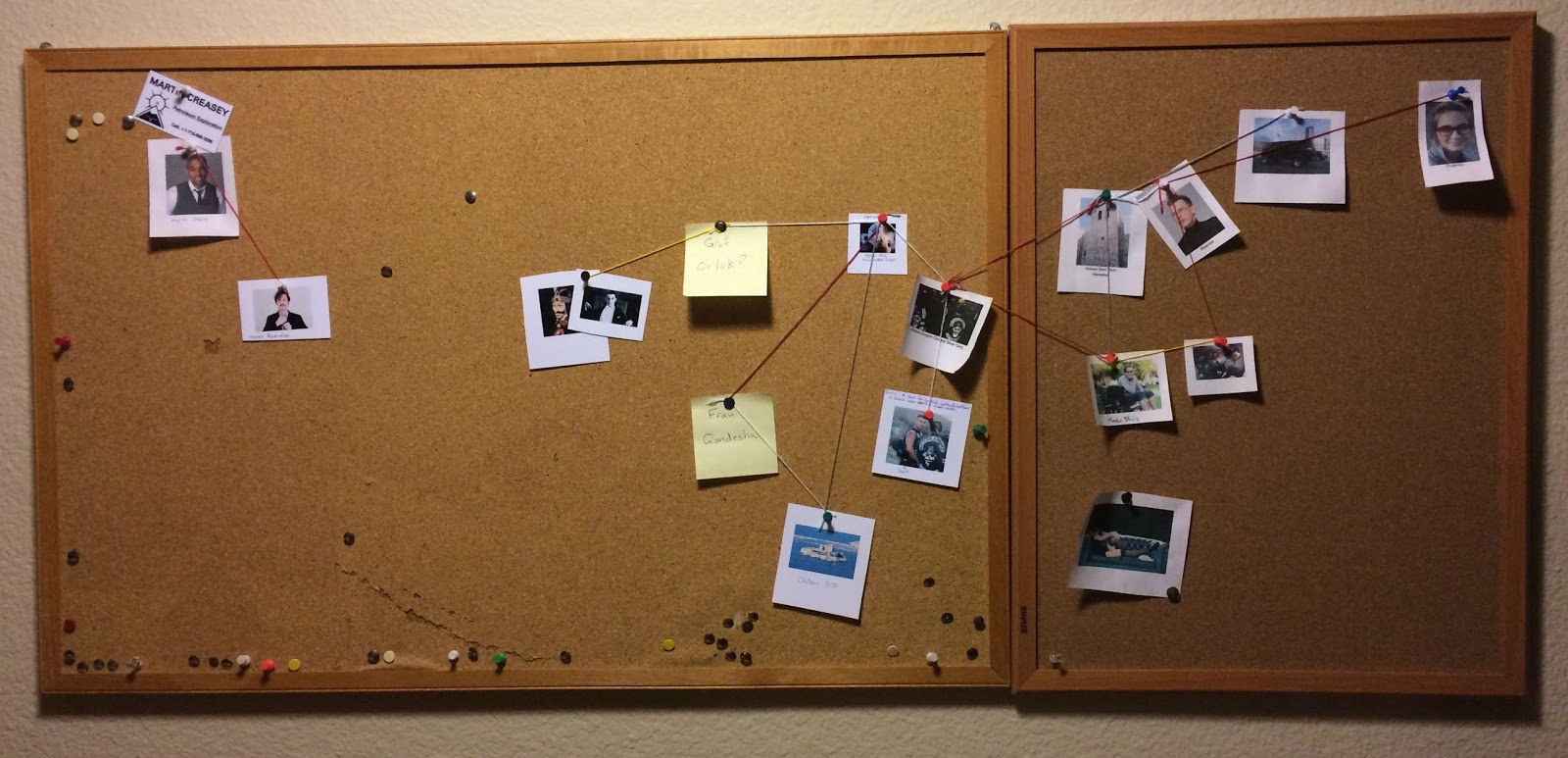
I'm talking about the Adversary Map. You know that crazy photo-and-thread "murder board" of suspects, victims, leads and connections that shows up in many a detective film. It is to Night's Black Agents what sheets of graph paper were to old school D&D. I love it. You hand the players some push pins, surveillance photos, and colored yarn and ask them to start mapping out the opposition.

It's not just a prop, it's also a mechanical reward. At the start of every Night's Black Agents mission the PCs get bonus points (that can be spent to improve die rolls) based on the connections they have successfully drawn between the mission's target and various other assets and locations in play. This is genius.


For one thing, it perfectly captures the feel of the genre. The PCs are basically trying to identify and pick-apart a giant conspiracy, and this provides some truly excellent immersion into that mindset. Having used this now in multiple campaigns, I can't imagine running a "detective genre" game ever again without using it.

Along with that oh-so-tasty immersion in the setting, it also helps the players visualize what they are up against. The existence of this player-built map forces the PCs to have an ongoing dialog about the clues they've gathered and the avenues of investigation still open to them. It's a mystery game, so you want the players to take it seriously and try to figure out the big picture. The Adversary Map provides a guiding structure for those efforts, and it's damn awesome that the game rewards that good behavior in play.

More importantly, it gives the GM a clear image of what parts of the scenario the players have actually figured out, which bits have them stumped, and where they have drawn entirely the wrong conclusions. It helps the GM nearly as much as it helps the players, because it brings to your attention the parts of your mystery where you're being too successful with your plotline obfuscation. Sometimes, you hear the players talking about some random photo tacked to the Adversary Map and it brings to your attention a red-herring you didn't even mean to drag across their path. Armed with that knowledge, you know which plotpoints still need associated clues or thematic reinforcement, and can figure out how to rearrange things behind the scenes to improve your game.


I tend to enjoy running complicated and mysterious plotlines, and fully-fleshed sand-box settings with lots of nuance and considerable PC freedom. When a GM does that, though, you always run the risk that players will feel overwhelmed, or get mired in the detail. The Adversary Map generates a big-picture view so you've always got some common ground to start from. It also keeps people from focusing in on one small subset of the plot or setting to the exclusion of all else, because they get a subtle weekly reminder that there's a lot more out there on the edges that they haven't explored yet. Should the players get stuck anyway, it's an easy thing for the GM to point at two or three different pins or photos and say "if you start shaking the clue tree in one of these spots,  I guarantee you something interesting will fall out". That's a little heavy handed, so I wouldn't do it unless they'd really hit a wall, but it's nice to know that you've got that option hanging on the wall to refocus them if the PCs are feeling lost or caught up in analysis paralysis. I love this this mechanic. It's both an immersive tool and a safety net for when I get too clever for my own (or my players) good.


Wednesday, July 24, 2013

Brainstorming about Observation checks

Someone over at the Warhammer Forums was having a problem with Observation checks for clue-hunting in a published scenario. A PC searched a location that had a hidden object, and the adventure called for an Observation check vs 3 Purple dice. The PC failed the roll, and suddenly the rest of the party wanted to dog-pile on it... despite there being no in-character reason for the PCs to suddenly find that particular bookcase interesting. Success rates in Warhammer are generally high, so 3 or 4 players all making the same roll is pretty much a guaranteed eventual success no matter the difficulty.

That GM wanted advice or options, and I gave them 12 possibilities. Cross-posted here:

  1. Only allow one check per location or clue, ever. Let the PC with the best Observation check roll it, and all others in the room add white dice for assisting. If they ask to check there again, explain that the consequence of failure was that their characters are now convinced there's nothing there. Just like how failing a Charm roll might actually upset the NPC you wanted to charm. Or like how failing an attack roll means the foe gets to counterattack before your next action.  Or how a failed Athletics check leaves you at the bottom of a ravine with several wounds. Failed checks have meaningful consequences.
  2. Only allow one check per day or per act. This is the less extreme version of the above method. You're temporarily convinced there's nothing there,  but you can come back later with a fresh perspective after thinking about it for a while.
  3. Allow additional attempts on the spot, but make each subsequent roll have escalating difficulty.  Ever have that experience of looking for your lost keys and you search the same room again and again only to eventually find it in plain sight somewhere you just could not think to look at? So frustrating, right? You can simulate that by adding +1 purple per check that preceded it. Eventually the banes and chaos stars will start to look daunting.
  4. Allow the rolls, but award Stress and/or Party Tension for each one after the first. "I all ready looked over there, Johann, I'm tellin' you it's not there!"
  5. Make each subsequent search take longer, or make more noise. Eventually an NPC will hear them or walk in on them. Can be combined with methods #3 or #4.  These are great bane and chaos star consequences, for example.
  6. Make your rolls per room instead of per sub-location within the room. The scenario says there's a 3-die test for checking the shelves. Don't roll when they check the shelves, roll when they check the room in general. Difficulty is 4 dice if they don't go into detail, reduced to 3 dice (or even 3 purple plus 1 white) if they specifically mention the shelf. EDIT for context: The original forum post had this extra complication that the scenario notes called for a roll only if the PCs examined the shelves.  I originally didn't mention it here, as it's mostly beside the point.
  7. Use the die roll only if the PCs search the room but fail to mention the specific part of the room the clue is in. If they specifically check the shelf, they automatically find the thing that's hidden there. If they just toss the room, they roll the 3-dice.
  8. Reduce all search difficulties everywhere to some standard number you're okay with, probably 1 or 2 purple. Use that same difficulty whether the hidden thing is plot-critical, trivial, or completely nonexistent. It's a bonus to the GM in that the PCs can't metagame the difficulties, but also a bonus to the PCs in that the hardest difficulties have been reduced. Everybody wins.
  9. Make all searches have a difficulty of exactly 1 purple, but with a variable (hidden) number of successes needed to reveal the clue. Similar to the mechanics the game uses for First Aid checks, and the recovery rolls from Diseases/Insanities/Criticals. The 1 purple is so there's a chance of stress or location-specific consequences. If the scenario notes call for a 3-difficulty die roll, translate that to mean they need a net of 3 successes to actually find the clue. Tell the players that this is the way you're handling it from now on, but never tell them the actual number of successes needed to find a specific clue in a specific place.
  10. Base the difficulties on who hid it, not how well they hid it. An NPC who's very careful and secretive sets a 3 or 4 die search die difficulty on his bedroom and office even if there's nothing there. Let the PCs know that's how it's going to work. They still get metagamy info, but it's more about the personality of the NPC instead of revealing "the clue is on this shelf somewhere". It's worth noting that "NPC is private and detail-oriented" does not mean "NPC is hiding an evil secret" but either could result in high purples on the search.
  11. Take the approach that the Gumshoe RPGs use: Clues are meant to be discovered, they exist to advance the plot. Make clue discovery automatic if the player's search the right places. No rolls at all. Fast and simple, and it favors the players so most of them won't complain. One small problem is that Intelligence and Observation are slightly devalued this way, so it might not be an ideal method if a PC has invested heavily in those stats. (As those with low Int + Obs will steal scenes that would otherwise be his spotlight moments.)
  12. Make clue discovery automatic so the plot doesn't stall out, but still roll the normal number of dice just for the bane & chaos-star results. If you technically failed the roll, you still get the clues, but it means you've left evidence of your tampering that the villain will later notice. This keeps the plot from stalling out (which can often happen if the PCs miss a vital clue) but it still rewards players for investing in Intelligence and Observation. 


To that, I could have easily added a 13th option: "Ditch those players and find yourself some new players that can keep out-of-character knowledge compartmentalized for the sake of the game." I decided to keep that one off the forums, since it's a little incendiary.

Personally, I've been using method #1 in my campaign. Reflecting on it this morning, I'm now inclined to use methods #9 and/or #12 in conjunction with it.

Friday, March 19, 2010

Core Clues ported to Savage Worlds

This started as a short tangent in my last post* (about using Gumshoe's "Core Clues" in Warhammer FRP), and grew long enough to need a post of it's own:

When I was running Savage Worlds on a more regular basis*, I borrowed from Gumshoe and set my difficulties for clue-gathering at a 2, usually with some added bonus/benefit if the PC got an 8+.

Didn't matter if it was an interrogation using Streetwise, or search involving Notice, the only way you could fail was by getting double 1's, and choosing not to spend a benny on a reroll. That way, the PCs either got the clue, or I was given an opportunity to narrate how some ridiculous blunder or bizarre coincidence kept them from getting the info they wanted.

It sounds better than it actually plays, unfortunately. I've found that some Savage Worlds players horde their bennies and only expend them in combat. Which means that in practice, there's still some danger of things stalling out because of a bad roll. It's still better than failing to get the clue because you rolled a "3" on a d8 and a d6, but not as much better as I'd imagined it to be. And should someone be so unlucky as to roll the critical failure, spend a benny and get a second critical failure, then you're adding insult to injury.

*: Link to the post using on "core clues" in Warhammer FRP
**: I'm still running my Savage Worlds fantasy game whenever my wife and I go visit our friends in Portland, but that only happens 4 or 5 times a year, so I hardly call that "regular".

Core Clues ported to WFRP

GUMSHOE has a concept called "Core Clues", clues that are so vital to the plot that you literally can't miss them. Whatever else you think of GUMSHOE, there is something very nice about knowing that a fluke bad die roll can't derail the plot and make the players spin their wheels for hours without a lead.

Let's face it, even when players get all the clues without the dice ever hosing them, there's still a good chance they'll misinterpret those clues, chase a red herring or accuse the wrong NPC, argue with the other players, or decide "my character wouldn't try to solve this mystery or pursue that clue". We've all seen situations where some player gets a wild idea and runs off tilting a windmills. What the GM thinks is crystal clear, turns out to be opaque to the players, and now he has to improvise some windmill stats. :)

Today, at the FFG forums, someone was asking about search checks in WFRP 3rd Ed. They were converting a 2nd Ed adventure, that relied on a lot of "A difficult search roll will reveal..." statements. I started typing up a reply about how it all depends on the nature of the clue. That if it's vital to advance the plot and make sure the players have fun, you should just give it to them automatically, but if it's a roll to find some treasure that's not a needed McGuffin, then dice are appropriate.

As I was typing that reply, though, I realized that the mechanics of WFRP are actually perfect for the whole "core clue" concept. You could make all (or the most vital) clue-gathering rolls succeed automatically, not even need a single success to get the info. Then, you just come up with some fun benefits for Boons, Sigmar's Comet or the "triple hammer line", and some nasty disadvantages for the Banes and Chaos Stars.


Here's an example of how it might play out:

The PCs are searching a nobleman's personal library, trying to see if there's any damning evidence of his guilt in some previous crime. The GM has decided that yes, there's some personal correspondence with his co-conspirator tucked behind some books. Without this bit of info, the players are unlikely to call out the nobleman, and will probably never connect the dots to the co-conspirator. Instead the game would bog down as they argue amongst themselves about whether or not he's guilty.

So the GM decides that any search roll will find the main clue, that being the letters behind the book on the shelf. However, a roll of Observation + Int is still called for, with the following possible effects based on the other symbols rolled:
  • Boon: You also find a loaded pistol resting out-of-sight and above your head on top of the same shelving unit. Taking it would be theft, but it would also prevent the sinister nobleman from using it against you later.
  • Bane: The household servants overhear your search, or notice that you've moved things around. This raises their suspicions of you. Any social rolls vs the staff or residents of the manor are now penalized by 1 misfortune die.
  • Chaos Star: The nobleman himself comes home early and walks right in on you. Everyone in the scene takes a point of Stress. He knows you're on to him. Since you've been ransacking his office, he'd be in his rights to grab the pistol from above the shelf and arrest or shoot you. It'd be foolish and dangerous, but within his rights as a nobleman, so depending on how many PCs are present, he just might do it.

Friday, February 26, 2010

GUMSHOE, from the other end of the table

I've been running a fair amount of GUMSHOE lately, but in two recent sessions at my weekly one-shot group, I finally got the opportunity to play the game. It was really neat to see the system from the other end of the table, and I think the experience has already improved my GMing of GUMSHOE.


My most important advice for GMs new to GUMSHOE is this:
  • Whenever possible, ask the players "Do you have any relevant skills?" or "Would you like to spend a point of something for a breakthrough?", instead of "Does anyone have a point of Anthropology?"
Phrasing it in the open-ended way engages the players better, coaxes them into problem-solving mode, and makes them more familiar with their characters.

Naming the skill, and phrasing it the "You need Skill X, does anyone have X?" way makes the game feel more stilted, and provides the appearance of railroading, even if there isn't any. It's a seemingly-minor presentation difference, but it has a fairly significant impact on the way it all comes off to the player.

Plus, by leaving it open for the players to pick the skill they think will work, it opens the door to the players coming up with something the GM hadn't even considered. If they have a cool idea for how to pump someone for information using First Aid, when the scenario called for Reassurance, everyone benefits from that improvisation.

In the case of the two-part scenario that John ran at Emerald City Game Feast recently, for the first session, he was using the "laundry list" approach, saying things like "Geology or Biology would be helpful here. Does anyone want to spend a point in them?" It was just okay, fun but not exceptional. In the second session, he was being more organic, less mechanical, and very flexible, and it really made the game come alive. I had great fun playing last night.


My best advice for people designing GUMSHOE modules is this:
  • Go back through your work, looking for every situation that might come up that where a Stability test or a Sense Trouble roll might come up. In each such situation, determine the difficulty of those rolls, and then put that information in a really obvious sidebar that is impossible for the GM to miss.
When you're in the middle of a scene, building tension or narrating action, it's really easy for the GM to completely forget those things (Stability tests, especially) and skip past them. As GM, you really don't want to break the scene to have to go look at a chart and make a judgment call. You need the information right at your finger tips, with a big box around it to make jump out of the page and get the GMs attention. The GUMSHOE rules are light on purpose to keep the narrative flowing. When you make the GM break open the rulebook to look up something obscure or hard-to-guesstimate, you undermine one of the strengths of the game.


The module he ran was The Black Drop, a Trail of Cthulhu adventure set in a remote location, with a multi-national cast of PCs. If you're interested in reading my feedback comments intended for the module's author, follow this link. It has a few spoilers, though, so is probably not a good read if you plan to play the module.

Thursday, May 28, 2009

Using Cthulhu Mythos (aka Mythos Lore to us Old Schoolers)

The cliff hanger I left off with in monday's session of Trail of Cthulhu was the realization that a monster was creeping up behind her, and she's got a long hard sprint back to the boat. On the plus side, the PC did spend Cthulhu Mythos to figure out what the monster was, which also clued her in to a possible weapon against it if she can just escape this encounter. It cost her 4 Stability and 1 Sanity to pull that clue out of Cthulhu's butt, and she hasn't even seen the monster yet. Which is creeping up behind her.

Prior to this session, I was a little dubious about the Investigative Ability called Cthulhu Mythos. It seemed to me like a cludge, a way for the Keeper to skip out on making a well-layered mystery with interwoven clues. I understood that some GMs might need that (he says, looking down his nose as if he himself never had a plot hole, deus ex machina, or mystery that was beyond the PCs ability to solve), but it struck me as cheap. Now I understand the real purpose of it, and I wish the rules had spelled it out just a tiny bit more clearly.

As the GM, you never want to set up your mystery so that PCs have to spend Cthulhu Mythos to put clues together - that'd be cruel and unfair since doing so saps their Stability pretty hard. Neither is it intended to let PCs skip doing legwork and jump ahead of the plot. Instead the Cthulhu Mythos spend exists solely as an escape valve for PCs, who have already jumped ahead of the plot by dumb luck or clever intuition.

Normal police procedures involve raids and arrests, but that's not always an option in Cthulhu. Cops just have to figure out whodunnit, then call in the cavalry. A Cthulhu investigator has to figure out whodunnit, whatdunnit, whether or not their weapons can hurt it, how to banish it without going crazy in the process. You're on their own, and you have to work fast - or else the world might end! Once you know whodunnit, there's a lot of motivation to confront them before they can grow any stronger (or summon something stronger). When you've figured out who the villain is earlier than the GM anticipated you would, you may no longer feel any need to track down seemingly unrelated clues. In Cthulhu, though, those unrelated clues are what usually hides the means to foil the the cultists plans, defeat the monster, etc.

If, in your rush to solve the mystery you've put yourself in dangerous proximity to some nasty thing without being properly prepared for it, Cthulhu Mythos is the emergency shut-off valve. Either it gives you the weapon you need, or suggests where you can find that weapon, or points back to the line of clues you skipped over that will eventually lead to that weapon, or it just hits your sanity enough that you faint and don't have to worry about the monster for the moment.

In other words, you don't spend Cthulhu Mythos because you aren't getting anywhere - you spend Cthullu Mythos because you got too far, too fast.

Tuesday, May 6, 2008

Tricks from Trail of Cthulhu

As with all GUMSHOE games, in Trail of Cthulhu random luck can't prevent the players from finding the important clues. All purely-investigative skills are 100% error proof. If you have just a single level of Evidence Collection, you will automatically spot the spatters of blood behind the sofa left over from the otherwise cleaned murder scene. With even 1 dot of Cryptology, you will eventually break the cypher. I like this approach, as it prevents one bad die roll from collapsing an entire plotline. Randomness is good and fine for fight scenes and incidental subplots, but when it comes to major clue-finding, GUMSHOE doesn't mess around.

There's even this sidebar on page 56 where they present the option of doing this with everything important:

Let's say your plotline hinges on the PCs getting onto the enemy base, which is guarded by a steep wall. Most games would provide stats for climbing the wall (and some would add details for knocking a hole through it). Nearly all RPGs would couch it as some sort of difficulty, and if the PCs failed to roll well enough, they'd be stuck (or, perhaps, they could annoyingly roll again and again until they succeeded*). What's more, the stats of the wall would be based on it's height and surface (for climbing) or thickness and material (for breaching it). That leaves a GM in a spot where he may have to fudge in the PCs favor, or at least provide an opportunity for the players to go fetch a ladder.

Trail of Cthulhu suggests that's entirely the wrong way to go about it. Difficulty shouldn't be based off the composition of the wall. Nor should it scale up with character level. Difficulty should instead scale inversely to the dramatic necessity of the task. If the PCs have to get over that wall in order for the plot to continue, climbing the wall should be automatically successful. If, on the other hand, there's more than one way to access the base, and those ways are built in to the scenario and/or addressed by the author(/GM) ahead of time, then it's okay to make some (not all) of the access modes more difficult.

They suggest not making the roll involve getting over the wall at all (that's guaranteed) but instead making "failure" on the roll mean you still succeed, but there's some negative side-effect doesn't stop the plot in it's tracks. Perhaps you're injured in the process of successfully climbing or you make enough noise descending the other side to attract attention from guards a few seconds after you make the guaranteed ascent.

The idea is this: Outside of major (non-trivial) combats and the climactic final scene of the adventure, player success should never be jeopardized by something as uncontrolled as the dice. Players can still fail by making wrong decisions. Players can still fail due to bad luck in the final confrontation. But no random nameless guard or 50 foot wall should be the source of the PC death or critical mission failure. That's a simple concept (and one I've used before without really thinking too heavily about it) but it's rare to see that appear in writing as a philosophy behind scenario design.

Kudos to Kenneth Hite and Robin Laws for putting that in words in a game that still has dice-based mechanics. Previously, I'd only seen such blunt statements in entirely diceless games. GUMSHOE is a happy medium between gaming paradigms.