Showing posts with label DnD/d20. Show all posts

Thursday, January 1, 2026

Popping In and Out of the Genie Bottle

I am going to be playing in a new D&D campaign that my friend Mark is running. He invited me to join his campaign that's launching in a couple weeks. I'm excited at the prospect, because he runs really fun games, but there was a schedule conflict. His game is every Monday, but I have a commitment that will keep me away every second Monday. The existing event is my Amber campaign I run twice a month, and neither game could easily be rescheduled.

So it seemed I was going to have to decline the invitation. Having a player miss 50% of D&D sessions is pretty rough. Either somebody else would have to play my character half the time, or we'd have to just kind of handwave/ghost my presence. It would be quite the narrative headache.  Unless...

The solution I hit upon was that I'll play a Warlock with a very demanding Genie Patron. (This Warlock subclass is in Tasha's Cauldron of Everything.) In the sessions where I (the player) am not there, my character will have been drawn into the Lamp, and is performing some task for the Genie. One of the other Party members will pick up the Lamp, and hang it on a loop on their backpack. Then start of the next session, I pop out of the Lamp, and grab it off their loop. "Hey guys, I'm back! Sorry about that, the Patron insisted I help them out, but I'm totally free now. What did I miss?"

It's bending the rules a bit, as per the Genie Warlock rules you can only be in the Lamp for an hour or two, but that's the PC's limitations. It's a small and harmless house rule for the Patron to not be limited the way the PC is. 

So now I just have to figure out what flavor of Warlock to be. We'll be starting with 3rd Level characters, and we'll be in Faerun using the 2024 rules, but the GM is pretty permissive about what books you can use. So I've built a couple variations, and am still trying to figure out what I want to play. What I'm theorycrafted thus far includes:

Idea #1: A gentle water-giant, native to the Moonshae Isles, but wandering about seeking places of natural beauty and power. 

  • Species: Firbolg. (From Mordenkainen's Monsters of the Multiverse. An 8-foot tall Fey who can talk to animals, and cast disguise self or turn briefly invisible)
  • Genie Type: Marid. (Water genie. Lots of weather spells on their list. Fog. Cone of Cold.)
  • Background: Moonwell Pilgrim. (From the recent Heroes of Faerun book. Druidic Magic Initiate, specific to Moonshae Isles region of Faerun)

The "Lamp" might be a canteen, which I open and submerge whenever I find a really special body of water, so that the Genie can draw some in to add to their collection. I see this as a really chill, zen character, cataloguing sacred springs and the like for the Marid's inscrutable reasons.

Idea #2: Someone who died in a rockslide or earthquake that a Dao created or felt responsible for, so they unearthed him and used a Wish to restore his body to life. (Or, maybe the Dao is a bastard who just wanted a pet, so they crushed someone to make one.)

  • Species: Reborn (From Van Richtens Guide to Ravenloft. Basically, this is a non-evil Undead, with some memory-issues / plot-hooks. Kind of like "The Crow".)
  • Genie Type: Dao. (Earth genie. Standout early spells are Sanctuary and Spike Growth.)
  • Background: Rune Carver (From Bigby Presents Glory of the Giants. Gives access to Comprehend Languages and then a smattering of other 1st-level spells.)

The "Lamp" in this case might be some sort of runestone or stone tablet. Or, it might be an Urn, since I'm reborn. 

Rune Carver seems like fun from a roleplaying perspective as being another thing the Genie taught me, and/or an explanation of what I'm doing when I'm in the Lamp being busy in the off-weeks: carving runes for the boss. 

That said, I'm not 100% convinced Rune Carver (or rather the Rune Shaper Feat it includes) is worth it mechanically. It gives you more spell variety than Magic Initiate, and even gives you 2 spells per day. It's just that one of those two is Comprehend Languages, which might well be irrelevant all campaign. I think the two Cantrips of that more-common Feat are probably going to be more generally useful in most some campaigns. It's a strange trade-off, hard to weigh against the other option, which does admittedly make for interesting decisions. I worry Rune Shaper will result in recurring negative play experience. "Hey guys, technically, if we take a Long Rest now, I could have the right spell for this situation tomorrow" Thing is, that better spell is still just 1st level. It seems like a tall order to convince the rest of the party to camp down early so you can swap out a 1st level spell. Ironically, this would be a better choice if we were playing from 1st character level instead of starting at 3rd level, as the extra spell is proportionally bigger the lower your character level. I'm probably worrying about nothing, as the overall package has a lot of upsides. I keep going back and forth about it.  EDIT: The more I think about it, the more I think it's probably actually really strong.  

I made both characters, but I'm not sure yet if I'll play one of those, or take a third stab at it.  I do really enjoy making characters.

One thing that came into clarity for me while making these characters is that I'm really not a fan of most of the Backgrounds in the 2024 PHB. It's a little weird that they bug me as much as they do. Because they include a combat-relevant Feat, they are indisputably stronger than the identically-named Backgrounds they replaced, but the rarely used social connection mechanics those 2014 Backgrounds had were what made me love the Backgrounds when 5e first came out. 

When I mentioned my character ideas to the DM, Mark said he's open to most 3rd-party content. So I'm now a little tempted to break open Crooked Moon, because I feel like it had some really weird Species to play in it.

Tuesday, March 4, 2025

The Way of the Weredodo

 Back in December, I wondered aloud about the Wereraven stats in the 5e Ravenloft book. It was, at the time of publish, the only official Lycanthrope that could regenerate. It had a Regeneration ability instead of the Resistance to non-magical Slashing, Piercing and Bludgeoning damage that all other Lycanthropes had in 5e. As I mentioned in that post (Transitive Property of Gaming: Wereraven Throwbacks) this made the Were-Raven much more powerful than most Lycanthropes. They're really hard to kill, in a way that none of the other lycanthropes are, and that seemed odd to me.

Since then, I picked up the Deck of Many Things set, which included stats for a Werevulture. This Werevulture was almost identical to the Wereraven. Identical except for more hitpoints and higher damage. The mimicry power is removed, but there wasn't anything added to make it more like a vulture. 

When I noticed that Werevulture about a month ago, I wondered if maybe the upcoming 2024 edition of the Monster Manual was going to give all Lycanthropes a Regeneration power instead of Resistance. There'd been rumblings for a while that Resistance to non-magical weapons was going the way of the (were)dodo. So I suspected that Regeneration was going to be added to all the Weres as a way of making them feel like the dangerous hard-to-kill shapeshifters that they are in the lore. 

Well, now I've got the 2024 (aka 2025, aka 5.5) Monster Manual, and I can see that no, there's no new Regenerating Lycanthropes. So, I guess just bird-based lycanthropes can regenerate, for some reason. I don't understand why. I suspect it's just a case of "the left author doesn't know what the right author is writing".  

There's no lycanthrope section in the new Monster Manual, but there are stats for Werewolves, Weretigers, Wereboars, Wererats, and Werebears (and Jackalweres in the "J" section). The rules for contracting Lycanthrope are abridged heavily, and just shoved into the individual monster stat blocks. Overall, they are a lot less likely to turn you into a Lycanthrope, and I think it's a bit of a shame as that downplays the most interesting thing about them. On the other hand, if you don't make the initial save, and they also manage to reduce you to zero HP after that failed save, then you transform and become an evil lycanthrope instantly. On the rare cases where that first save is failed, you'll now really be sweating, assuming you know how the rest of the power works. That scariness is kinda cool... but it does make fights very swingy, as a PC going down is a double-whammy to the action economy when they get back up and join the enemy. 

It's also unclear from the Monster Manual whether or not its possible to restore the newly-evil newly-NPC character to their original status. The MM doesn't make it clear if Remove Curse works or not after you've transformed. It's pretty clear Remove Curse works between when you get the Curse from the first bite to when you fall to 0 HP, but once you've been KO'd you "become a werewolf under the GMs control". Is that new status an ongoing symptom of the curse, or is it a permanent change of status? Is "you're now a werewolf" the equivalent of "you're under an enchantment" or is it the equivalent of "you died"? I could make see an argument for either interpretation. 

Nothing in the Monster Manual takes a stance on it, and the Remove Curse spell in the 2024 Player's Handbook is vague as well. So I went looking in the DM's Guide, where it says: 

"Some monsters are associated with curses, whether as part of their origins or due to their ability to spread curses—werewolves being a prime example. You decide how a spell like Remove Curse affects a creature with accursed origins. For example, you might decide that a mummy was created through a curse and it can be destroyed permanently only by casting Remove Curse on its corpse."  

So, officially, the answer is "it's up to the DM". This is actually a bad answer. Everything is always up to the DM. What's a Werewolf's AC? How many HP does the werewolf have? Those are also things that a DM can (and often will) choose to change, but having a default answer is really helpful. It makes DM-ing prep run faster, and provides a default the DM can use if they want a baseline experience. If the Monster Manual said "AC: DM's Call" and "HP: Whatever the DM things is appropriate" we'd be annoyed that this monster entry was incomplete. Being vague, and not providing a default lethality setting for a werewolf's curse is lame. But this is worse than saying "Damage: DM's choice", because they don't even say in the monster description that this is up to DM fiat. They talk around it, thereby implying that the rules must be somewhere else. A new DM could well throw a werewolf encounter at their party without having thought this through at all, and then get stuck with a situation where a PC turns mid-battle. That player will naturally be curious as to how final/fatal this new condition is, and the DM's going to be caught checking two other books (like I did) only to find that in the end there's no guidance offered at all. 

I'm also not happy that their vulnerability to silver went away. I get that a design goal of 2024 was to try to bridge the martials vs spellcasters gap. Monsters that have Resistance to non-magical weapons makes them much harder for low-level non-caster PCs to battle, in a way that benefits spellcasters. Which is a shame, because spellcasters already have some big advantages especially later in the campaign when high-level spells do crazy things. So closing that gap is a noble goal, and I understand why that was something 2024 edition leaned into hard (see Weapon Mastery for another example), but I'm still not happy with the impact here. Silver weapons though were a really cool thematic element, so their removal detracts from the lore, and makes lycanthropes just a tiny bit less interesting. 

What makes a lycanthrope a lycanthrope? What separates them from other monsters now? Two things:

1) They can transform as a Bonus Action, but those different forms have identical stats, so this is kind of meaningless. It's narratively cool, and I'll certainly use it in play. But it doesn't do much, and since only Weretigers have anything else they might do with a Bonus Action instead, it's not meaningful.

2) If they kill you, there's a 50% chance you'll get up instantly as an NPC Lycanthrope and attack your fellow PCs. That's certainly interesting and meaningful, but it's got serious potential to cascade into a full TPK. Even if it doesn't do that, it's likely to ruin a player's fun, and/or result in an argument that boils down to DM's fiat after you've searched in 3 books for a rule. And the implications of what this means in-universe are kind of crazy. Because there's no delay now, any Lycanthrope ought to be able to convert any village into a full-on wolf's den faster than you can say "One-Night Ultimate Werewolf". I mean I guess it's good that you don't need silver to damage them, as now its possible that the villagers could get lucky and kill the new werewolves as fast as they are made. 

Lycanthropes in previous editions (including 2014 5e) were very hard for commoners to kill, so the scenario of "we need to hire the PCs to save our village" was very believable. At the same time, those older rules delayed the onset of lycanthropy until the next full moon or other trigger, so the PCs had some time to get hired and conduct an investigation. Now there's less need for the commoners to hire the PCs, and it takes the werewolf a lot less time to co-opt the entire town. I'm not a fan of any of those changes. 

Sunday, January 5, 2025

Session-Based Advancement vs XP from Combat RAW

 It's really weird to me how completely disconnected the main level-up options in the Dungeon Master's Guide are.

Here's the text from 2014 DMG about leveling up your characters based on how many sessions you'd played:

A good rate of session-based advancement is to have characters reach 2nd level after the first session of play, 3rd level after another session, and 4th level after two more sessions. Then spend two or three sessions for each subsequent level. This rate mirrors the standard rate of advancement, assuming sessions are about four hours long.

The 2024 DMG adds a couple little sentences about adjusting this for length of session and accomplishment, but sticks to the general formula above. 

So how does that compare to XP gained from combat encounters, which I will note is the default system that the game largely assumes you are using, and which the various rulebooks (2014 and 2024 DMGs, and also Xanathar's Guide To Everything) spend a lot of time and word count (and math) hashing and rehashing.

I'd say that if you're tracking XP by combat it will take you at least 2, and more likely 3 sessions to get to level 2. I've also seen it take a lot more than that, especially with cautious players, or with those still learning the system or playing a new class for the first time. 

I'm not saying it's in any way a problem that the recommended progression rate for leveling-up by session is two to three times the speed of advancement if you did the XP math, but it is odd to me that this wide a gap exists without them mentioning it in any of the books that present that math.

Supporting XP math and book references can be found below the fold, along with a fair amount of rambling.

Monday, December 23, 2024

Wereraven Throwbacks

 I was about to insert a Wereraven (from Van Richten's Guide to Ravenloft) into one of my 5e D&D campaigns, until I read the stat block more closely. 

The NPC in question isn't really meant as a combat challenge, but more of a roleplaying challenge, so I almost rolled ahead with this without looking too closely at the stats. Glad I noticed it now, while I still have time to scour the internet for a different version of the Wereraven, or make up my own custom stats for this NPC.

The stat block in Van Richten's is weirdly retro. It feels like it is from a completely different edition of the game. Here's all the stuff that seems out of place:

Lack of Immunity:  Most lycanthropes in 5e have "Immunity to bludgeoning, piercing, and slashing from nonmagical attacks not made with silvered weapons". The Wereraven does not. Instead it has:

The Only Lycanthrope with Regeneration: "The wereraven regains 10 hit points at the start of its turn. If the wereraven takes damage from a silvered weapon or a spell, this trait doesn’t function at the start of the wereraven’s next turn. The wereraven dies only if it starts its turn with 0 hit points and doesn’t regenerate."  

It is identical to what a Troll has in 5th Ed, just with silver and magic as it's weakspots instead of fire and acid. So it's not entirely unprecedented for a monster, but it's really unlike any of the other lycanthropes in 5e. it is like lycanthropes in earlier editions, from back when Regeneration was a much more common effect. It seems like the authors of Van Richten's Guide just converted an old 2nd Ed stat block directly, without looking to see how the current version of lycanthropy plays at the table. 

10 HP per turn is more than 100 times better than a Ring of Regeneration (heal 1d6 every 10 minutes) or Ioun Stone of Regeneration (heal 15 every hour).  You might be thinking "yes, but those are magic items a PC might get their hands on"... but if I were to use this Good-Aligned Wereraven as-written, I think my PCs would feel a strong temptation to get themselves bit. Regeneration 10 would be huge on a PC. 

The only downside to lycanthropy in this edition to prevent PCs from seeking it out is this: if you catch lycanthropy your personality and alignment transform to that of the species that bit you, and the GM is free to turn your character into an NPC when that happens... but if our party's Lawful Good Paladin contracted wereravenry and became... Lawful Good? Well, I think their player would be pretty miffed at me taking their character away for that, and rightly so.

I will say that the default 2014 Lycanthrope Damage Immunity rule makes Lycanthropes very dangerous if you don't have an appropriate weapon or spell, but keeps the fights reasonably short if the whole party does have access to such features (and usually they all do by the time you're high enough level to fight were-critters). So it makes you feel like well-equipped competent heroes, and explains why the townsfolk needed you to save them. I'm glad they went with immunity for these monsters (generally) instead of regeneration, which sometimes makes fights drag on forever.

Useless Mimicry: The wereravens have a Mimicry ability that seems entirely pointless. They can duplicate nearly any sound, which has cool roleplay possibilities, but they are hamstrung by not using the current editions typical rules for illusions, tricks or buffs. Seeing through an illusion in 2014 edition PHB usually involves the person using an entire Action to make an Intelligence (Investigation) check. You basically don't get to roll unless the player has some reason to wonder if things aren't what they seem, and is willing to waste a turn gambling that they'll roll well. (2024 PHB is basically the same, but they standardized this into the Study Action, which means there's a couple subclasses who can do this as a Bonus Action instead of burning their turn.) 

Instead of following those standards, this mimicry ability can be detected with a Wisdom (Insight) check vs DC 10, with no mention of it taking any other resource (not Action, Bonus Action, Reaction, etc). 

In 5e, the target numbers for such things are usually 8 + Proficiency Bonus + Spellcasting Modifier.  So for a CR 2 monster with all above-average mental traits like this one, I'd expect a DC in the 11 to 13 range, not 10. And since it didn't cost an Action, chances are the whole party is going to want to roll, so somebody's bound to pass it. Even if you do the Insight equivalent of "Passive Perception" so that you're not alerting the table to the fakery by having someone roll... well that DC 10s not enough to fool basically anyone. You'd need a below-average Wisdom and be untrained in order to fail that Passively. (Not that Passive Insight is a thing in 5e either, but my point is that even swapping what skill is being tested to Perception and avoiding the die roll still doesn't salvage this useless ability.)

EDIT: And lastly, it seems odd that a creature with a Mimicry ability doesn't have ranks in Deception skill. I know the GM rarely rolls such skills, but thematically it sure would make sense for this ability to involve such a roll, and/or to give the wereraven Advantage on Charisma (Deception) checks made to mimic a voice or fool someone about what they heard. Just a thought.

ANOTHER EDIT: I know I already said "lastly", but I just noticed that the Language entry says "Common (can't speak in raven form)". That parenthetical clause sure makes the existence/logic of the Mimicry ability even more questionable, doesn't it? I know it's actually like that to be more consistent with the other 5e lycanthropes, but I find it funny and a little frustrating that they stick to the template on this one issue where it would actually make sense to divert, but then go way off the gameplan on more critical stats.

ONE MORE EDIT: I eventually figured out why the DC is 10. It's because they just copy-pasted the Mimicry entry from the normal Raven stat block of the Monster Manual. That basic Raven is CR 0 and Charisma 6,  instead of Wereraven's CR 2 and CHA 14.  It would be a very unusual circumstance if a normal Raven were using its mimicry to trick someone or lure them into an ambush, so it didn't need much in terms of rules. 

Wednesday, October 16, 2024

Anchorite Kastyx Broadpaddle

Needed a memorable way to answer the gate at a nobleman's manorhouse for an upcoming session of D&D, so I dreamt this nonsense up:

Sister Kastyx Broadpaddle is a gnomish anchorite who lives in on a noble family's property and advises them spiritually without ever leaving the blessed dovecote in the backyard (it's the site of some famous miracle, that justifies an anchorite taking a vow to prove their devotion by never leaving the bird-hut). 

Visitors who seek spiritual advice (or the next plot coupon, in the case of the PCs) may approach from the side gate to the grounds and ring a little bell there. She uses Thaumaturgy to answer the door remotely: making her voice 3 times as loud to be heard, but requiring the visitors to hollar their name and intention in return or ring the bell twice for no, etc... Then using Thaumaturgy again to make the gate swing open or closed as appropriate. If some business the PCs bring to her requires the attention of the noble family, she uses Speak With Animals to send a dove deeper onto the property (i.e.: to the manor house) to signal them.


Tuesday, January 23, 2024

The Blood Nebula and The Devil's Armpit

 Ran my first session of a new Spelljammer campaign tonight.  (5e Spelljammer gets a lot of bad press, and I only agree with some of that. I'll probably save that critique for another post some other time.)

The PCs are Pirates, and/or friends-of-pirates. The PCs are also delightfully weird. 

  • Captain Kiera Glitternoodle is a Fairy Bard Pirate. She has a damaged wing (so that her full Flying Speed won't unlock for a few level-ups, because level one PCs with flight gets kinda crazy). Her hated rival is a Bullywug who is the Captain of a ship called The Pennywort. 
  • Rrrprr Mrrdrrmnn is a Thri-Kreen Artificer Noble. Everyone calls her Ripper Murderman, because those are the words that the clicking buzzing thri-kreen name sounds closest to. She's a princess, her mother is the great Empress Mrrrdrrdrrdrr, whom Ripper is sort of rebelling against. 
  • Dawg Grippe Tumbuckler is a Water Genasi Druid Wild Spacer. A skilled hand aboard spelljammers their whole life. They had a harrowing run-in with the Necromancer/Vampirate who is the Captain of a rival ship known as The Cenotaph.
  • Grimsbee is a Firbolg Fighter Sage (Astronomer) who is traveling the spheres because of a prophecy (we're still working out the details of the prophecy, as this character was made about a day before our first session).
  • Lia Galanodel is a blue-skinned Moon Elf Warlock Archaeologist. She's equal parts Indiana Jones and Liara T'soni (from Mass Effect). Her Warlock Patron is The Celestial, an Empyrean named Var. 
  • Oldarin Blue is a Mind Flayer Wizard Astral Drifter. He had a run-in with Corellon Larethian that changed him forever, and he no longer eats brains. We cobbled together a Mind Flayer PC write up from a few we'd found online. The psionic blast power is being modeled as a modified version of the Sapping Sting Cantrip from the Explorer's Guide to Wildemont. Short range low damage attack spell that knocks the target Prone if they fail their Intelligence Save. Instead of doing extra damage at higher levels it will affect multiple targets (extra targets added at the same progression as Eldritch Blast, but can only do one instance of damage per target) and eventually upgrade to single-turn Stuns. It's possible that it will be broken as sin when we get to Level 11 where Prone turns to Stun, but I'm happy to risk that chance if we end up playing long enough for it to matter. 

The characters are a lot of fun, and the players really got to ham it up in the first session. When the most "normal" character in your campaign is "blue-skinned Indiana Jones", you know the game is going to be memorable.

Their port of call is in The Blood Nebula, a huge cloud of red mist in which are hidden several asteroids and the calcified body of a dead god. Several pirate vessels have signed a Compact declaring the God's Body neutral ground. Pirates are agreed to not murder each other within sight of the God's Body. So it works like Port Royal of Black Sails, or Tortuga of the Pirates of the Carribean. A port where you can fence your stolen goods, take on crew, and have drinks with rival pirates that you'd definitely try to murder if you ran into them on the open sea. Every pirate captain knows a half dozen safe routes through the nebula, and you sneak in and out while trying to avoid nastier rivals in the mist. This will let me handle the first few sessions as sort of stealthy Wrath of Khan / submarine warfare motif, with enemy ships stumbling upon each other at short range. As we level up, I'll probably gradually fold in the Star Wars -ish dogfight system from this video and pdf: 


In one part of The Blood Nebula, there's a single giant arm of a dead god that's called The Devil's Armpit. It's a long curved armlike asteroid that bends around a natural bay. There's a current in the nebula that causes derelict ships adrift in the mist to crash on the banks of this arm of land. For several years, a particular pirate crew camped on that arm, and grew fat on the salvage of ships that drifted in. But one day a few years back, a ship crashed on their shores that held some Prince's personal zoo. Now The Devil's Armpit is infested with Cockatrice, Rust Monsters, and other less savory things. Not the sort of place you visit frivolously.

At the start of the campaign, Kiera (not yet a captain) was high in the crow's nest of a ship that she hated, working for a captain and crew she detested, when she spotted a derelict ship in the mists adrift and headed toward the Devil's Armpit. Rather than reporting the sighting, she waited till her ship got to port, then went AWOL. She gathered up a few trusted souls, former co-workers that she didn't hate, and old drinking buddies from the local tavern, and they rowed out on a Jolly Boat to find this derelict ship. 

The derelict was once a Living Ship: it had a Treant for a mast once upon a time, but several decades back some Gith marauders shot the ship full of holes, chopped down the Treant and ripped its roots out of the Spelljamming Helm, and left it all drifting uncontrolled in The Blood. As the PCs explored the ship, they discovered the Treant wasn't actually dead, but was now more of a viney shrubbery growing over the aft castle. (This allows us to use the fun concept of a Living Ship without the combat strength of a CR 9 Treant overshadowing the PCs.) The Treant's name is Fraxinus. Botany nerds will recognize that's the genus of tree that has those "helicopter" seeds. I do my best Treebeard impression when he talks, but we'll see how long anyone has the patience for that pace of conversation.

The ship is badly damaged, and Fraxinus has been starved of light and water across decades drifting in the nebula. So the hope is that if they can sail out for a while, Fraxinus' health and abilities will improve. (Slowly growing into full Treant stats as the PCs level up.)  

Also aboard the ship was a feral, broken, seemingly drunken lizardfolk sailor. He had been marooned here, and was taking shelter aboard this derelict. At first they couldn't figure out how he'd gotten so terribly drunk, with no empty bottles about, but by the end of the first session it was clear: Somewhere down in the bilge is some sort of monster whose magical aura makes you terribly drunk. Oldarin and Grimsbee failed DC12 Constitution checks and became instantly bumbling drunkards. For one hour, they will have the Poisoned Condition, and an extra clause that if they move more than 1/2 pace they fall prone. (The monster as written in the rulebook I stole it from is brokenly good. It requires you to make this save every turn if you're within 20 feet of it. That's nonsense, so I dialed it back by adding a clause of "if you make the save, you're immune to the effects for 12 hours".)

We ended the first session with the party tracking down the critter deep in the bilge, with initiative to be rolled at the top of the second session (in two weeks). If they can kill or chase off the Rum Gremlin, and then get Fraxinus some water and sunlight, they have their very own ship.

The session was a lot of fun. Mostly goofy roleplay shenanigans, with some exploration. They also found part of a map in the captain's quarters, so we've got a hook into a larger adventure. Not bad for a first session.

Monday, January 16, 2023

The Return of Dungeon 23

 My computer has been replaced, so I'll be able to type up my scribbled notes about the rooms in my Dungeon 23 sometime in the next few days. Until then, here's the current state of the ground floor of my map: 


EDIT: And then, as soon as my computer was replaced, I fractured a rib, and as dumb/lame/pathetic as that sounds, found it too painful to sit in a chair and type. For several weeks. So that was the end of Dungeon 23 for me. What a bummer.

Sunday, January 8, 2023

Days without computers

 My computer died.while it's in the shop, I'm continuing to work on the Dungeon23 challenge, but won't be posting much as it's really a pain in the keyboard trying to post to blogger from my phone.


Wednesday, January 4, 2023

Dungeon23, Bridge 1.4

Room 1.4: This is a 70 foot long stone bridge connecting the north barbican gatehouse to the Northwest Gate of the Castle. The stone handrail is mostly intact, the surface is heavily scratched and mostly free of moss. 

Two sculptural elements adorn the bridge, one of which is considerably more broken than the handrails. Both stone sculptures appear to be creatures with humanoid torsos and serpentine lower bodies. The more complete of the two is along the railing, it's tail weaving between the railposts, and it reaches towards the castle. The other is inconveniently placed in the middle of the bridge, and its upper half is broken off the snake body, and rests in several pieces. The shattered one is in poor condition generally, but the one weaving through the railing is not only in great shape but also an incredibly detailed carving with lifelike (though inhuman) features and little signs of weathering. 

In reality, these are of course the petrified features of Yuan Ti who died upon the bridge earlier this year. Players will likely grok to this quickly, and the GM should make no effort to conceal it from them if they inquire along those lines. They'll probably draw the wrong conclusion anyway, assuming it to be foreshadowing of a Medusa much later in the module, rather than a basilisk showing up in the next couple of rooms. 

Speaking of which: While most of the time this bridge is empty (other than stone cold snakemen statues), there are two fairly regular exceptions when the creatures from Room 1.XX show up. On cold days, the basilisk comes to sun itself on the bridge for an hour or two in the middle of the day to warm up. At sunset, it's owner takes it out for a 15-minute walk and a frequent snack, often plucking a tasty bat out of the air when the swarms release from 1.1A. At either time, both creatures from 1.XX arrive together.


Tuesday, January 3, 2023

Dungeon 23, Room 1.3

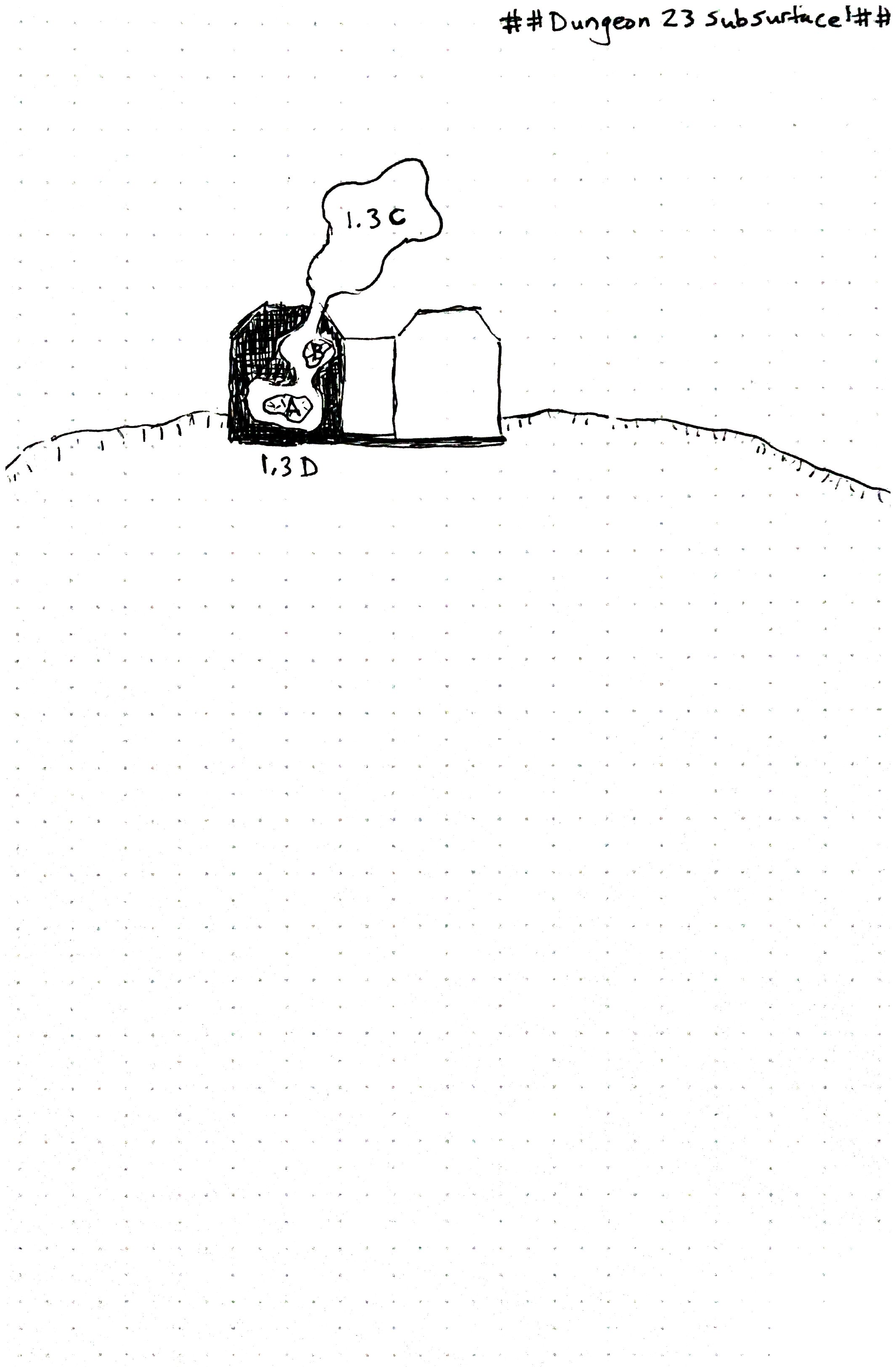
Room 1.3: This is inside the base of the Northern Barbican Gatehouse. When the barbican was originally built, this base was a solid rock foundation, in-filled with stone debris and aggregate. It was still intact when the castle was defeated by sorcery and treachery, but in the years since, it has been consumed by the acidic roots of several semi-intelligent plant monsters. Their digestion has weakened the tower, causing the floors above to partially collapse, and leaving a hollow that has of late become a nest for a large colony of bats.

The locations marked A and B in this room are holes leading further below, opening onto the sublevel areas 2.XX. The holes appear to be ringed with snarls of thorny roots. These are two Stone Creepers (2x CR 1 medium plants from the Tome of Beasts 2).

In addition to the two Stone Creepers, a total of 7 Swarms of Bats nest here. (7x CR 1/4, Monster Manual)  During daylight hours, assume 1 swarm adjacent to each of Creepers A and B, and the remaining 5 Swarms in the larger cave marked 1.3C.  At sunset, the bats alight and fly out of the tower. They return 1 Swarm at a time over the hours before dawn. 

Lastly, the dark cave here is also appealing to snakes, of which there are many in the vicinity of the castle. At any given time there are 1d4-2 Poisonous Snakes (CR 1/8, Monster Manual) here, either hunting bats, or curled up in the roots of a Stone Creeper.


A Potential Disaster: Nothing that lives in this hole will seek to cause trouble for the PCs, but incautious PCs who plunge into the depths, make shocking loud noises, or unleash open flames will create a chaotic and perilous situation. 

Stone Creepers are not generally aggressive to other organic life, but they will get panicked if the PCs try to uproot them, or if Medium size or larger PCs try to push through or past them to get to the area on floor 2, below, and will use their acid-exuding thorns to defend themselves in such circumstances. If the PCs bring open flame down in to this area, the Stone Creeper's panicked reaction will be even worse. 

The wall marked 1.3D has been weakened over the years, and the creature will rip its way through to escape. This will cause the entire west tower of the north barbican gatehouse to collapse. Damage to any PCs in or within 10 feet of the tower (and any Sword Wraiths in 1.2, above) is as described for the Stone Creeper's Weaken Stone ability. If the Bat Swarms and/or Poisonous Snakes survive they will become agitated and violent. 

In the wake of the collapse, a large pit will be left open directly into area 2.XX. This collapse will obviously raise a great commotion, and the sudden unexplained transformation of the tower will put all the denizens of the ruins on edge. If this happens, raise all Alert Levels by 1.


Sunday, January 1, 2023

Dungeon23, Day 2

(I'm jumping the gun a little, getting ahead on this because I don't anticipate having time tomorrow night. Don't want to fail the challenge on day 2.)

 Room 1.2: The upper floor of the gatehouse. The eastern section has a Scorpion (treat as a Ballista, per the DMG) that can be pivoted to aim out any of three firing ports. Additional slightly smaller arrow slits allow for crossbow shots along other avenues of approach. 

The western section has a collapsed floor leading into area 1.1A, and the Scorpion that should be on this end is missing. 

Between the two sides is a middle section overlooking the bridge. It has two raised portcullises in this upper space, and the floor section between them has numerous murder slits for raining bolts downward. Note that the gears and winches for the portcullises also collapsed when the floor in the western section gave way. The grates are held in place by locks and wedges. If they were to be released, they would slam downward into place, and given the broken and missing winch system, there's no easy way to lift them back up.  (Lifting the now-jammed gates by hand in the middle of a battle is a Difficulty 25 Athletics check. Doing so with a group of people outside of combat is automatic, but takes several minutes of focused labor.)


This room is guarded by two Sword Wraith Warriors

(2x CR 3, per Mordenkainen's Tome of Foes) 

In life, these warriors were tasked with guarding the bridge, but when the castle was defeated by treachery and sorcery instead of by force of arms, they were trapped within the barbican and starved to death. They now wait eternally for the attack they were sworn to repel. 

If any of the PCs (or their allies) come from a distinguished family line with a famous coat of arms or long history, it's possible that these warriors will recognize their heraldry and seek to block their passage on the bridge. The same holds true if a PC returns to the surface with the magic shield emblazoned with the three black crowns on a red field (see room X.XX, below). In such a case, the portcullises come crashing down forever and the Sword Wraiths will sally out for combat, or fire bows or scorpion as necessary. 

Note as well that the Sword Wraith's special Martial Fury ability has great synergy with fighting on the staircase from 1.1B: they get the extra attack, and the Advantage it would give the PCs is canceled by the Disadvantage of fighting up the stairs. That would be part of these Warrior's trained tactics from their mortal posting to this tower, so it's definitely a tactic they would attempt to utilize from beyond the grave. 

Treasure: Scorpion (if you can disassemble it), 20 large bolts for the same, 14 electrum pieces dating to the era the castle was built in, and the weapons and armor on the Sword Wraiths.

(The missing scorpion and winches from the western section can be found in room 1.3, below.)


Dungeon 23: Day 1.

I've decided to try the "Dungeon 23" Challenge. The goal is to make a 365-room, 12-level Mega-Dungeon, one room at a time, one room per day for a year.  I'm sketching out the map in my RocketBook, so that I can snap regular photos of it and post them here. Probably won't take pictures every day, as it's one thing to find a few minutes to draw a room and think about what might go in it, but it would be a whole additional hurdle to have to find time to post that here every day. 

Here's today's initial sliver of my map (...and part of my thumb, because of how I was holding the RocketBook).  It's actually sort of two rooms, and a bit of a bridge, but none of these have monsters or anything, so I'm just counting it as my one room for the day. The idea I'm working from is that my dungeon is a castle ruin. So this part is a gatehouse or barbican at the far end of a bridge or causeway leading in to the castle. There will probably be a few other above-ground features, so my first official Dungeon Level may actually be split between two floors. 

I plan to label the rooms in MM.DD format (Month/Day).
 
Room 1.1: Two towers sit on either side of bridge or causeway, their upper levels connected to house a gate. Both look intact (though very weathered) from the Northern approach towards the ruin, and the portculis is raised.

1.1A: The western section of the gate house is in rough shape. The door is missing, just a few old shards of wood dangling from a mangled hinge. Within, a large section of the floor is broken away, leaving a gaping hole nearly 15 feet wide. A central support column holds what's left of the floor in place. Darkness below. 

1.1B: The eastern section of the gate house is completely intact. The closed door to this tower is greyed and swollen wood.  PCs who try to force this open via foot or shoulder should roll a DC15 Athletics check. If they fail, they still get it open, but take 1d3 damage in the process. Characters with axes or mauls can smash it down automatically, but doing so will alert the undead sentries in area 1.2, above.
 
An inner wall and a central support column divide room 1.1B in half, and on the other side, a narrow staircase winds up the wall. The stairs are tight to the wall so that anyone (such as the PCs) fighting their way up them in melee will have a hard time swinging with their right arm, putting them at Disadvantage for any attacks made using their right arm (or both arms, if using a two-handed weapon).

Monday, July 4, 2022

Mathematically Confirmed: Advantage is NOT +5

 Last year I wrote a blog post pointing out that the D&D rulebooks are WRONG when they say that "Advantage" is equivalent to +5. It's actually equivalent to just +3.25. 

A couple days ago, the excellent youtube channel "Stand-Up Maths" did a video on exactly this topic, and came to the same conclusion I had (though he proceeded to push the math much further because, y'know, he's a mathematician, and I'm not). 

 The average roll of 2d20k1, aka "d20 with Advantage", is just 13.825.

https://www.youtube.com/watch?v=X_DdGRjtwAo 

This is most important for DMs when planning adventures, but can also be really critical for PCs who have some reliable way of achieving advantage on a common die roll. If you use the recommended short-hand equivalency that the rulebook suggests and think of advantage as if it were +5, you will over-estimate the power of the PCs and generally make things much harder for the players than you intended.

The video also helpfully provides formulas for similar rolls of various dice sizes.

Average roll of n-sided die "with advantage" is  ((1/6n) x (n+1) x (4n-1))
So average of 2d6k1 is 4.472  (1/36  x 7 x 23)
So average of 2d20k1 is 13.825 (1/120 x 21 x 79)
The average of any 2k1 roll is roughly 2/3 the number of sides. The larger the die, the closer they get to that 2/3rd limit.

Average of 3dnk1 is ((1/4n) x (n+1) x (3n-1))
So 3d6k1 is 4.9583 ((1/24) x (7) x (17))
So 3d20k1 is 15.4875 ((1/80) x (21) x (59))
The average of any 3k1 roll is roughly 3/4 the number of sides.

Average of any 4k1 is roughly 4/5 the number of sides.

Average of xdnk1 is  ((x/(x+1))n +1/2) where x is number of dice rolled, and n is number of sides on each die. So 5dNk1 is 5/6 N, 6dNk1 is 6/7 N, etc. It's a really cool formula that makes it super easy to figure out the average roll on some seemingly complicated dice pools.

Saturday, January 1, 2022

Bright Red Party Hats!

 Had two great sessions of D&D over New Years, about 15 or 16 hours of play across 2 days. Hardly any combats in that time. The PCs avoided every fight I intended them to get into, by way of clever actions and occasionally good luck. Then they picked a fight with one encounter that was intended to be an info dump. It was huge fun, but very unpredictable.

The best part was right at the very end of the second session: the party's Paladin accidentally adopted a Redcap. The Redcap was assigned to a Pixie noble by his boss, and the Pixie was kind of hoping to get the Redcap killed so they wouldn't be supervised any more. The PCs managed to subdue the Redcap via quick thinking, and then, axe to his neck, said something along the lines of "try any more funny business, and I'm keeping your Redcap". To which the Pixie replied "It's a deal! You want him, he's yours!" A few minutes later, a contract was signed on a mushroom stalk, and ownership of the Redcap had transitioned to the goodie-two-shoes of the party. The Paladin didn't understand at that moment that in D&D, Redcaps need to murder every 3 days or else they shrivel up and die. 

Corruption and deals with the devil have been major themes of the campaign, so it was some kind of wonderful for the moral-compass of the adventuring party to accidentally volunteer himself to be the keeper of a literal murder-monster. Good times all around.

Monday, December 27, 2021

Firework Wand

 Here's a useful low-level Wand for your D&D game. It's an upgraded version of the Wand of Pyrotechnics from Xanathar's Guide to Everything, rendered more useful (and less harmless) but still weak enough that you could give it to 2nd level characters without it wrecking game balance. 

Wand of Fireworks:  (Wondrous Item, Wand, Rarity: Uncommon).   Description: This redwood wand has a blackened tip that faintly glows with a smouldering inner red light like an old coal not quite extinguished. Despite this appearance, it's not particularly warm to the touch.
Properties: This wand has 7 charges. While holding it, you can use an action to pick a target creature, item, or space that you can see within 120 feet, expend a charge, and decide whether you want the effect to be harmless or dangerous.
The harmless effect is a burst of multicolored light and sparks. The burst of light is accompanied by a crackling noise that can be heard up to 300 feet away. The light is as bright as a torch flame but lasts only a second. The controller may choose the color of the flames.
The dangerous effect is as above, but the flickering firework is briefly hot enough to actually burn things or start small fires. The target must succeed on a DC 12 Dexterity saving throw, or else suffer 1d10 fire damage. If the target is a flammable object, it ignites if it isn’t being worn or carried.
The wand regains 1d6 + 1 expended charges daily at dawn. If you expend the wand’s last charge, roll a d20. On a 1, the wand erupts in a harmless pyrotechnic display before burning down to ash, destroying itself. 

It's basically the Wand of Pyrotechnics, plus an optional damaging effect that's a modified version of the Fire Bolt cantrip. 

Clever characters will quickly figure out its not a great attack, and often better used for distractions or signalling. The color-change aspect was added specifically to empower that utility, so that even if that's all you're using it for, it's a minor improvement on the Wand of Pyrotechnics. Evil characters will quickly figure out that it's even better for arson.

Why'd I make such a thing? Well, I'm gearing up for some D&D on Roll20 over the New Year. At the end of the previous session, the PCs had surprised me by searching a place that totally made sense for a recently deceased NPC wizard to have hidden something. In fact, it was unintentionally implied by something I'd narrated, and they'd picked up on my unintended implication. I'd been focused on the main plot, and had nothing prepared for this hidden stash, but wanted to reward their clever thinking. Since it was near the end of the session, I told them they found a wand hidden there, and left the discovery of what type of wand for next time.

Well, "next time" is almost here, and I've made myself a minor problem. My characters are just third level, so there's not really a good wand for them.

A Wand of Magic Missiles is probably a too large step up in offensive power. Even at just using 1 charge per turn, it's 6-21 guaranteed damage per turn at a time where the PCs are still rolling a single damage die and no one has Extra Attack yet. Dropping 4 or 5 charges would vaporize the campaign's current big bad in a single turn. So that's out.

Xanathar's Guide to Everything has some common Wands, but I hadn't read through them yet at the time. They're cute, kinda fun, but have sort of the opposite problem of the Magic Missiles: they aren't useful in a fight at all. If the dour old wizard hid away a wand for safe-keeping, it's got to be a little better than making people scowl, or grow a single flower. My players were excited at finding a wand because there have been relatively few magic items in the game, and now they've had some time to imagine what the wand might be and do, so it's possibly built up a bit in their minds.

Unfortunately, all the Uncommon Wands are either too powerful for the current moment in my game (Magic Missiles, Web), or so limited as to be nearly useless (Wand of Secrets in a group that already has two Rogues with pretty decent Perception/Investigation skills).

So I need a wand that's a little more useful than any of the common Wands in XGE, but not such a step up that it causes the group's fighter or one of the rogues to give up their normal attack in favor of the wand for the first two rounds of every combat. Something that's cool and useful, but requires some cleverness to get the most out of.

I went with an custom upgraded version of the Wand of Pyrotechnics because it fit nature of the deceased NPC wizard: he was a bit of a show-off in his youth, but was old and frail and not so great at magic anymore. This wand was his crutch. D&D doesn't really have provisions for growing old, so there's no official reason why he couldn't just use a cantrip that would probably do more damage since he was at least a 5th level wizard in his youth, but it makes narrative sense for him to have lost most of his magical edge in his final years. The "old coal not quite extinguished" was a pretty apt metaphor for the character before he was murdered.

Also, currently the PCs are at odds with the local Duke, and I like the idea of them being tempted by the newfound ability to burn down the Duke's manor. I think that will lead to some fun role-play moments as they debate the ethics of such skullduggery.

Saturday, March 27, 2021

Platypus Justification

The more I think about it, the more I am convinced the Platypus only exists because God needed a CR3 monster for the third room of his new "Australia" dungeon, and he'd already used up Owlbears in the first room and Displacer Beasts in the second.


Sunday, December 27, 2020

D&D Maps

 The following is a snapshot of the Roll20 landing page for my current irregular D&D game. 


We'll be playing a bunch in the next few days, and then probably not again for months. This tends to be a holiday game, as that's the only time all the players have days off in common.


Sunday, November 8, 2020

Currently Gaming Nov 2020

 Other than that bit of math yesterday, I haven't really posted here in a while. Figure I should say a word or two about what gaming I'm doing.

D&D: Played the first session this week in a friend's campaign of D&D. I'm playing a flighty gullible Halfling Warlock. 

For those who know D&D, my Warlock Patron is Archfey, and my background is Guild Artisan. Dimple Copperock was an apprentice to a Colton Smelt, a master smith who makes fey-killing magical cold-iron weapons. Titania offered me power in exchange for betraying my master and leaving his employ. 

The campaign world seems pretty cool, and the GM has a lot of good ideas... but for some reason really likes the idea of the skill challenges from D&D 4th and has ported them over to 5th. I hope they don't come up too often. He did one in the first session, and it was clunky. Maybe they'll get better as we get more practice with them, but it felt arbitrary and flavorless to me. Definitely the weak-point of an otherwise excellent first session. The rest of it was more than enough fun to justify letting the GM do his thing with his favorite mechanical concept. Who knows, maybe once we've got a few skill challenges under our belts I'll grow to like them.

As I'm now playing a Warlock, I am eagerly awaiting the imminent release of Tasha's Cauldron of Everything, a new D&D rulebook that has a bunch of cool Warlock stuff in it.

Torg: I really like my playgroup, and am having a lot of fun, but I'm also having a hard time wrapping my head around Torg some nights. Not just because the rules are sometimes weird, but because I don't always understand the setting real well. This is my first Torg campaign, and most of the rest of the group have played Torg for decades. So they all grok the setting inside out, and I feel like I'm constantly playing catch-up. The GM threw a really interesting "Invasion of the Body Snatchers" plot at us recently, and I had the darnedest time figuring out if my PC (a dinosaur-man who worships a nature goddess I don't really know much about) should honestly be upset about body-snatching plant-clones. I guess it's an intruding reality, and as a Storm Knight I should be generally against that, but I also kind of felt like "Law of the Jungle" suggests mind-whammy plant-monsters gotta eat, too.

More D&D: I have a big campaign we play marathon sessions of on long holiday weekends. Had to convert it all to Roll20 because with the Pandemic nobody wants to get together for Thanksgiving Dinner. It was a ton of work taking my graph-paper (and Dwarven Forge) dungeon online... but now that I've got the tools/campaign built, I'm almost certainly going to want to keep using them even when things feel safe to play at the same table. Roll20 is pretty great.

Amber: We're 5 sessions into the campaign, and having a lot of fun. Nearly every scene has taken place in Amber itself, which is kinda weird, and probably my fault. I encouraged the players to get invested in Amber the place so that the big plot would matter to them, and I set a lot of interesting schemes in motion within walking distance of the castle, so they're sticking nearby thus far. It's cool, but I'm hoping to dive into the improvisational poetry of a hellride soon, as that's always a lot of fun to GM.

Shadows of Brimstone: Ran a bunch of Trederra adventures during DiceFest Online. I don't tend to talk too much here about work, but we did some almost theatrical productions this time. Fancy 3D board, 4 cameras, cool stage lights, creepy life-size Trederran Legionnaire standing right behind me, and a fun custom scenario with Darkstone Mortar fire. It was a lot of work, but also a ton of fun.

Mansquito -- I mean, Night's Black Agents: In recent sessions, the PCs slew The Man In The Iron Mask and a Moroccan Djinn. We've taken about a month off for various scheduling conflicts, but will return next week. The PCs have successfully infiltrated the power structure of Graf Orlok (the monster from the silent film Nosferatu), but they betrayed his bride while hunting those other baddies I mentioned, so next session will be a painful reckoning unless the players come up with a really clever cover story for what went "wrong".


Saturday, November 7, 2020

Advantage Math (It's not +5)

 I'm sure this is posted elsewhere on the internet, but I'm putting it here so I can remember so I don't have to do the math again if I forget it. In D&D 5th, Advantage is roughly equal to +3.325 on your roll on average, and Disadvantage works out to -3.325 on your roll on average.

That said, for typical difficulties of your character level in a thing your PC is built to be good at, the effect of Advantage is probably functionally better than that +3.325 suggests. Example: if you need to roll a natural 11+ (just counting the die, not considering modifiers) to hit, you'd normally hit 50% of the time, but with Advantage you'd be hitting 75% of the time. Which feels like it's a +5 bonus (a +25% success chance, since each +1 on a linear d20 = +5% success rate) in that situation, and if you look online you'll see people talk about it as if +5 were accurate.

I'd argue that +5 equivalency is really more of an illusion or an ideal, than an actual mechanical reality. You can't count on it reliably. Those people are just wrong.

I mean, the "it's practically +5" notion is predicated on a very middle-of-the-bell-curve target number. Aside from the fact that a roll of 1d20 isn't an actual bell curve, you also can't really expect to have the ideal mathematically balanced scenario show up at the table with any consistency. Yes, if you built your character really well, and your GM is very careful about the Difficulties they set and Monsters you encounter, then, sure, pretty often you'll find Advantage pays off roughly like it were a +5 boost to your average. But not every time. The moment the DM picks an above-average challenge for your climactic final encounter (or, for that matter, a real low-ball DC because they want you to succeed and some minor hurdle), or rolls on a Random Encounter Table, or the situation causes you to try something "outside the box" rather than what your PC is actually good at, this whole notion of it being equal to +5 is out the window. 

Lets say the GM puts a high DC on something, and you need a natural 18+ on the die to succeed. Your base chance of success is 15%. If you have Advantage, your chance of success goes to 27.75%. So that's just a hair better than a flat +2 boost. On the rolls where it really matters because you're trying to do the impossible, thinking of Advantage as being +5 will make you badly overestimate your odds of success. It's not only more accurate, but also safer, to think of it as if it were +3.

This fact is of greatest importance for GMs. If you plan out your scenarios thinking Advantage is +5, you'll end up making things impossibly hard for the PCs by mistake, and do so fairly often.


UPDATE: The excellent youtube channel "Stand-Up Maths" has done an a video on exactly this topic. So if you're reading this and you think "rbbergstrom's out of his gourd, as the PHB says advantage is the equivalent of +5 and the PHB wouldn't lie to me", you should watch this video:  https://youtu.be/X_DdGRjtwAo  As he points out and explains, the average roll of a d20 with advantage is 13.825. In other words, just +3.25 more than the normal 10.5 average of a single d20 roll.

Sunday, January 12, 2020

A little D&D over new years

At the end of the year we get together with some of my oldest dearest friends from back in the day. As usual, this resulted in a little bit of D&D. A total of 23 hours of D&D 5th Ed across 3 days. For most of that we had DM + 5 players, and for the last day of it there 7 players. It was a lot of fun.

As you may recall from my posts about gaming with this group a year ago, the PCs had rolled into a town called Whitspur and immediately found that something was terribly wrong there.

The landmark ancient tower that used to reach toward the heavens had been torn apart, leaving a tunnel in the middle of town. The local Duke had cordoned it off, and sent teams to explore the depths. Those teams came back with mysterious cuts of meat, which the Duke started selling at his Inn. Everyone who'd tried it raved about the delicious new food, and soon thereafter most of the town was physically addicted to the delicious rewards of the dungeon.

So my players dove straight in. I'd kind of intended there to be more investigative stuff going on in town, but they hopped a fence, burst into the dungeon, and disrupted the Duke's subterranean butcher-shop. Good for them.

In the process, they kind of got themselves stuck in the Dungeon. The Duke's men hadn't got a good look at them, but knew that some group had raided, killed a few of his guards in the process, and were well on their way to exposing and/or ending the unsavory bargain that the Duke had made with the intention of feeding his people. We left off a year ago, with them in the thick of things, and me having to keep very good records of what Dwarven Forge terrain pieces were laid out so I could rebuild a year later should they decide to backtrack. They'd explored a bit of dungeon, had their escape route cut off by the local guards, and discovered that the mystery meat was ghoul meat. There was a temple down in the dungeon, and the Duke was making some sort of regular sacrifice to it, which provided him with a ready supply of magically-produced ghouls.

I'd had a bunch of stuff prepped up in town that would have allowed them to discover the heart-breaking tale of the Duke's fall from grace. How he'd been hearing rumors of a big warlord and army coming from the West, and decided to tear open the old ruins in search of a weapon against the inevitable siege. What he found inside was an endless supply of ghouls, which, being a good and noble ruler, he wasn't about to unleash even on the worst enemy. However, it would at least solve the problems of the recent crop blight and inevitable food shortages that would come with a siege. Infinite meat might not be a superweapon, but it was a way to provision regardless of what happened outside it's walls. Who knew filet-of-ghoul was addictive, and his whole city would end up junkies and gluttons? I had this great back story worked out, difficult choices to be made, nuanced villains who certainly didn't think of themselves as villainous in the least (the Duke had a couple levels of Paladin under his belt)... I was really proud of myself. It was as if some great ancient evil had built this dungeon in anticipation of this exact turn of events. Those prophetic demony types are real good planners.

Then my players took the left turn at Albuquerque and dove straight into combat and a line of actions that seemed to make all my nuance not matter in the slightest. It was a fine pickle they'd gotten themselves into. But that's gaming. The script is not set, players have agency, and you can never be sure what direction things are going to go. You don't want all that prep to go to waste, but you can't force it on the players. It has to feel organic. Players absolutely have to have the power to go where you weren't expecting, or to decide that a given plotline just isn't for them. My players are especially good at going where I didn't expect, but I don't want to discourage them at all. I had a year to come up with a new story, or a way to make the original idea more appealing or accessible.

Thankfully, one of the players said his new girlfriend would like to join us this year. Her arrival gave me a way to still get them at least the most critical parts of the exposition that they'd missed by jumping straight down the hole. Better yet, it could be delivered by a PC instead of hoping they'd take some loose-lipped NPC prisoner, or gambling they might return to the surface and start following all my carefully constructed trail of clues.

When we left off a year ago, they didn't know what was in the next room of the dungeon, but they knew it was a room the Duke's men had already explored and used. So at the start of this year's mega-session, they found the new PC chained up in that room. I gave her a bare-bones one-page synopsis of things she'd found out about the Duke in her previous adventure that had ended with her locked in his dungeon. It wasn't the full mystery, really just a couple "gimme" clues they'd missed, because I didn't want to overwhelm the new player with too much detail. Turns out it was just enough to get the whole group talking and thinking about what was really going on here beyond just some monsters in a hole in the ground. This started the ball rolling. The PCs did a little more clue-collecting in the dungeon, found a hidden exit and got to see the blight on the countryside first hand, and then chased after more clues back in town. There was a long interview with a burned-out old Wizard who was a friend of the Duke's family. Some more clues at the edge of town, and later at a murder scene. A clandestine meeting with the Duke's right-hand-man by PCs wearing disguises. 23 hours worth of stuff. Long story short, this gave them enough of a goal and purpose that they even managed to extract a confession from the Duke before it was all over.

It was pretty great.

I should also mention that this group I get to game with in Portland is collectively just so much fun. Everybody leans hard into the role-playing, but also makes sure to leave room for fun and humor. We've got a crazy priestess of a heretical cult who recites randomly-generated platitudes like a walking fortune cookie; a conniving charlatan master-of-disguise that loves turning the tables on NPCs; an exceptionally short human fighter who gets real sensitive because everyone's always confusing him for a dwarf; and a cowbell-playing minotaur bard who cracked us all up with his "jazz hooves". The three new PCs (a dwarf paladin, and elvish druid and rogue) aren't quite as outrageous as those, but they were clearly defined and deeply played characters. They dove right into the deep end, and started swimming like pro's. Everyone was lively and remarkably focused... except for the moment when a character talked about the metaphysical taint on the Duke and everyone just lost it laughing for 5 very juvenile minutes. Tons of fun. Miss it already. December can't get here soon enough.