Showing posts with label espionage genre. Show all posts

Saturday, August 29, 2020

Chateau What-d'If!

 Super happy with the Night's Black Agents session. Had two simultaneous thriller scenes: A fight on Chateau d'If with 3 PCs against the Man In The Iron Mask*, at the same time a 3-way fight in downtown Marseilles between 2 PCs, a team from the British vampire program, and a corrupt cop on the take from a French vampire, which then turned into a chase sequence. Two PCs got mauled by a vamp, 1 got tased by spy, sniper fire broke out on a city street, and a group of characters had to jump off the cliffs of Chateau d'If and swim to safety.


*= It turns out the Man In The Iron Mask is a vampire that's been locked up beneath Chateau d'If for hundreds of years. Also locked beneath the castle was a beheaded Moroccan Djinn, and the animate mummy of Jean-Baptiste Kleber. Their warden is one of Les Immortals (the 40 influential people in charge of the French Language) who happens to be a Karcist (Goetic Mage) who has been tending their prison since the French Revolution. He was originally their warden, but has sort of fallen under the influence of the Djinn. It's complicated. Also more creepy, and less campy, than this short summary would lead you to conclude.

Tuesday, February 21, 2017

Mapping Your Adversaries in Night's Black Agents

As mentioned last time, I've recently started my third Night's Black Agents campaign. Today I'm going to talk about one of my favorite mechanics in NBA, a mechanic which builds you an awesome in-game prop as you go.

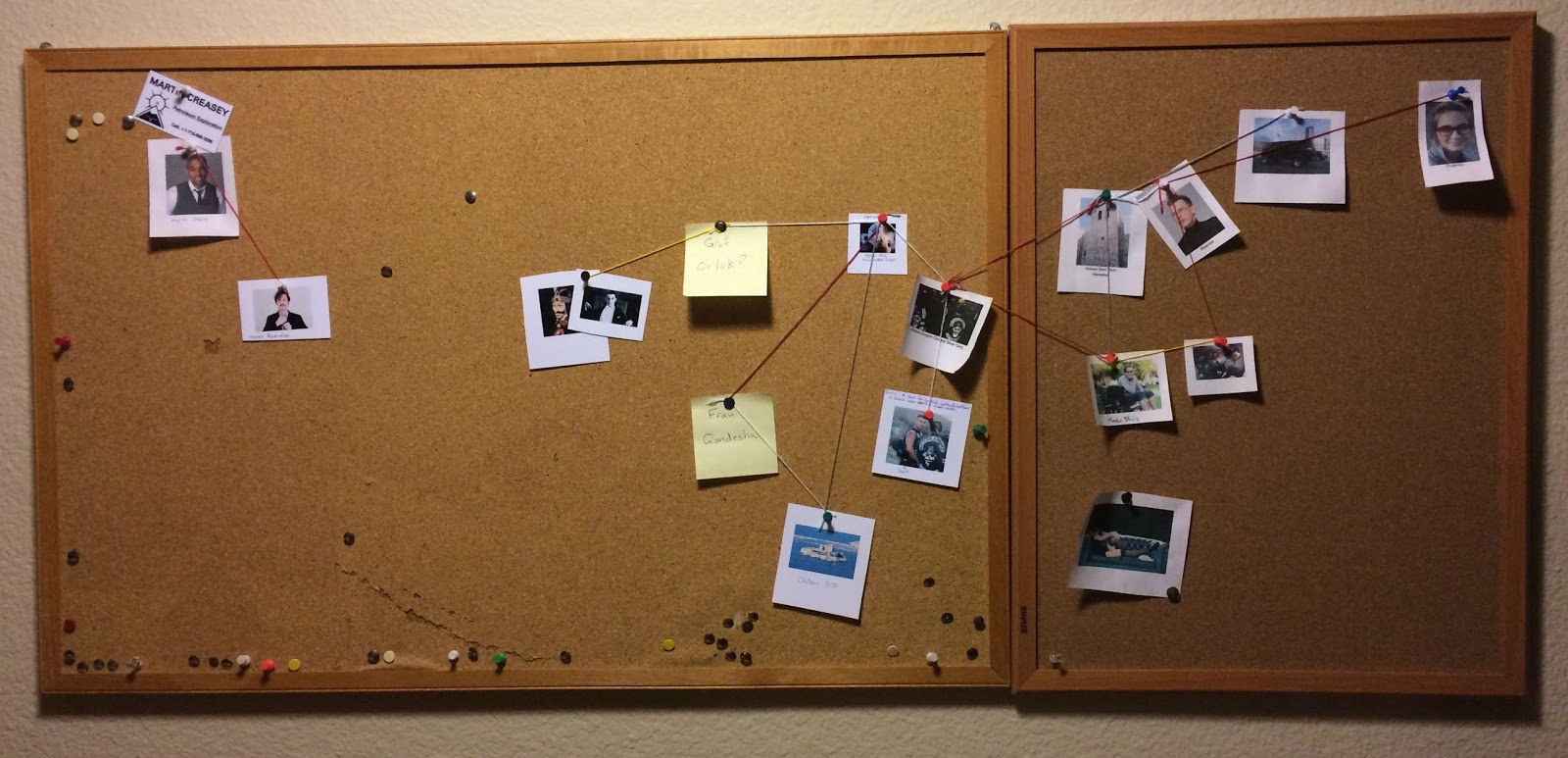
I'm talking about the Adversary Map. You know that crazy photo-and-thread "murder board" of suspects, victims, leads and connections that shows up in many a detective film. It is to Night's Black Agents what sheets of graph paper were to old school D&D. I love it. You hand the players some push pins, surveillance photos, and colored yarn and ask them to start mapping out the opposition.

It's not just a prop, it's also a mechanical reward. At the start of every Night's Black Agents mission the PCs get bonus points (that can be spent to improve die rolls) based on the connections they have successfully drawn between the mission's target and various other assets and locations in play. This is genius.


For one thing, it perfectly captures the feel of the genre. The PCs are basically trying to identify and pick-apart a giant conspiracy, and this provides some truly excellent immersion into that mindset. Having used this now in multiple campaigns, I can't imagine running a "detective genre" game ever again without using it.

Along with that oh-so-tasty immersion in the setting, it also helps the players visualize what they are up against. The existence of this player-built map forces the PCs to have an ongoing dialog about the clues they've gathered and the avenues of investigation still open to them. It's a mystery game, so you want the players to take it seriously and try to figure out the big picture. The Adversary Map provides a guiding structure for those efforts, and it's damn awesome that the game rewards that good behavior in play.

More importantly, it gives the GM a clear image of what parts of the scenario the players have actually figured out, which bits have them stumped, and where they have drawn entirely the wrong conclusions. It helps the GM nearly as much as it helps the players, because it brings to your attention the parts of your mystery where you're being too successful with your plotline obfuscation. Sometimes, you hear the players talking about some random photo tacked to the Adversary Map and it brings to your attention a red-herring you didn't even mean to drag across their path. Armed with that knowledge, you know which plotpoints still need associated clues or thematic reinforcement, and can figure out how to rearrange things behind the scenes to improve your game.


I tend to enjoy running complicated and mysterious plotlines, and fully-fleshed sand-box settings with lots of nuance and considerable PC freedom. When a GM does that, though, you always run the risk that players will feel overwhelmed, or get mired in the detail. The Adversary Map generates a big-picture view so you've always got some common ground to start from. It also keeps people from focusing in on one small subset of the plot or setting to the exclusion of all else, because they get a subtle weekly reminder that there's a lot more out there on the edges that they haven't explored yet. Should the players get stuck anyway, it's an easy thing for the GM to point at two or three different pins or photos and say "if you start shaking the clue tree in one of these spots,  I guarantee you something interesting will fall out". That's a little heavy handed, so I wouldn't do it unless they'd really hit a wall, but it's nice to know that you've got that option hanging on the wall to refocus them if the PCs are feeling lost or caught up in analysis paralysis. I love this this mechanic. It's both an immersive tool and a safety net for when I get too clever for my own (or my players) good.


Monday, February 13, 2017

Blog In The Saddle Again

Now that my commute is about two hours a day shorter than it had been (I've moved much closer to work), I think I'm going to try a bit of blogging again. I'll start by telling you about my latest RPG campaign...

I recently started a new campaign of Night's Black Agents, the spies-vs-vampires RPG from Pelgrane. Our fourth session meets this weekend (at my new apartment). The game is off to a great start.

My players include some very strong character-actors, and they seem to be really enjoying themselves with the slow-burn horror of trying to convince themselves that the supernatural forces arrayed against them really are supernatural (and specifically vampires) and not just some elaborate psy-op. In my previous NBA campaigns (this is the third I've run), I've felt the need to throw overt and obvious vampirism into the PC's paths very early on, usually the first or second session, to start the game with a bang. Not this time. I'm taking the vampirism slow, and been just focusing on creepy but deniable supernatural evil thus far, as well as a tangled web of counter-intelligence operations. Part of the reason for this new pacing is because, as mentioned, I have the right play group for it. The other half of the explanation is because for this game I've we're using what is probably the coolest RPG sourcebook ever published: Dracula Unredacted, and it enables a very unique play structure and pacing.

Dracula Unredacted is part of The Dracula Dossier, a collection of tools for running a freeform improvised campaign built around the notion that in 1894, British Naval Intelligence tried (and failed) to recruit a Vampire as an asset. You hand the players (not just their characters) a copy of this after-action report from that mission, annotated by at least three generations of spies, and let the players (and their characters) decide what parts of the "novel" to dive into. Do they poke around London and Whitby searching for corroborating evidence that this document is legit? Do they cross the border into Romania and attempt a raid on Castle Dracula? Do they stalk Dracula's leave-behind-network of criminals and undead minions, as hinted and mapped by Stoker's manuscript? Do they seek out the retired operative that ran MI-6's attempt to pit Dracula against Hitler in WWII, as referenced in the annotations? There's a million directions you can take the campaign, and the accompanying Director's Handbook features multiple competing interpretations of every NPC, location or organization mentioned in the Unredacted version of the novel, so as GM you always have multiple ideas at your fingertips no matter where the players decide to take the plot. The players are in control of where the plot goes, and the GM has everything they need to make sure the game is exciting and intriguing along the way.

In the first session of my campaign, the PCs raided a German BND safe-house, got their hands on an antique manuscript that can't be judged by its cover, fought off "trained attack rats" (that's the rational explanation they decided on, any way), and escaped pursuit by killing an MI-6 scuba team. In the second session they smuggled a hypnotized fugitive asset across the border, won big in Monaco, and stumbled into the aftermath of a botched operation involving the CIA and the Romanian SIE. In the third session they encountered another unusual rat; this time it was draining the blood of their fugitive asset / former employer. They chased it off, got the hell out of Monaco, and covered their tracks once again. Then they decided to double-back and trace the movements and actions of some of the opposition assets they encountered in the first session. This weekend, my PCs will be running a surveillance op against the "Median Empire" outlaw motorcycle club, as that gang conducts some sort of mission at the Chateau D'If, the famous "Count of Monte Cristo" prison island in France. Going in to the mission, they don't know if the bikers are mundane criminal types, vampiric Renfields, or some entirely other sort of supernatural working either for or against the vampires. Heck, the PCs aren't even certain that vampires exist yet. It's kinda awesome how much time they spend debating the notion that it might all be just a tandem psy-op and pilot animal-control technology program. Man am I having fun in this campaign.

I'm sure I'll have plenty more to say about it in the coming weeks.

Friday, December 21, 2012

A Fight Gone Wrong

A few weeks ago, in my Night's Black Agents game there was a fight scene that ended poorly for a character, and it shouldn't have. From my perspective, I saw that a PC made a poor tactical/mechanical decision, that nearly got them killed.  However, the message that at least some of my players walked away with was "wow, this system kinda sucks, and the PCs are really weak". I didn't realize till today, reading the comments to my last post, that any of the players felt this way. It's a pretty heavy disconnect, and I think I need to address it. I'd prefer to do this in person, but we won't be playing again till after the holidays.


How To Succeed At Gumshoe Combat

General advice on how to approach Gumshoe fight scenes.
  • Spend Points. Lots of them. Enough that you never actually have to roll, because even a "1" on the die will still be a success.
  • The goal is to end every fight with zero points left over in your three best General Ability pools. You will almost always have the ability to restore all your points in any three pools between any two fight scenes.
  • The consequences of "wasting" points by spending too many are very minor. The consequences of not spending enough are far more dire. I'll go into more detail on this at the end of the post, but trust me, it's always better to over-spend.


And now for the specifics of one particular scene, and how it went horribly awry...

The Scene

Night's Black Agents is a game about Spies and Vampires.

During the session, a PC got a phone-call from an adversarial NPC who wants to arrange a meeting at the PCs hotel room. The meeting is, of course, an ambush, and the players knew it.  None-the-less, this PC chose to handle this scene by themselves, with no other PCs involved.

The NPC shows up at their door, and the PC looks out the peephole. I give the player a Sense Trouble roll, which he makes, and I tell him that he can tell there's two thugs with the NPC, at the edge of view on either side of the door. The player dithers, tells the NPC to leave because he's not feeling well. The thugs smash the door open, and combat begins.


The PC's Stats

The PC on question is the team's sniper, and thus a bit of a "glass cannon".

His big advantage is 10 points of Shooting, and the Cherry that gives a 3-point refresh per scene. If shooting runs out, he does have 4 Hand-to-Hand points he could fall back on. 

He has the default Hit Threshold of 3, and has only 6 Health, which is tied for lowest in the party. Since he's a player character, he can operate from health 0 to -5 with just a -1 to his die rolls, which is a minor (but risky) advantage over the NPCs.


The Opposition

There's two Thugs plus the named NPC. The thugs have guns, the named NPC has just a wooden stake. The thugs are low-level Russian mafiya goons, and no stranger to violence. The named NPC is a corrupt Russian Orthodox Priest, with exorcism experience. He's got a touch of athletics and plenty of occult, but not a lot of combat skill. The Priest thinks the PC is a vampire, the goons think they're just getting paid to be muscle.

The Thugs are Hit Threshold 3, same as the PC. They have Health 3 each, to the PCs Health 6, but unlike the PC they go down when they hit 0 Health. They have a combat pool of 4 points.

The misguided Priest is very determined, but lacks the skill-set for this kind of work. Hit Threshold 2, and no combat pool to speak of. He does have as much Health as the PC (so twice that of his thugs), but is out of the fight the moment that is reduced to zero.


GM's Game Plan

The thugs will follow the "Opposition Spends" rules on page 52 of NBA. That means they will only use 1 point from their attack pools on the first round, and only escalate beyond that if 1 point per round is failing to get results.

I picture the fight as follows:

Round 1: PC has the higher pool, and goes first. He spends 2 (of 10) shooting, and drops one thug. Since they're at point-blank range, it's literally impossible for the gunshot to not take the thug out, as the thug has 3 health and the PC is doing 1d6+2 damage. The second thug returns fire, and probably hits the PC for 1d6+2 damage. The priest, having never been shot at before, freezes up for a second and does nothing.

Round 2: PC fires at the second thug. They spend either 2 or 3 points (depending on whether or not they are wounded), which would be enough for an automatic hit. Again, at point blank range any hit kills a thug. So, he's down to either 5 or 6 Shooting points left, before he invokes his Cherry and refreshes his Shooting pool back up to an 8 or 9.  At this point, the Priest will no doubt have seen his two bodyguards die bloodily, and will probably bail.

Round 3: The PC either shoots the Priest in the back, or chases after him and knocks him out with hand-to-hand, or decides to just flee the scene before hotel security responds to the sound of gunshots.  The PC is probably wounded at this point, but in no real danger unless something really unusual happens.


What Actually Happened

Round 1 goes as expected. The PC spends 2 shooting, and drops one of the thugs, but then takes a bullet from the second one.  The thug rolls maximum damage (8), leaving the PC at Wounded (-2 Health).

Round 2 is where things get weird. The players are worried because the PC is wounded, and still has 2 foes to fight. They've drawn some inaccurate conclusions about the Priest, and expect him to be attacking this turn as well.

One of the other players suggests the PC should make a called shot to ensure that whoever he shoots goes down. This wasn't really necessary if the PC shoots the thug at point-blank (since any hit will kill him), but it would matter if the PC decided to plug away at the named Priest instead. That would be a tactical error, but the player doesn't know that because they don't know the hit point total of the unwounded enemy.

This leads to conversation about how called shots work. It's kinda fiddly and there's a chart, but it basically works along the lines of "add N to difficulty, to add N-1 to damage if you hit." There were too many people talking at once, and little fiddly details getting mentioned and discarded.

I think in the process, the player of the PC in question got a bit confused. He announced that he was targeting the face of the thug, raising difficulty by 4 to get +3 damage. To hit he would need to roll a 3, increased to a 4 because the shooter was wounded, increased to an 8 because of the called shot.  He then announced, to my horror, that he was spending 2 points of Shooting, and rolled the die. His total was, as probability would suggest, less than an 8 on 1d6+2. He missed entirely.

Naturally, the thug returns fire. I spend zero points on the roll (he'd hit the previous round), but he still only needs to roll a "3" to hit, which he does. I proceed to roll maximum damage again, for the second gunshot in a row. The player is now at -10 health, and thus must make a difficulty 10 roll to remain conscious. Suffice it to say, that didn't happen.

Round 3: The PC is lying on the floor, bleeding out. The thug bails before the cops can arrive.  The Priest is left with a very messy situation on his hands, and is still there when the rest of the party shows up.


What I, As GM, Should Have Done Differently

Prior to the fight, I probably should have more strongly encouraged the party not to split up.  I wasn't too worried, because the PC should have been able to take the bad guys in a couple turns with only minor injuries. Still, if I had kept the group together, this would have been a cakewalk for them.

I should have made the NPCs breaking in the door take more than 1 turn. That I would definitely do differently if I ran this scene over again. If the player had a couple turns to think and act while the thugs kicked at the door, he might have come up with a clever plan, or just gone out a window to escape.

On the first round of the fight, perhaps I should have given the player an explicit reminder of the rules for taking cover, and the rules for invoking Tactical Fact Finding Benefits. Either would have made the fight look a lot less intimidating to the players. Ironically, a less-threatening fight probably would have resulted in the player being more inclined to spend points. It's a little counter-intuitive, but basically by presenting the fight as being a challenge, I inadvertently encouraged the player to horde their points for later rounds. This desire to stash points away in case things get worse later is a fairly common reaction when you haven't yet figured out how Gumshoe really works, and it almost always backfires.

I'm still not sure if I should or should not have told the player: "Don't bother with called shots, this guy will go down with one hit without it".  In this situation, that particular player character option didn't really help at all. Since a two-point spend without a called shot was sufficient to kill the thug, there was no point in using a fancy combat option that raised the difficulty. Some GMs would be inclined to help the player out here, and others tend to keep the bad guys HPs (etc) secret or leave strategy up to the players. I was on the fence, and could have gone either way.

At the very least, I should have taken better control of the table so we weren't all bombarding the player with different bits of rules detail. I think we overwhelmed him.

Certainly, if I'd processed that he was only spending 2 points before the die left his hand, I would have encouraged him to spend more.


Not my best moment as a GM, but not game-breakingly bad either.  I've fumbled worse before, and will likely do so again at some point.


Arguments In Favor Of Spending More Points


Not convinced that it's better to spend your points now then save them for later? Here's some rambling arguments to support my position:


Refreshing pools is easy, so there's no need to save points. Most NBA characters have some sort of Cherry that lets them refresh 3 points in their best skill, once per scene. Even without that, if you get an hour's peace and rest between fights or chases, you get a full refresh of any three General Ability pools. That's a standard rule in Gumshoe. If 24 hours go by without a fight or chase, you'll refresh all your General Abilities. If you accomplish a major success that wraps up an "Operation", you can expect for the whole party to refresh everything.  It should be very rare that you go more than one session without a refresh of some sort. You can routinely drain three entire Abilities per major fight or chase scene without suffering any long-term consequence.

The secret of Gumshoe is that it is actually a diceless system. Rolling the die should be the thing you do only when you're out of points. Anything worth doing is worth spending enough points on that you auto-succeed.

The point of Gumshoe is avoid the narrative collapse that can happen in normal systems when a bad die roll derails an investigation. The GM wants you to solve the mystery, so the rules ensure that you can't accidentally fail it because the dice suck. The same logic applies to combat rolls as well. The GM wants you to win the fight, and hates to see you fail just because of a bad die roll.  If you spend lots of points, the die roll won't matter.

Gumshoe is not d20, you're not going to have to make dozens of attack rolls per battle. Most foes will go down in one or two gunshots.  You don't need to hold back points in case the fight "goes long". You need to spend points early so that your victory happens quickly and decisively.

On a related note, if some NPC in NBA doesn't die after the second gunshot, that almost certainly means they are a wickedly-powerful supernatural entity and your guns won't save you. Time to flee. Come back later with holy water, lots of explosives, and the element of surprise.

If that sounds like gunfights in Gumshoe (especially NBA) are intentionally lop-sided, you're getting the picture.  It's intentional. Long drawn-out fights are bad, and generally a sign that the players should have fled several turns ago. If you can win, you'll do so very quickly.  By turn 3 of any battle, you should either be mopping up the stragglers of your obvious victory, or running for the exits because your life depends on it.

If the PC in our scene had spent 4 more points on his second roll, he would have killed the second gunman and thus won the whole fight. Instead, he saved himself 4 Shooting points but "paid" 8 health instead.  As this left him with 6 Shooting and -10 Health, it was not a good trade.

The consequences of "wasting" points by spending more Shooting (for example) than you needed to on early rolls is fairly minor: in some later turn you might have to take some action other than shooting. You might use hand-to-hand to keep fighting, or athletics to escape. You might take cover, and let some other PC do the shooting for a while. These are pretty minor consequences.

The consequences of not spending enough points on a Shooting roll is usually that you miss, and then you get shot later that round or the next when your foe survives to counter-attack.  That is a far worse consequence then wasting a point here or there. It does you no good to hold back 2 points of a skill "for later" if not using them right now gets you killed. You can't spend those extra 2 points after you die, so you might as well use them this turn instead.

Tuesday, December 11, 2012

Night's Black Examples

I've run two sessions of Night's Black Agents so far, and I'm really enjoying the game. One of the area's where Night's Black Agents (hereafter called NBA) is really strong is in the mechanical additions to the Gumshoe system. The new rules take the game system in entirely new directions, and, as always, Kenneth Hite's writing is quite clever. However, he in a few places he failed to provide enough concrete examples to fully utilize some of the groundbreaking new rules.

In this post, I'm specifically talking about Tactical Fact Finding and Preparedness, though the general "not enough examples" complaint can be applied to other parts of the otherwise-delightful rulebook. Tactical Fact Finding is a new mechanic, while Preparedness has been around since the very first Gumshoe product and is simply dialed up a little in NBA.

Both of these mechanics allow for players to cut corners during the planning stage and ret-con in surveillance and preparations. In theory this should seriously reduce time wasted micromanaging details or arguing over what the correct course of action is. In practice I'm finding the players still demand all the details and take several hours per session trying to work out the perfect attack plan. More and better examples of allowable spur-of-the-moment ret-conning to point the players at would be one way to encourage them to speed themselves along and not sweat the small stuff.

Even more importantly from my perspective, however, is the degree of GM fatigue and GM fiat that could most certainly be reduced if they only had better examples for these two mechanics. They're not the most radical rules in the book, which is probably why they got under-exampled, but they are rules that will require a lot of GM improvisation and possibly some house-ruling.

Tactless Facts about Tactical Fact Finding Benefits 

While I love the concept of the TFFB (Tactical Fact-Finding Benefit), I find the execution to be a bit incomplete and even vague. In a nutshell, a TFFB is a bonus that the players get during a fight or chase by using their Investigative Abilities. This is an awesome concept that really catches the feel of clever spies fighting smart and dirty. However, it's so open-ended that there's just not much guidance for the GM, and I find myself raising a critical eyebrow at that.

For starters, the actual benefit could be just about anything. The rules list 5 general categories of benefit, and sheepishly suggest point-ranges for the three categories that have something to do with bonus points. The numbers are pretty vague, a TFFB for a group of 4 players could render anywhere between 4 and 24 points if I'm reading it right. Those points could come in the form of a group pool, individual refreshes, reductions in enemy point pools, or reduction in difficulty numbers - and lets not kid ourselves about those categories being 1-for-1 comparable.

There are 35 investigative abilities in the game. Some, like Architecture or Military Science, are really easy to imagine how they'd be helpful in a fight or chase. Others, like Accounting or Forgery, are difficulty to dream up tactical uses for, on the spot, after the bullets have started flying.

That is, by the way, exactly what you're supposed to do: improvise these on-the-fly based off of player actions. Each individual player may invoke one of these per combat round, so even if the GM preps a half dozen between sessions, they'll quickly have to start improvising.

Creating a TFFB involves defining 5 very open-ended variables.
  1. An investigative ability (from the list of 35) chosen by the Player. Everything after that is up to the GM.
  2. Whether or not the player has to spend a point of that ability to get the benefit. 
  3. An action or situation that is somehow linked to that ability and the scene at hand. 
  4. A benefit of one of five general types (or something new the GM dreams up). 
  5. The intensity (point-value) of that benefit. 

 I'm sure they are so open-ended, vaguely defined, and situational on purpose. No doubt that is intended to be a benefit here. The experienced GM can make up whatever they want, as long as it corresponds to the skill the player chose. This can be really simple, if your players are always grabbing the same couple skills or generally under-using the mechanic. If they are instead trying to get the most out of these potentially very powerful bonuses (and they should be), they can really put the GM in the hot-seat.

Some d20 book in my collection (quite possibly the 3.0 DMG) made the then-remarkable assertion that any unusual situation or circumstance that could modify a roll could be represented by a simple +2 or -2 instead of trying to compare and rank the details. If there's seven different factors at play, 4 good and 3 bad, you'd throw +8 and -6 at them, for a net bonus of +2 and be done with it. Quick and easy. Warhammer 3rd went one step further by using white and black dice that were every bit as easy to pile on to a roll, but didn't automatically cancel each other and you could get more nuanced results. Why does NBA, a game using an engine that is far less fiddly and crunchy than either of those two games, have such a completely inelegant system for handling these benefits? It boggles my mind. It is, admittedly, kind of cool and very immersive, but it's also uncharacteristically fiddly.

I've got 6 players at my table, so in theory I could have to come up with 6 of these things per combat round. Frankly, that sounds fatiguing. I would gladly pay money for an entire sourcebook (or even a deck) full of examples of TFFBs that I could use or riff off of. Instead the game gives a mere 4 examples, 2 of which are not generally reusable.

Unpreparedness 

Preparedness is a General Ability that can be used to acquire equipment the moment you need it. Need a tracking device in a hurry, but forgot to tell the GM you wanted to bring one (or honestly didn't think about it at all till right now)? A successful preparedness roll puts the device in your pocket retroactively. This is a standard of Gumshoe games.

NBA adds the extra wrinkle that you can use Preparedness to ret-con in an entire spy cache of useful equipment. If you need a large number of items, but aren't in as much of a hurry, you can make a roll to access a storage unit, safe house, or safe deposit box full of stuff that you'd stashed away months ago. The difficulty of this roll is 6, and it essentially allows everyone in the party to each name an item that's in your stash.

Could that stash have a suitcase nuke, or a wrist-watch with a hidden laser? That's up to the GM. Are guns allowed, or just the miscellaneous tools mentioned specifically in the base preparedness write-up? Again, that's up to the GM. The only guidance given here is that a maximum of one item per cache can be a vehicle. While I'll gladly agree that the most outlandish items should be subject to GM veto, nowhere in the book does the game give any solid advice on what is or isn't a legitimate request from a cache, or what the difficulty of high-powered gear should be outside of a cache.

The equipment section of the game is about a dozen pages, and yet manages to almost completely avoid mention of Preparedness. The new GM is left without any guidance, and players basically have to read several pages only to conclude that all equipment is gained by GM Fiat. What's the difficulty to pull a grenade out of my backpack? 3? 4? 5? That's entirely up to the GM - even though pulling multiple grenades out of a Cache is (almost-clearly) difficulty 6. How fancy can that one vehicle per Cache be? Again, that's up to the GM. Shouldn't this sort of stuff have been on an equipment chart somewhere?

What really bugs me about this is that the book includes this nifty set of icons that are used repeatedly for tweaking mechanics to match which ever subgenre of spy-film you're trying to emulate. Preparedness is exactly the sort of mechanic that should be tweaked depending on whether you're running "Dust"-mode realistic spies or "Stakes"-mode over-the-top cinema. So if the excuse for not providing guidance here can't be "we don't want to dictate to the GM what kind of game to run". If you're already encouraging the GM to pick-and-choose which rules subsets to use, then you can only gain by providing suggested examples to go with those subsets. It seems like an oversight to have not given Preparedness a little more per-mode attention.

The Plan: 

Venting to the internet may make me feel a little better, but it rarely improves the external reality. It's not like I hate the game, either. I'm really enjoying it, I just wish there were more useful examples provided for these specific rules. The Conspiramid and build-a-vampire rules, for example, are chock full of really useful examples, even though the everyone at the table will interact with those systems far less often than with the TFFB and Preparedness mechanics.

The obvious solution is for me to go to work dissecting and building examples of my own. Keep your eyes open to this blog, and eventually I'll probably have "Night's Black Examples part 2", hopefully with a few dozen TFFB examples and maybe some Preparedness charts for the four main game modes.

Friday, May 27, 2011

Intrigued by a new Wilderness of Mirrors

I just saw that the "double-oh-two" (002) edition of Wilderness of Mirrors is available as a PDF. There's a six-page preview up on DriveThruRPG, but it doesn't offer much in terms of what's different in the new edition. Since the actual book is itself about 14 pages long, a 6-page preview is rather generous. I can't really ask for more, even if it isn't answering my questions.

So what are the differences between the first and second edition of Wilderness of Mirrors? Here's what I can gleam from the preview:
  • The stats are no longer named for Roman gods. Judging from the index, it looks as though the whole mythology theme has been moved to what is perhaps an optional setting that takes up about a page at the end of the book?
  • There's a new stat that represents using muscles or physical force to get what you want. 
  • The stat that was for killing looks to have been basically split up into shooting and the new muscles-related stat.
  • As near as I can tell, the stat for being team leader is gone. 
  • The final page has some sort of list of (possibly real-world) intelligence agencies.
What changes I see look good. The mythology stat names worked against the theme/setting of the game, so I'm happy to see them gone. Saturn was a dump stat for all the PCs except the actual team leader, so I'm happy to see that stat not just renamed but removed. Setting information, even if it is just a page or two, could be good for getting your mental gears turning. What John Wick did choose to change or add, looks to be 100% improvements.

One change I would have liked to see, but clearly isn't in the new edition, is fixes to the character creation math. As mentioned in my various other posts, there are certain builds that are just better than others in terms of in-game effectiveness, but if everyone made the "smart" decision during character creation, you end up with lots of overlap and little differentiation between PCs. Replacing Saturn with "The Heavy" may fix that a little, but probably not completely. Which makes me curious as to whether or not there's any changes to the way mission points and threat are generated,  as  you could perhaps fix the problems there.

Links to some of my previous posts about Wilderness of Mirrors:
So now I have to decide if it's worth picking up the new edition. On one hand, it's only 5$, so I can clearly afford it. On the other hand, it's $5 for just 8 pages that I haven't read, most of which might be content I already have (so the big improvement might just be a spiffier layout). To further complicate the decision, the new version of Wilderness of Mirrors will eventually end up reprinted in the upcoming The Big Book of Little Games, price unknown, release date unknown. Hmm.

Friday, March 5, 2010

StarWarsderness of Mirrors

Last night I ran a one-shot of Wilderness of Mirrors, using the setting from Star Wars.

I replaced the 5 stats of Wilderness of Mirrors with five similar, but subtly different stats. The five attributes were:
  • Droid - used for tech, repair, and computing
  • Flyboy - used for piloting and acrobatics
  • Jedi - used for The Force, Luke
  • Princess - used to charm, inspire, and command
  • Wookie - used to intimidate and battle
Effectively, I folded the "Saturn" and "Mercury" roles from the main game into each other, since my previous experience had told me that "Saturn" was too weak. I used Saturn's power, with general social-roll utility of Mercury. This left me with Mercury's special power sitting unused, and I realized that being able to tell a perfectly convincing lie was very much like "These aren't the droids you're looking for", so I added in the Jedi stat. The end result was that the five attributes felt much better balanced, instead of Saturn having the awkward "dump stat" status it has in the main rules. I was very pleased with that.

If you look at the attached character sheet I made, you'll notice I also tweaked the power of "Pluto". Stealth isn't really center-stage in the Star Wars films, it's got it's place, but it didn't seem it should be a central character focus. So, I made "Flyboy" cover acrobatics and piloting, with the modified special power to escape from any one tight situation. This is a slightly more frenetic and active version of Pluto's power, and it can be used in a ship. Again, I was pleased with the way it played out.

Overall, things went well. My only complaint involved my own memory issues re: the rules. The main rules are so simple, I didn't re-read them before play. I got about half way through the session, and then commented "I don't remember this being such a cake-walk for the players. I feel like the difficulties should be higher." That's when one my players (thanks, Erik!) stepped up and reminded me about the tokens/points the GM is supposed to get. Off the top of my head, I couldn't remember the rate the GM earns these Setback points, so we went with one every 30 minutes. Turns out that it's supposed to be one every 20 minutes, which would have been much more challenging, and probably far better to have the extra 3 or 4 Setbacks, but we had fun anyway.

As always with Wilderness of Mirrors, the GM just sets up a very brief mission proposal, and then lets the players roll with it. (The bulk of my game prep was making that character sheet.)

Players have a lot of narrative control, and you never really know where things are going to go. We started with the PCs having to steal the Death Star plans and convey them to Princess Leia. By the time all was said and done, the plot involved Wookie and Gamorrean porn stars, evil architects with brain-sucking Dark Side powers, lots of EVA (zero-G combat in space-suits), and an escape in a garbage scow. Very amusing... but trust me, the less you know about "the Wookie Wax", the better.

Wednesday, September 30, 2009

Chipped-in Wage-Slaves

Over at Pair o' Dice, they mentioned the concept of chipped workers in Shadowrun (and the same could be done in Cyberpunk), people who are slaves to the company they work for. A company that never had to train them, they just plugged in a skill chip that guides the worker's hands. Scary, creepy, sci-fi fun. And it's only a few years off.

Talking about it, Scott at Pair o' Dice wrote:
Wageslavery as a Backdrop to the Action

I am not suggesting players take on wage slave characters (although some runners have backgrounds as an ex-wage slave or corporate drone), that would probably be a terribly dull game.

But I gotta say, that actually gave me two really cool campaign ideas that aren't dull at all:

  1. A game where the PCs are wage slaves, and some sort of mix-up happens. One day, they show up for work, and their "Assembly Line Efficiency & Company Loyalty" chip has been replaced with a "Urbo-Anarchist Badassery" chip. Or just a Martial Arts chip. You're playing ordinary people who suddenly have a single maxed out skill, which was no doubt slipped to them by someone for some reason. Cue the clues, interspersed with Matrixy fight-scenes. You have to break out of work, with company property still in your head, and the pursue the mystery.
  2. A game where you don't play the meatbag, you play the AI. I'm a super-spy that only exists as a skill chip. Plug me into a person, and I immediately over-ride their personality as well as tacking on a couple of very important skills. If things go south and I need to lay low, I just convince someone else to try this awesome skill chip instead. You'd play the same character, but have new character sheets and background every time you swapped your plugging. There's some logistics to work out about the couple seconds between unplugging from your current body and getting plugged in to the other, but I'm confident it could be explained in a way that would at least diminish the risks and plot holes. If the persona lingers for a few minutes after the chip is pulled out, for example, or if the last thing you do before unplugging is auto-hypnosis. Every NPC you meet that has a visible chip socket becomes a potential bodysnatching.
Anyhow, the blog post over at Pair o' Dice is pretty cool. Check it out

Friday, August 7, 2009

Character Creation House Rules for Wilderness of Mirrors

The next time I GM the Wilderness of Mirrors espionage RPG, I'll be completely doing away with the point-buy system for character creation. Instead, we'll just assign each PC one stat at level 5, one at 4, one at 3, one at 2, and the final (weakest) stat at 1. The players get to choose which stat gets which rating.

Why the need for the change:
The point-buy system in the Wilderness of Mirrors rulebook looks neat on the surface, but (as I'd mentioned in my initial pre-game post) it boils down to only 6 different arrays of stats.
  • 5, 5, 5, 1, 1
  • 5, 4, 3, 2, 1
  • 4, 4, 2, 2, 2
  • 4, 3, 3, 3, 1
  • 5, 5, 2, 2, 1
  • 3, 3, 3, 2, 2

To save the group a lot of time learning crunching numbers, I wrote down those 6 permutations and brought it to the game I GM'd yesterday.

All four players in my group looked at that an decided 5, 5, 5, 1, 1, was superior to the other five possible arrangements. And honestly, they're right. It gives you a total of 17 dice, whereas the other versions give between 13 and 15 dice total. Analyzing those trade-offs, The more you think about it, the worse the other set-ups look, because you'll be rolling one extra die in your weak area at the cost of losing a total of three (or more) dice from two of your best areas. And it's not like that second die in your weakspot is going to really help much - you'd need to roll an 11 or 12 on 2d6 to get any measure of narrative control.

My group is not typically a munchkiny bunch - we run weird one-shots and run lots of goofy narrative systems. Realizing how heavily the system rewards that choice, the decision was easy. When one option is so much better than the alternatives, no one wanted to be the only person left in the dust.

This quickly developed into several different (but related) problems.

All or nothing: With the stats being just 5's and 1's, that means that for any given stat you either always have narrative control, or never have narrative control (since you're looking to roll a 11+ on either 5d6 or 1d6). If it's just a binary function, why spend time rolling dice and adding numbers? Okay, I'm over simplifying it - there's actually plenty of times you want to roll 16+, which means the options aren't "yes" and "no", they're more like "50/50" and "no". That's really not an improvement.

Character redundancy: With all characters having the 5, 5, 5, 1, 1 stat arrangement, you can be certain that any two characters will have one stat that's rated the same - they'll overlap one of the 5s. This is detrimental to accepted notions such as individuality, character concept, and character niche. Instead of "I'm the assassin, and he's the techie" you end up with "We're both assassins and techies, but I'm also the team leader and he's also very stealthy".

Saturn is a dump stat: The character overlap problem gets even worse because you almost never roll Saturn. The team leader needs it at level 5, everyone else is going to want to rate it at 1. Which means the above problem of character redundancy just got worse, since every character except the team leader has a Five-Star rating in 3 out of 4 remaining stats. This also has the unfortunate effect of making the team leader the weakest character in the group.

Special powers: The highest-ranked PC in a Stat gets a corresponding one-time-use power. If there's a tie, they both get that power, but whoever uses it first uses it up for the whole group. For our group of 4 players, this meant that the special power for Saturn went to the team leader. The special power for Mercury was shared between two players. The special power for Mars was shared between 3 players, as were the special powers for Vulcan and Pluto.

It was ugly.

We all looked at it and said "this isn't gonna work". After a few seconds of pondering aloud, I instructed everyone to switch to the 5, 4, 3, 2, 1 spread instead. That change resulted in characters that overlapped less, but it still resulted in 4 out of 5 characters having a "1" in Saturn. It was better, though. With this spread, everyone felt like they had a focus, and the characters weren't just carbon copies. We played it out, and were happy with the results (though Saturn still seems like a dump stat).

Earning Mission Points in Wilderness of Mirrors

On paper, mission points are the main tool and resource of the players in a game of Wilderness of Mirrors. The first time I GM'd the game, however, they failed to provide the expected dramatic tension, and weren't even a meaningful form of resource allocation. The PCs had far too many Mission Points for them to carry any weight or meaning.

This is bad, as one of the ways the game achieves the "you don't know who to trust" element of the spy genre is by giving out "Trust Points" when PCs betray each other or narrate in events that hose the group. But if you're sitting on a pile of 12 Mission Points and have only been using about 2 per hour of play, you're really not motivated to do anything underhanded to add Trust Points (which, other than how they're gained, work just like Mission Points) to your collection.
It's worth noting that I did not play using "Solution #1" from the rule book. It strikes me as much harder on the players. It may turn out you're just fine handing out tons of Mission points if using that mechanic. Eyeballing it, it seems like too harsh a correction to me. After 2 hours of play, the difficulty needed to earn basic narration rights for a PC would be a 41 (instead of 11), and that's pretty brutal. In the final scenes of 4-hour session, the PCs would need to roll a 65 to even get a veto/ammendment option.

So, the rest of this post assumes you, like me, are not using "Solution #1", and are instead using solutions 2 or 3, or some similar variant of your own devising.
It feels to me that the number of Mission Points needs to be curtailed a bit. Of particular concern are Mission Points gained by flavorful embellishing details, and Mission Points gained by details that help the Party succeed at it's mission. The goal is to reduce the former and all-but prevent the later.

House Rule regarding how Mission Points are earned:
At the start of the planning stage, the GM sets aside X # of Mission Points, under the name "Style Points". X is usually 3, but if there's fewer than 4 players, X is one less than the number of players (minimum of 1). These X Style Points are for flavor, in-genre tropishness, awesome ideas, etc. Whoever comes up with the coolest idea during Planning gets all 3 points, but if the GM's having a hard time deciding, he can split them between 2 or 3 players. Style Points go directly to the pool of the player who won them, they don't get split up by the Saturn. In all other ways, they work just like Mission Points.

Actual Mission Points then are handed out only for details that provide challenges to the team. On the map or plan that the team is drawing up, anyone may designate a detail to be a challenge. They describe the challenge, and list 2 of the 5 attributes - those are the only two attributes that can be used on that challenge. This gets written on the plan, and is then worth one Mission Point. This might not seem like much of a bonus, but there's nothing stopping players from putting in additional challenges beyond what they expect to deal with. For example, if there's two entrances to the building, one might have a guard post (takes Mercury or Mars to get past) and the other has a security lock (takes Vulcan or Pluto to circumvent). Unless things go very badly, no individual player will have to deal with both of them. In fact, the existence of these two challenges makes it easier for the party that splits up, because they can match appropriate skills and get in by different routes. But at least they've added some measure of a challenge in exchange for the two Mission Points they've earned.

I suspect you'll end up with 8-15 mission points per player, but if still at the high end they'll be offset by more (and better defined) challenges.

The rules for Trust Points remain unchanged, and will hopefully become more attractive since there's a bit more challenge in the mission.


Thoughts behind that House Rule:
For those interested in why I concluded such a house rule was needed, here's the problems I found with the existing system. These became apparent in just one session of play, and were a real shame to deal with...

Earning Mission Points for trivial details: Here's the prime source of the problem. The game says any given "detail" the players bring up in the planning stage is worth from 1 to 3 mission points. But it gives no parameters of what constitutes a "detail". It being a cinematic game, you naturally want to reward stylish and flavorful details, details that play to tropes of the genre, and of course details that provide challenges for the players to overcome.

So at first I'm giving out mission points freely. As I'm handing out the 12th or 13th point, however, I realized that really the only detail they've given that potentially adds any challenge was "The perimeter is patrolled by guards in scuba gear with harpoon guns." The scenario at that point was shaping up to be flavorful and cool, but a total walk in the park.

Crap. Half the details given out so far were actively making it easier on the players, and I was foolishly rewarding them with bonus dice for making it easier on themselves. So I slammed on the brakes, and started only giving out points for details that actively made the scenario tougher on them. I feel I was draconian from then on. At least 50% of the details after that didn't get rewarded, and only one detail in the whole list was awarded more than one point. Despite my being a hard-nose, the party still earned 31 mission points during the planning stage.

Motivating Saturn to not just evenly split the mission points: This is a minor problem, but worth mentioning. So you've got 31 mission points, and your team leader has Saturn rating of 5 so the other 3 players each start with 5 free mission points (for a total of 46 points for the whole team). What's that team leader going to do?

Unless there's some abnormally clever reason to do otherwise, they're gonna take 5 of the 31 free points for themselves, then split the remaining 26 points roughly evenly between all the players. It just felt like there wasn't much of a motivation for splitting it in any other way. With a total pot of 46 points, it's not like anyone can argue that their character really needs more than say 14 or 15 mission points. Which means that one of the big "advantages" to the Saturn stat (to compensate that you probably never roll it) is negated by the decision being almost meaningless. Maybe, late in campaign, after you've established some rivalries and betrayal, there might be a situation where a Saturn is motivated to snub someone at Mission Point allotment time, but for a one-shot it was pointless. (And yes, I gave my team leader secret directives to get the "traitor" killed, so she slighted him by about 4 mission points. This tipped him off, and yet still wasn't enough of a deficit to matter, since it left him with about 9 points.)

Defining what you roll: In most RPGs, you take an action, then roll for success or failure. In Wilderness of Mirrors, you basically just state the category of action (from five categories) and roll. If your total is 11 or higher, you narrate what happens. If you roll lower than that, the GM narrates.

Since the categories are very broadly (and vaguely) defined, it's pretty easy to justify using your specialty for just about everything. Seriously. You put a PC in a knife-fight, expecting them to use Mars (the hit man stat). Instead, they roll Vulcan (the fixer / techie stat) to produce a hidden sonic device that immobilizes the foe. You present them with a locked and alarmed door, expecting them to use Vulcan to disable it, and they instead suggest Pluto (the stealth stat) for thievery, or Mars for demolitions, or Mercury (the charisma stat) to charm an code-key off someone. Surprise, it turns out every stat is actually a 5! Or, rather, that every roll is made using your best stat.

This flexibility with the stats and rolls means Mission Points and Trust Points are further devalued - as you'll almost always be rolling 5 dice even without them.

When can you spend mission points? The rules seem to be implying you spend the mission points before you roll, but don't state it very firmly. For reasons stemming back to Luck Points in Cyberpunk 2020 (but also applicable to 7th Sea's Drama Dice, and Savage World's Bennies), I generally prefer to have players spend such resources after they've seen their other dice. It just sucks too much to squander a rare resource on a roll that would have succeeded without it, or on a roll that doesn't have a chance to succeed even with the resource.

In Wilderness of Mirrors, however, the resources aren't rare at all. Instead of 3 per player, you get at least 10 per player, maybe as many as 15 or 20 counting Mission and Trust. Unless you trim back the number of Mission Points earned (or use Solution #1), I heartily endorse making the players choose how many Mission Points and Trust Points they'll spend before they roll any dice.

PC Mortality House Rule for Wilderness of Mirrors

Wilderness of Mirrors is largely a game about narration rights. However, it provides precious little in terms of guidance as to what is or isn't allowed when you're narrating. Technically, if you wanted to narrate "a nuclear bomb kills everyone but me", the only thing stopping you is the fact that no one would ever game with you again. Obviously, that extreme an action is out of bounds, but there's no good guidelines in the rulebook to what is or isn't acceptable.

On page 12 of the rulebook, under the label "Solution #2" (the second of three possible ways to handle the mechanic of putting the mission on a time deadline), there's some helpful advice regarding "permanent damage" and how the GM needs full narrative control to inflict any lasting injuries on your character. (Attaining full narrative control isn't easy for the GM.)

Sadly, this "permanent damage" rule is only mentioned in one of the three options of how to handle that mechanic. If using "Solutions" 1 or 3, the issue of how to deliver such injuries is a little unclear.

More importantly, the game is rife with inter-party conflict. The rulebook actively encourages the GM to create situations where one PC is ordered to plant a bomb to kill another. That begs the question, can a PC kill another PC? Can they narrate permanent injury to a PC? If the answer to either of those is "yes", then how do you defend yourself? The game has no contested rolls, partly because until someone's narrating the results, you wouldn't know if they're attacking you.

The Two-Chip Rule:
Here's my proposal, which replaces the "permanent injury" rule, and is intended to work with any of the three "solutions".

Each PC starts the game with two poker chips (or colored stones, etc ), one each of two different colors, let's say red and blue.

While you have the blue chip, the narrator cannot give you any permanent damage. He can still wound you, even describe that you're captured, etc, but escape remains likely and your future actions are in no way penalized. Any time his narration (or veto) wounds you, he may choose to take away your blue chip. If you don't have a blue chip any more, when the GM's narrating (not just using his veto) he can give you permanent damage. So, the GM has to "set up" his big moves against players by first stripping their blue chip in some harmful development. It takes a one-two punch to really hurt a PC.

While you have the red chip, no other players can incapacitate you, nor give you permanent injury. If a player narrates some sort of harm to you, however, they may choose to remove your red chip. Thereafter, for the rest of the session, any time a player narrates harm to you, they may choose to give you a permanent injury or incapacitate you. Note that even if Player A makes you discard your red chip, you become vulnerable to actions from not just Player A, but also B, C, D, etc.
The reason I put in the "gang-up" aspect of this rule is because Wilderness of Mirrors lacks a detailed initiative system. I didn't want an inter-party conflict to be determined solely by who acted first. This way, the timely intervention of another PC can tip the scales.
The GM can't kill you, no matter what. There's only two ways a PC can die:
  1. That PC's player may narrate their own character's death, via heroic sacrifice, suicide, or enemy action.
  2. Another PC may kill them, but only if the target PC currently has no red chip, and has already been incapacitated by a PC's action. So a PC can be killed by another PC, but it takes 3 successful narrations to do so. The three narrations could be performed by 1, 2 or 3 different players, however.
Once per session, a narration (not a veto) that details healing, medical treatment, the passage of large spans of time, etc, may include the restoration of your blue and/or red chip(s).

Monday, July 20, 2009

The Planning Stage in Wilderness of Mirrors

I bought Wilderness of Mirrors for one reason - because it does a really good job of modeling (in gaming) the planning stage of spy movies, caper films, etc.

In other game systems: This common element of espionage films is often a bit of a trouble in RPGs.

If there's one obvious solution (just one good way into the enemy base, for example) then there's a good chance the players will feel railroaded.

A GM who's conscious of that will come up with more than one way in - which means the GM does a lot of redundant prep work when they pick only a single approach. There's a chance that the players won't see one of the paths to success, or will value one as being much better than the other, and they'll still feel railroaded.

This results in the typical dungeon-structure showing up in spy headquarters, military camps, space stations, etc, because trying to hit the right balance is really hard - you want to keep the player's decisions meaningful, but not have to come up with a ton of work for yourself or bore everyone with a lengthy exposition dump. *

Ultimately, once you've given them the intelligence report on the site of the mission, it becomes a contest between the craftiness of the GM and the craftiness of the players. Often that contest involves the GM intentionally handcuffing themselves by leaving back doors that it's hard to believe the enemy overlooked, so that the players have a chance. If you don't, you run a greater risk the PCs will hit a wall they can't surmount.

This is going about things the wrong way - it's not supposed to be the players trying to outsmart the GM, it's supposed to be the Player Characters (who have different skillsets than their players do) trying to outsmart the NPCs. Really, James Bond shouldn't be at a disadvantage because the guy playing him doesn't know as much as the GM does about how alarm systems work. But I've ranted about that before. **

Wilderness of Mirrors avoids all of those traps. How, you ask? By not having the GM do a darned thing, and always assuming the PCs kick butt.

Between sessions, the GM only has to brainstorm a one-sentence description of the new mission. He can seriously just show up to the game with that sketchy little description, and absolutely zero additional prep work. ***

Each session starts with the planning stage, with the players collectively sketching out a loose map, and filling in details of how the defenses that have to be overcome. Each such defense or detail gets you a mission point award, which you'll use later to overcome those same defenses.

While the rules don't say this as clearly as they could, I believe you're supposed to run the planning session in-character. At least as much as possible. So it's not "Wouldn't it be cool if there were like those infrared beams, you know, set up like a web somewhere and we had to like crawl through them without touching them? Should we put that in, like near the vault room?" Instead you should be saying "Before he was captured, our Mole reported that an InfraWeb 9000 alarm system had been installed in the chamber outside the vault. We'll need to requisition the proper gear to see the infrared lines, and assign our most acrobatic agent to getting past that."

The point is, you're not motivated to come up with something really easy, or really hard - but rather to come up with something really cool that'll look and sound awesome when you circumvent it. The players should absolutely be proposing things that sound terribly difficult, but which they already have an idea on how to solve or slip past.

The difficulty to infiltrate the evil lair (or whatever the framework of the mission is) is beside the point. Your dice rolls don't determine success or failure, they determine narration rights. Success is assumed in most circumstances. If I roll poorly, I may still take out that guard - but the GM will decide his body is found by a random patrol 10 minutes later, and we have to act fast.

As with any good caper or spy plotline, the infiltration is only half the mission - getting out again is the tricky part. The setback points that the GM accumulates every 20 minutes are designed to make all hell break loose once you're inside. Expect something to go wrong, and a good chase or fight scene to break out in the second half of the night. By the same token, you might win the roll, and still choose to narrate a result similar to my guard example in the previous paragraph. Little unexpected twists get you "Trust Dice", as does betraying the group. (Gotta love the name of those Trust Dice.) Narrating a minor setback now can help arm you for controlled success at a critical juncture where it really matters.

This game is sweet.I'm very excited to try it.


*: For an idea of my own on how to avoid the exposition dump, see: Discussion Cards. That idea works well with science anomalies / mysteries and for conveying situations where the Players lack info the PCs have.

**: Pet Peeves Regarding Attributes. Since writing those words 20 months ago, I've seen a few "hippy games" that let you use mental and social traits this way. Sadly they all seem to be games set up for one-shots only, either being very gimmicky or having no XP system. (Or both.)

***: Myself, when I get around to running this in a couple of weeks, I might actually spend 20 minutes before / between sessions. I like the idea of presenting a loose structure to the map, for the players to build off. Like just drawing a coast line, or the outlines of 5 buildings that are left unlabeled for the players to define. I'll then absolutely have the PCs do the planning stage in-character.

Crunching the Wilderness of Mirrors

I recently picked up Wilderness of Mirrors, a mini-RPG from John Wick.

Overall, I was very impressed. The game is short and sweet and elegant, and absolutely nails it's theme. I'm considering putting my copy of Spycraft into the sell/donate box, because I'd definitely run WoM (Wilderness of Mirrors) over any sort of d20 Espionage game. A few simple reasons:
  • Characters in WoM start off as professional master spies, with no need to "level up" or run training missions.
  • The mechanics are fast and simple. Outside of character creation, there's exactly one chart. PCs have two resources to keep track of, and 5 stats. It's a definite c4 on my crunchometer.
  • The burden on the GM is really diminished. Your work between sessions is about 5 minutes of brainstorming. During the game, the GM never rolls the dice, and only has one resource to track. The toughest part of GMing WoM is keeping an eye on the time (your one resource arrives every 20 minutes of real time, so the tension of the story ratchets up the longer you play).
  • Best of all it captures the feel of the "planning" stage of any good spy or caper film, which is really hard to do right. More about that in my next post.
The game is very narrow - focusing on Bond / Bourne / Bristow type scenarios - but it's really good at what it does. With a little elbow grease, you could also expand it to cover things like Ocean's 11, Reservoir Dogs, or even The Great Escape. So, in general, I love the game, and will be hauling it out first chance I get.

I do have a few little nitpicks, though:
  1. Given the game's basis and theme, the name of the 5 skills puzzles me. You have five skills, which are basically leadership/planning, fighting/wetworks, techie/fixer, faceman/deep cover, and stealth. Instead of choosing appropriate espionage-genre names for those skills, instead they're named after Roman Gods. It's supposed to sound like codewords for the training types, but seeing as how the game has no defined setting (beyond "your favorite spy setting"), the Roman codes seem silly. If you were running an MI-6 / James Bond game, you'd talk about Q and M, not Vulcan and Jupiter. In an Alias game, you'd say this is SD-6's top Wetworks agent, not "He's a Mars". A minor quibble, since renaming is easy in such a light system, but it feels like a strange hold-over from Wick's previous game Enemy Gods (where the names of the Gods were also the names of your stats, but with a more flavorful connection).

  2. Character creation is light, but still presented as being more complicated than it really is. You have 30 points to buy the five skills, and a non-intuitive cost chart that looks simple but will have to be explained three times to some players. Yet despite that, there are only possible spend patterns that don't waste points, and two more that do waste a point or two but don't hamstring your character.

    To save others the trouble of doing the math themselves, the four efficient builds are:
    • 5, 5, 5, 1, 1
    • 5, 4, 3, 2, 1
    • 4, 4, 2, 2, 2
    • 4, 3, 3, 3, 1

    In addition, the following two builds each leave one or two points unspent, but don't leave any dice hanging, and are not strictly inferior to the other four builds.
    • 5, 5, 2, 2, 1
    • 3, 3, 3, 2, 2

    For the record, I don't think that last one is a particularly good idea, as you'd be guaranteeing that you don't get one of the five "I'm the best in this skill" powers, but for a group with 6+ PCs, or for a really long campaign with a lot of mission types and some attendance spotiness, it might be worth it to have such a generalist in the group. Maybe.

    That there's only 6 ways to split the points isn't a complaint - the complaint is that they could make this much easier for new players with a chart of your 6 (or even just the 4 best) options. The details of the point system behind those 4 or 6 arrangements really only needs to be explained if you want to make more or less powerful agents for some reason - a notion the game doesn't explore as it already starts you off with James Bond / Jason Bourne level characters.

  3. No XP system. This is actually my biggest gripe. I can rename a stat, no problem. I can crunch the math on character creation and make a list that simplifies things for new players. Both of those are easily fixed. The game lacks any form of XP or Character Advancement.

    For a lot of players, that means they will never look at it as anything more than a one-shot. I've run long campaigns of Everway and Amber, and I know first hand that some players just seriously dislike any RPG without tangible advancement.

    James Bond never levels up - he's every bit as tough in the first movie as he is in the most recent one. Such an argument just might work in WoM, at least for a little while.

    Jury-rigging such a system seems doomed to fail, too. The game's just not granular enough. Assuming the stats cap at 5, all PCs would end up carbon copies very quickly. If there was no stat cap, you'd end up rolling unwieldy handfuls of dice and in the late game the GM would have no narration rights. It'd get ugly.

Friday, January 2, 2009

Hobbit Mafia and Blofeld's Cat

We'd all got sick and tired of being cooped-up and snowed-in, so when the weather turned nice for New Years Day, the Emerald City Game Feast group got together for TWO one-shots. Both were really top-notch.


The first scenario: Goodhobbits
Setting: Freeport (a published Fantasy / Pirate city)
System: Savage Worlds

This was a well-crafted mystery scenario. The PCs were corrupt (is there any alternative?) officers of the City Watch, and the "crime" we were investigating looked to be a death threat on the Sea Lord (Freeport's equivalent of Governor) from a legendary mafia-ring known as The Finger Of Baggins.

As I said, the adventure was well-crafted: there were multiple leads, and even the red herrings revealed information that helped figure out the big picture. There was enough clue/lead redundancy to prevent a couple bad Investigation or Notice rolls from miring us down. Crafting an RPG mystery scenario that plays anything like a Detective novel or film ain't easy, but John did a great job with it.

My Character: Smeagol Fairfoot, more corrupt than his fellow Watch-men, but with an honest face and good family reputation. I managed to ingratiate myself to two different mob bosses in one night, and came *this close* to making away with something like 10,000 illicit gold pieces I would have had to melt down (because they were marked with The Yellow Sign). Despite all my greed and corruption, I managed to come out looking clean (or at least unobtrusive and unthreatening) to my superiors on the City Watch.


Second Scenario: 007: The Teeth of Fenris
Setting: James Bond films
System: InSpectres (with modifications)
An aside: This is the third time I've played InSpectres, but since every time the games suggested scene structure has been abandoned, so I still don't know how vanilla InSpectres plays. From the reviews I've read, the suggested structure is dynamite. Man, am I ever looking forward to playing it with the default rules sometime.
That said, Peter did an awesome job with the game. He diverted from the suggested format, but did so in a clever and unique way. The players weren't working together, we were at cross-purposes. Two PCs were members of MI-6. Three PCs were villains (and encouraged to backstab each other repeatedly). The last PC was a Mexican Intelligence agent - he was ostensibly allied with MI-6, but had secondary goals that conflicted with them. Bond was a communal NPC - anyone could narrate his actions, as long as they were in-character. The villains would narrate him falling in to our traps, and the heroes would narrate his escapes. Very cool.

The two sides had seperate franchise dice and resource pools. Rather than having a total we were all working towards to resolve the whole story, each scene had a (much smaller) franchise dice goal. Which ever side hit that total first got to narrate the conclusion of the scene as they wished. This worked beautifully - the villains won every scene except the last one of the night. That meant that the plot just continually thickened and got more dire, but Bond triumphed in the end despite phenomenal odds. Beautiful. One of the most genuinely cinematic RPG scenarios I've ever played in.

My Character: Sugar, the cat owned (and pampered) by Ernst Stavro Blofeld. That meant I got to narrate all of arch-villain Blofeld's actions, but had to frame them all as things he did to make his cat happy. Blofeld himself wasn't my character (per se), so I refrained from putting words in his mouth, but I made sure all his computers were touch-screens (so I could brush up against them to initiate or deactivate the automated defenses), and my litterbox was placed in the room Bond was most likely to infiltrate. It was fun.

Wednesday, January 23, 2008

overuse of the CIA

In gaming, when you need a shadowy organization to pull the strings behind the curtain, it's far too easy to just say "he works for the CIA". The truth of the matter is, there's 16 different agencies in the US alone that a PC/NPC mole, conspirator, or black-operative could work for. Why settle for the boring old CIA, when you can be an operative from the DMA's office of GEOINT? Those guys are the ones with the real power - "hey Fred, whattya say we move the space needle a couple hundred feet southwest today?"

Here's the list from the Wikipedia page on the Intelligence Comunity...

The IC consists of 16 members (also called elements). The Central Intelligence Agency is an independent agency of the United States government. The other 15 elements are offices or bureaus within federal executive departments. The IC is led by the DNI, whose office (ODNI) is not listed as a member of the IC.