Showing posts with label Games Workshop. Show all posts

Tuesday, June 21, 2011

Black Crusade / Broken Chains / Free RPG Day

This past Saturday was Free RPG Day, and my local game store asked me to run a demo in their store of one of the free modules they'd be giving away. Sounded like fun, so I signed up to run the introductory scenario "Broken Chains" for the upcoming "Black Crusade" RPG.

Before I dive in to what I thought of Broken Chains and Black Crusade, I'd like to take a moment to thank Greenlake Games. They were really invested in the whole Free RPG Day concept. They had tons of product to give away, and packed gaming tables into every square foot of space they had available. They were especially nice to us GMs. I walked home with a stack of freebie adventures, a commemorative d6, and a coupon for 25% off my next purchase and a free Iron Die. Very cool of them.

Now on to Broken Chains and Black Crusade...  
  • SPOILER WARNING - Plot points of the adventure (as well as mechanics of the game) are discussed below. Read at your own risk.
Black Crusade is the next iteration of the ongoing Warhammer 40k RPG. This version is from the point-of-view of renegades of Chaos. 40k has always had a thing for anti-heroes. One of the major conceits of the setting is a "damned if you do, damned if you don't" perspective, where the agents of the Emperor do horrible things in the name of saving mankind from itself. Black Crusade focuses more closely on that aspect of the setting, by having the players take on the role of the legions of Chaos. The PCs in this game are the very demon-worshiping psychic psychotic heretics the rest of the game line is trying to save humanity from.

Black Crusade uses mechanics adapted from Dark Heresy, Rogue Trader, and Deathwatch (the three other 40k RPGs currently in print), which in turn use mechanics adapted from the 2nd Edition of the Warhammer Fantasy RPG. Now, personally, I would have preferred it had it used 3rd Ed Warhammer's rules, because I love the dice and it plays fast and easy. 2nd Ed is a bit clunkier and old-school-ier, and not nearly as familiar to me these days. 2nd Ed is grittier, but certainly not easier.

The demo version reduced the mechanical complexity a little in various places, and I very intentionally played fast and light with the system myself. I cheated the initiative system a little, skimped on the die modifiers, and kept the combats short. Several of my players were clearly interested in taking it the other direction, however, and would have been happy to use the full system with all of it's many combat modifiers and special actions. In retrospect, I wish I'd anticipated that and spent some time refamiliarizing myself with the options available to them, as it may have enhanced the gaming experience for more than half the table. That said, I think everyone had fun, and at the end of the night I got thanks and hand shakes from strangers, so I don't think it bombed by any stretch of the imagination.

It's worth noting that this is a very lethal system. We actually only ended up with 1 PC getting hit at all during the game, but despite his thick Space Marine armour and his genetically uplifted Toughness stat, that single hit ate up about 80% of his hit points. Most of the PCs would have died from that blow, and it came as a surprise attack from ambush so it's not like anyone could really avoid it.

This brings up a few related issues I have with the game system.

I'm not certain the game concept is particularly well-suited to the high lethality nature of the mechanics. One can argue that in Dark Heresy or Rogue Trader, much of the crux of the game is in avoiding gun battles. It's a dark, deadly world and the PCs should try to manipulate situations so that they don't end up fighting except when they have a strong advantage (or no other options). They've got the authority and power to push people around a bit, and should be engaging in as many social conflicts as physical ones. Death Watch (the space-marine version of the 40k RPG) certainly features less talking and more action, but the PCs are compensated with power armor, heavy weapons, and redundant bio-engineered organs. Black Crusade features a mix of PC types - armoured Chaos Marines, wild demon-possessed Psykers, and social-oriented Apostate Heretics.  The gap between the combat-focused and social-focused PCs is pretty wide, and quite quickly lethal. As renegades, you lack the support and authority to leverage conflicts away from combat. And if the party has even one Blood-God-worshiping berserker in its ranks, the squishier characters aren't gonna have much luck avoiding fights.

The adventure did include some special threats intended to challenge the parties heavy-hitters, but as mentioned above my first die roll of such nearly vaporized the toughest PC. There's a steep curve to figuring out system balance and encounter design given this PC mix, and any mis-step is likely to result in quick character turn-over. So while I appreciate that some efforts were taken to address this in the adventure, I really found the system far too lethal and unforgiving for my tastes. What's more, there just wasn't any justification within the adventure for including the non-beefy PCs. 3 out of 6 characters were geared for combat, and 3 out of 6 were decidely not. Of those 3 non-combatants, only 1 really ever had anything to do in the adventure as written, and the other two completely lacked a moment to shine.

Now it may be that that particular gripe is well addressed and balanced in the main rulebook. I'm not sure how, given what I saw in the Broken Chains intro adventure, but it's possible. I imagine doing so would probably take some high-end social and support powers, but such powers just weren't evidenced in the sample characters provided with the adventure. The closest I saw in this adventure was a character who had the ability to add +1 degree of success to all her successful social rolls. This sounds impressive on some abstract level, but as near as I could tell it did nothing in the adventure. There really wasn't any point in the scenario where you needed a particular level of social success, and the abbreviated start-up rules didn't offer any suggestions of what the in-character difference was, either. The difficulty chart was of no help, either, merely telling me that a "challenging" roll was +0 and a "very difficult" social roll was at -30.

This was further complicated by environmental factors around the first likely scene in the scenario where a social roll was going to be of use. The PCs wake up in a derelict spaceship that's been drifting for generations; most of the people they meet are half-mad cannibals who attack on sight. The first NPC they meet who actually has any clues to what's going on is down in the bilges. He lives in the sewers of the ship, hip-deep in noxious sludge and dedicated to the God of Plagues. My players looked at the entry point to his lair, and the three socially-competent characters decided to wait outside. The  combat-specialist PCs, being Marines, were equipped with full environmental suites in their power armour. So the three beefy kill-happy PCs marched into the muck, and engaged in a "don't ask, just kill" policy. The NPC with all the info is non-human, disgusting, murderous,  and yet a push-over that "in no way is supposed to be a challenging fight". The PCs got the thing they new they needed from him and ripped him apart (long before any mention could be made of him knowing roughly what had happened on the ship in past 200 years and who had woken them from suspended animation or why).

Even had the PCs tried to get info out of him, a lucky Intimidation roll would have done it just fine, so again the Marine characters are all you really need. This is, sadly, a recurring theme of the adventure. I guess you need the fallen Tech Priest character for the first scene or two as well, but once the PCs have all their equipment back (they start unarmed), everything after that can be solved with nothing but brute force. Given this as the "introduction" to the game, I don't have a lot of faith that the finished product will feature mechanics or advice intended to make the squishy human / social characters viable.

For that matter, I gotta say, I don't feel this adventure was a particularly good introduction to the game. Don't get me wrong, I actually think it's great way to start a campaign, just lousy at it's role as a one-shot introduction to the setting.

Here's the plot: The PCs wake up from suspended animation in a prison ship, having missed the riot by 200 years. They have to battle generations of prion-infected cannibal savages, a couple of creepy demons, automated defense systems gone haywire, and eventually the team of Inquisitors who were also woke up about the same time as themselves at the opposite end of the ship. There's some mystery stuff going on in the background, but if you don't have time to explore the vessel in its entirety, that won't really matter. Eventually, the PCs make it to the bridge and battle the Inquisitor. Assuming they win, they can pilot the ship to the Screaming Vortex (or some other Renegade gathering) and gain a buttload of Infamy Points for "capturing" a mile-long Imperial ship. It's a great place to start a campaign, and early success will reward the players with a huge creepy ghost ship that can serve as a long-term plot device or setting. Other than a lack of balance for the squishy humans, it sounds and plays great.

Problem is, it gives you absolutely no feel for what the session of Black Crusade is likely to be like. I imagine very few sessions will start with the PCs waking up in a prison. The likely enemies of the PCs, Imperial troopers and citizens, are almost absent from the scenario. Part of the charm of Black Crusade is presumably going to be that you get to play the rebels and renegades, but that streak of rebellion was almost entirely non-existent in this scenario. It didn't feel like you were playing the "bad guys" either - every NPC they met was more depraved and less civilized than even the PC berserker.  There are two demons in the scenario, but no appreciable word count is spent on any sort of Faustian deals that would have illustrated that the "heroes" of this adventure are supposedly in bed with Chaos.

So there was lots of genericly 40k-ish theme and flavor, but nothing about the Broken Chains adventure made it feel particularly "Black Crusade"-ish. While reading (and later GMing) this adventure, the thought that crossed my mind was that everything but the first and last scenes could have been run identically for a group of loyalist Imperial PCs in Dark Heresy or Rogue Trader. Have the PCs be Inquistor Crane and his Acolytes, and make the encounter at the end be against a group of Chaos Marines who escaped from the hold, and everything in-between could be identical. In fact, I kind of suspect this adventure was first written (or at least brainstormed) as Dark Heresy scenario, and then converted to Black Crusade as an afterthought when it was realized that the marketing opportunity known as Free RPG Day would fall just a month or so before the Black Crusade release date.

I still enjoyed it (a lot, actually), but I don't feel it gave me any particular insight into what a typical session (or campaign) of Black Crusade will be like. Which means that as an introductory adventure to the upcoming game, it probably fails. As a generic starter-seed for a slightly atypical campaign of any of the four 40k RPGs, though, it's a success. Enough of a success, actually, that I regret running it as a one-shot. I kinda wish I'd hand-picked a play group and used a slightly expanded and modified version to start up a campaign of something. In our one-shot, we didn't get anywhere near the end of the adventure, but we did see enough of the ship that I couldn't reuse the concepts in another campaign without having to dream up a whole new ship and scenario. Whatch ya gonna do?

Tuesday, May 18, 2010

Stance Matters

Yet another post on the dice in Warhammer FRP 3rd Ed. I'm milking these plastic polyhedrons for all they're worth.

This time, the topic is the conservative and reckless stances. Here's a graph of very typical dice pool*. What the graphs show is the changes to the probability if the character is in a neutral stance, or if they are rolling 2 Conservative (green) dice or 2 Reckless (red) dice instead of 2 of the neutral Characteristics (blue) dice. The lines are even color-coded to make the charts easy to read.


General observations:

Conservative (green) dice are always better than Characteristics (blue) dice.

Reckless (red) dice are better than Characteristics, as long as you don't have a really nasty bane result waiting in the wings. Before taking a reckless action, it's a good idea to look at the card and see what 1 bane would do to you. If you can't live with the result of 1 bane, you need to shift back towards neutral.

Red dice result in high variance, really extreme outcomes.

The charts show what happens out to 3 successes or boons. Most of the time, that's what's going to matter. However, there are some situations (first aid and recovery being the most common in the core rules) where you want lots of successes. When making those sorts of rolls, Reckless can really pay off. If we take extrapolate the numbers further out (to 4 to 6 successes) the red dice go further out and don't drop off as quickly.

There's an optional "Higher Lethality" rule in the GM's toolkit, where excess successes do more damage. If you use that optional rule, reckless looks much more appealing, since red dice will generate more high-success results.

These charts don't address Exertion or Delay icons. In general, those only matter at key moments and aren't the sort of thing that a chart like this can really account for. If one point of Stress or Fatigue will Strain you, or if two Recharge tokens or a change to Initiative order will derail your plans, then you're best off dropping back to neutral. The rest of the time, Green or Red is the way to go.

The best Reckless actions are one's whose cards achieve their results through the higher success lines, not the boons. A really nasty single-bane line can ruin an otherwise good reckless card.

The best conservative actions either have a good mix of boon and success results, or concentrate their power in a single success and don't need multiple successes to be worth it.

The following Talents turn Boons into Successes, and are thus best for a character who relies on Conservative Stance: Charismatic, Might Makes Right, Girding Oneself, Determined, Coordinated Efforts, Clever. A character who spends a lot of time in Reckless stance will rarely find it useful to activate them.

The following Talents generate additional Boons based on number of successes rolled, and thus are best for characters who rely on Reckless Stance: Silver Tongue, Deductive Reasoning. A character who spends a lot of time in Conservative stance will rarely get the full benefit out of them.

Since the green dice outperform the red across the two main axis of differentiation (i.e.: green roll slightly more successes, and far more boons) it seems likely that the designers intended for the impact of one Delay icon to be somewhat more potent than the impact of one Exertion icon. It's hard to say whether or not they achieved that goal. The fatigue or stress of Exertion is usually something you can afford to take a few times per encounter, where as your very first Delay can hose you pretty badly. However, building your character to minimize the impact of Delay requires fewer XP than building your character to cope with Exertion. The majority of the action cards have better results on the red side than the green, though, so perhaps the designers took that into account as well.

*: The dice pool in question would represent a character with 4 points of the relevant characteristic, 1 level of relevant skill and 1 bonus fortune die (from a specialization or talent, or from a situational modifier), rolling against 1 challenge die and 2 misfortune dice (either defense of the target, or a situational modifier). I ran a lot of other charts, but again this dice pool provides a good summary and representation of the main effects, plus it's likely to come in play quite often.

Friday, May 14, 2010

+1, -1, +1, -1 ≠ 0

Yet another post on the interesting dice pools of Warhammer Fantasy RPG 3rd Edition. This time, we'll be taking a look at Fortune and Misfortune dice (the white and black d6's that are half blank, and which represent situational modifiers).

GM Tip: If your players do something crazy in character, that might just work but could also backfire, the proper reward for that is to add 2 white and 1 black die. It's mostly a benefit, but has a small chance of making things fail spectacularly.


We're going to start this one off with a graph that's not even Warhammer. Here's your standard graphs of normal rolls of ordinary 2d6, 3d6, or 1d20, the cornerstones of many a gaming system.

Now, let's say you were rolling one of these systems, and there were a lot things going on. The GM applies a bunch of modifiers, and they just happen to be an equal number of positive and negative modifiers. Maybe it's an archery roll, and you're shooting a top-quality bow (+1) with a magic arrow (+1) at a stationary target (+4), but it's kinda windy out (-2) and the sun is low on the horizon (-2) and it's beyond your first range increment (-2). What would that do to the graph of your odds to hit a particular target in one of these kinds of systems?

The answer, of course, is nothing. The graphs would look exactly the same, because the equal modifiers balanced out. Despite all these crazy details being in play, it ends up with you having the exact same odds of making the shot that you would normally if none of the modifiers were in effect. In most systems, conflicting modifiers just cancel each other out (sometimes literally, sometimes just effectively, but the result is the same). If a truly complicated situation comes up, you can end up doing a fairly large amount of math only to discover that the end result is the same, or very similar to, the unmodified default roll. I don't know about you, but I find that a little frustrating.


In contrast to that, Warhammer fantasy role-play involves less math, and makes sure the conflicting modifiers actually have an impact. Nearly all modifiers in Warhammer are abstracted out to either one Fortune Die, or one Misfortune Die. It's easy to remember, and the GM is free to tweak it on the fly. If something crosses your mind as a possible modifier, you throw another die into the pool. As you can probably guess from the tone of my description, I'm inclined to like this. I'm a sucker for elegant flexible systems, so I'll acknowledge that bias before going on.

One area I was worried about though, was whether or not these dice would effectively just cancel each other out. I know that in general with normal numbered dice, the more you put into a pool, the steeper the bell curve gets. I was a concerned and suspicious that a big handful of fortune and misfortune dice would just make the average result happen a lot more often. Much to my surprise, the exact opposite occurs. Additional dice leads to greater variance in the dice pools.

On the right is a simple graph of a very small dice pool (3 Characteristics dice vs 1 Challenge Die). The blue line shows what happens when we add an equal number of Fortune and Misfortune dice to the pool. Odds of basic success and failure barely changed at all. Success dropped 2 points from 59% to 57%, a variation that's hardly going to be noticed. At the same time, however, the chance of scoring the important triple hammer uber-success line of most action cards nearly doubled, shooting up from 6% to over 12%.

How exactly that happened is better illustrated by the next graph, which also shows the same die pool, but breaks out the possible results a little differently. Instead of showing the odds of scoring a particular result or higher, it gives the percentages for every discrete number of successes possible. Here we can see where those extra results are coming from. The odds of getting exactly one success have actually dropped rather far, but the improved odds of scoring the bigger hits have compensated for most of it.

Extrapolating from the 2 charts, we see that with the Fortune and Misfortune dice added, you're only 25% likely to score exactly 1 success, but you're 32% likely to score 2 or more successes. Without the extra modifier dice, the numbers are essentially reversed, and you're more likely to score 1 success than 2 or more.


Of course, as I noted in last week's articles about the Challenge Dice, looking at successes is only half the equation in Warhammer 3rd. To get the full picture, we have to look at boons. Here's a pair of graphs of a somewhat larger pool of dice. I've graphed what it looks like as an unmodified pool, as well as what it looks like with 1, 4, and 7 sets of matched Fortune and Misfortune dice. Not that I have any desire to roll a 20+ dice pool that's been loaded down with 14 situational modifier dice (on top of the realistic pool of Stance, Characteristics, Skill and Challenge dice) but since the Warhammer probability tool made it easy for me to calculate those odds, I thought I'd share them. They do make for some interesting graphs.

All the graphs I compiled for all the pool sizes shared a few traits in common. In general, more black and white dice meant more extreme results. They increased the chance of triple-hammer successes, but also the chance of failure. They increased the odds of scoring banes, but also increased the odds of scoring 2 or more boons. Reckless dice (the red d10's) are a little more complicated, and probably deserve a blog post of their own, but the charts shown here are very representative of a wide array of pools composed using Conservative Dice or Neutral Dice. In many of the pools, adding more black and white dice (at least in the quantities likely to be seen in-game) would have almost no impact on the odds of scoring at least one boon, but would pump up the more extreme boon and bane results. It would accomplish this by reducing the odds of scoring a "boon neutral" roll where the boons and banes didn't come up, or came up in equal numbers and cancelled each other out. The odds of a single boon goes down at the same rate that the odds of multiple boons goes up.


Ultimately, the amount of variance provided by the Fortune and Misfortune dice wasn't huge. The green lines on these last too charts look impressive, but that represents 14 dice of modifiers being added to the pool. You're just not likely to use enough modifiers or dice to get to the point that the numbers really get interesting.

I find that I'm happy that the dice don't just cancel each other out, and that they lead to increased chance of the more extreme rolls occurring. At the same time, I'm a little let down that it takes so many dice to achieve these effects.

Warhammer 3rds die rolls get interesting because of the Boons and Banes, they provide the subtle nuance of the system, the extra oomph that other rules sets lack. Boons and banes are also more sensitive to large variance. There's very few cases in the default rules where getting 5 successes is functionally better than getting 3 successes (mostly just for first aid and recovery rolls). But, there's often something useful to do with a 4th or even 7th boon, and frequently some horrible side-effect waiting to be triggered by yet another bane. Looking at it from that perspective, there's plenty of reason to want boons and banes to be the most likely result of the Fortune and Misfortune dice. Sadly, they're not. Each such die has 2 Success or Failure symbols, and only 1 Boon or Bane symbol. They're twice as likely to impact success as boons. I see them as a step in the right direction (since a ton of modifiers actually does something, instead of just canceling out), but they strike me as being a little bit of a missed opportunity. If they had it all to do over again, I would encourage FFG (the publisher of Warhammer 3rd) to swap the Boons and Successes ratios on these dice. That way more modifiers on a roll would result in a more dramatically increased chance of side effects stemming from the roll.


One last observation (and this is where I stole the GM tip from for the start of the article): Let's say a PC at your table does something really risky, but which might just pay off. Swinging across a chandelier and kicking an enemy, for example. Throwing themselves against a foe on or near a clifftop. Muckraking and name-calling during a social event. Having seen these numbers, I'd feel pretty comfortable "rewarding" such behavior with both a Fortune and a Misfortune die - the net result will be about a percentage point or two against them, but with a big impact on the odds of making the likely result more extreme either way.

If you want to genuinely reward such behavior, and encourage it in the future, then I'd consider giving 2 Fortune and 1 Misfortune die to the action. That will probably help them out a bit, but also open up a small chance of it backfiring. I think this is a lot better than the example in the rulebook where a PC dives out of a tree at a beastman. In the book, they just give him two Misfortune dice (and no Fortune) because it's tricky and dangerous, which is just going to discourage your players from taking such colorful actions again in the future.

2 Fortune and 1 Misfortune is also fun because it mirrors the effects of being drunk. The "intoxicated" condition card gives 1 Fortune and 2 Misfortune. The subtle difference of these pools shades the distinction between bravery with a side of foolishness, or foolish with a side of bravery. Plus, if a PC is ever drunk, and the player does a good job of hamming it up with outrageous actions, they'd stand to roll 3 Fortune and 3 Misfortune total, which as we've seen does a great job of making something unusual (for good or ill) come out of the roll.

Thursday, May 13, 2010

Two By Three

In yesterday's analysis of the dice from Warhammer Fantasy Role-Play 3rd Edition, I came to the conclusion that 1 Challenge die was worth 2 Misfortune dice. That was, as it turns out, an over-simplification.

Let's look again at the chart that shows the relative impact of challenge dice and misfortune dice. Here it is, a very typical starting character dice pool, 4 trait dice, 1 skill die, and 1 fortune die. The graph shows how that pool performs against various difficulty ratings.
As you'll recall from yesterday's post and can see today, 1 challenge and 2 misfortune is almost identical to 2 challenge. The math of it gets a little complicated as you try different dice pools, but this chart sums it up nicely, being represented by the way the yellow line and brown line overlap, and the way the green line overlaps with the light blue line.
The impact on the success or failure of the action is essentially the same whether you add 1 challenge or 2 misfortune.

But this Warhammer 3rd we're talking about, and success is only half the picture. The game also has boons and banes, which represent silver linings and nasty side-effects. A roll can "fail" but still generate some sort of minor beneficial effect. An attack can hit, but fatigue the attacker. You can save the day, but still make things worse while you're at it. That's part of the charm of the system.

Let us now examine the boon and bane odds of those same die rolls.

For ease of comparison, I kept the same color coding of the lines, and kept the chart oriented where the better rolls are on the right. But since we're looking at Boons and Banes now, the chart doesn't run from 0 to 3. It runs from -3 to +3, essentially. The middle column of the chart represents rolls where either no boons or banes come up, or where equal numbers come up and they cancel each other out.

Two things become obvious about this.
  • One, the brown and yellow line no longer overlap, which tells us that 2 challenge dice is worse than 1 challenge and 2 misfortune, afterall.
  • Two, the green line is still hidden. Except now, the green line is hidden behind the brown one, instead of the light blue. That suggests a challenge die has a similar impact on boon/bane odds as three misfortune dice.

So I ran the numbers quite a ways up (as well as down to just misfortune with no challenge), and discovered that yes, the boon and bane numbers for 1 challenge die are about equal to the boon and bane numbers on three misfortune dice. I'm not posting the full chart here as it became an eyesore of overlapping rainbow colored lines, and to get any useful information out of it you have to keep turning various columns and dice pools on and off so they don't obscure the data layered beneath them. The edited version above should convey the general point clearly enough.

Does 1 challenge die equal 2 or 3 misfortune dice? The answer is "yes".
  • For purposes of affecting whether your action succeeds or fails, it's worth two misfortune.
  • For purposes of determining whether the side effects that go with your action are positive or negative, it's worth three misfortune.
That has an interesting effect on those Improved Active Defenses we were talking about yesterday. Taking "Improved Parry" does not improve your odds of completely avoiding an attack, at least not significantly. But it does reduce the quality of that attack, and make it more likely the enemy will suffer some sort of drawback or side-effect. How much of a boost that is, and how dire the side effects will be, depends entirely upon the action card you're being attacked by. It's beyond the player's control, and even beyond their ability to know in most situations.

It will definitely impact how I design monsters and NPCs for my own campaigns, though. I'll make certain I include plenty of juicy bane lines on monster actions to benefit the PCs who took the improved defenses.

One more interesting observation: As you add more and more negative dice to the roll, the odds of getting boons goes down, but after a certain point the odds of getting a net-zero roll stops advancing as well. If you roll the die pool above against 3 challenge dice, for example, you end up with a 45% chance of getting boons, a 30% chance of getting banes, and only a 25% chance of getting neither. You can see it starting in the second graph in this post, where the light blue line shows equal odds of getting 1 bane or zero. That plateau turns into a peak (or a capital "M" shape), and then grows ever more extreme as you throw more dice at it. In a future post, I'll revisit this interesting aspect of variance in the warhammer dice, and how it differs from what you'll find in most other RPG mechanics.

Credit: In my previous post, I did all the math myself, but for this one, I saved myself some trouble and lots of drudge work by using a wonderful internet resource, John Jordan's WHFRP 3rd Probability tool. It saved me hours, and allowed me to test graphs up into dice pools you'd never be able to fit in your hand.

Wednesday, May 12, 2010

Purple Is The Two Black

This post is about the dice in Warhammer Fantasy Role-Play 3rd Edition. Specifically, the Challenge Dice and Misfortune Dice. This will probably be the first in a series of posts looking at various aspects of the often-opaque mechanics of Warhammer 3rd.

Rather than save the big surprise for the end, I'm going to put the most important conclusions of this article right up front where you can't miss them:
  • 1 Challenge Die is about equal to 2 Misfortune dice. For the past month and a half I thought it was nearly as potent as 3 Misfortune dice, but I was grossly mistaken.
  • Improved Active Defenses barely improve your defensive stats over the "non-improved" versions. They are a tiny bit misleading in that regards, because the real benefit isn't what you'd think it is.

The Challenge dice are purple 8-siders, and the Misfortune Dice are black 6-siders. The challenge die is decked out with various penalty symbols, and has only 1 blank side. The misfortune die has half it's sides blank. Clearly the challenge die is much nastier than the misfortune die.


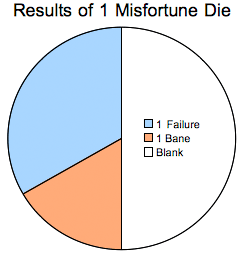
These pie charts show us the distribution of failure symbols and banes on a single die of either type:


On those pie charts (and the ones below), blue represents failure symbols (the little crossed swords that cancel out successes / hammers), and orange represents banes (the little skulls that cancel out boons / eagles and thus cause negative side-effects). The white region is the blank sides, and the black region is the dreaded Chaos Star (which sometimes counts as just another bane, but often presents much nastier side effects of its own). To generate the charts, I just entered in the percentages of each possible outcome into a spreadsheet, and had Open Office generate charts for me. The larger the area, the greater the percentage of rolls it will come up on. A quarter of the circle corresponds to 1/4 of all rolls, etc. As an extra note, the darker I colored the area, the stronger the effect (i.e.: Medium blue is 2 failures, but light blue is just 1 failure).

It's obvious that one challenge die is much worse than 1 misfortune die, but just how much worse is a little harder to figure out. Is it worth 2 misfortune dice? 3 misfortune? Let's look at a few more charts to figure that out. Here's the challenge die pie chart again, but this time we'll set it next to a chart that shows the combined results of 2 misfortune dice:


With charts like this, comparing the dice becomes a relatively simple matter of eye-balling it. I kept the colors the same, but added in purple to represent mixed results of both failures and banes. If you want to know what percentage of the rolls will result in one or more failure symbols, look at the blue and purple blocks. If you want to know what percentage generates bane symbols, look at the purple, orange, and black blocks.

In this case, the blue section of the challenge die chart is smaller than the blue and purple section of the two misfortune dice chart, so we know that you'll be more likely to get at least one failure symbol on the misfortune dice. However, the challenge die generates more banes (and chaos stars) as evidenced by the size of the orange and black sections of that chart being bigger than the orange and purple section of the 2 misfortune chart. Exactly which is worse, 1 Challenge Die or 2 Misfortune Dice, largely depends on the situation. In some Location cards, and for some Action cards, a Chaos Star can be devastating. In those cases, the Challenge die is worse. In all other situations, they're about equal.

(For those who are oriented towards numbers instead of visuals, the challenge die has a 37.5% chance of generating at least one bane. Two misfortune dice rolled together have only a 30.56% chance of generating at least one bane. Failure odds on the dice are 50% for a challenge die, and 55.56% on the pair of misfortune dice.)


The equality of 1 Challenge die and 2 Misfortune was a big shock to me. There's numerous points in the rules (and cards) of the game that imply 1 Challenge is the next step after 2 misfortune. That would suggest it's worth either 2.5 or even 3 misfortune dice, but it's not.

The best example of this implication is the Advanced Defense cards. They all turn your existing Parry or Dodge from 2 misfortune dice into 1 challenge die, and provide some other minor benefit almost as an afterthought. It turns out the minor benefit is actually the lion's share of the bonus provided by upgrading to an Advanced Defense card. Don't take Advanced Parry because you want your parries to do a better job of protecting you from enemy attacks, as the growth in that area is minimal. Instead, if you take Advance Parry, it should be because it will sometimes make one of your attack cards recharge faster. That's the only real benefit over the normal Parry.

The chart to the left illustrates my point about the Improved Parry. This graph takes a typical attack roll (4 Characteristics Dice, 1 Expertise Die, and 1 Fortune Die) and charts the odds of scoring 0, 1+, 2+, or 3+ successes. The different colored lines correspond to various levels of defense.

In particular, pay attention to the brown and yellow lines, which overlap significantly. The yellow line is vs 1 challenge and 2 misfortune, essentially an attack against a target in leather armor who uses Parry and has Weapon Skill Trained. The brown line is vs 2 challenge, essentially an attack against a target in leather armor who uses Improved Parry (and thus also has Weapon Skill Trained, since it's one of the prerequisites). The target with Improved Parry will be hit 70.37% of the time, and the target with the normal Parry will be hit 72.78% of the time.

A similar relationship exists between the light-green and light-blue lines on that chart. They're against a target with 1 point of Defense, so he's got slightly better armor. Again, having an "improved" active defense only shaves a tiny bit off the odds of being hit (down from 65.42% to 63.25%), and the two lines are practically on top of each other. The challenge die is just a hair's breadth more potent than 2 misfortune dice. Adding one more misfortune die has a lot more impact than converting two misfortune into a challenge (about 7% improvement, instead of about 2.5%, in the specific dice pools shown on the chart).


For the sake of completeness, I'll provide one more pie chart, this time a picture of the results of rolling 3 misfortune dice. I'll again set it side-by-side with the familiar 1 challenge die graph for comparison:


Interestingly enough, three misfortune dice have exactly the same odds of all coming up blank as does a single challenge die. That, coupled with the challenge die's strong chance of rolling 2 failures, were both factors in my over-estimating the power of a challenge die when I first started playing with the game.

Another non-obvious "advantage" to the 3 misfortune dice comes in the form of "mixed" or "overlapping" results, represented by the purple regions of the above pie charts. Rolls that fail because of a challenge die are likely to have a "silver lining" in that they'll score boons, but rolls against a handful of misfortune dice are likely to negatively impact both your successes and your boons.

Friday, May 7, 2010

Filling up the tablespace

Last night I GM'd Warhammer 3rd for 6 players, 5 of whom had never even looked at the game before. It wasn't without its bumps, but overall I was pleased with the way it went.

6 PCs, with all their cards and sheets really eats up some table space. A friend showed up half way through the night, and we really couldn't free a place for him to sit at the table. Even before his arrival, I had to move my GM screen to a nearby empty chair, and I kept track of A/C/E pools in my head instead of with tokens because there wasn't room for them on the table. Likewise, I couldn't use a progress tracker for the beastman's morale like I wanted to, because most of the puzzle pieces ("event" markers in particular) were being used by players, and there wasn't much space to lay anything out.

We didn't get very far narratively, a tiny bit of role-playing followed by one encounter, and then another scant round of role-playing and wrap up after that. That was mostly about time constraints, though. Two of the 6 players had card problems and arrived late. Laying out the character sheets and explaining the rules ate up a big chunk of time after that. So, the actually adventure was only from about 7:45 to 10:00 pm. So while we didn't get far, the truth is that you really can't expect to get a lot done in 2 hours and 15 minutes with 6 players who are learning the new system. Second round of combat went around the table in about half the time of the first round, so it felt like we were getting over the learning curve pretty quickly. I think with a little more familiarity with system and characters, I think it'll run pretty well.

A few observations:
  • The system is pretty bloody, a direct result of the high success rate on attacks. Our fight lasted less than 3 complete rounds. This is a system where one mistake puts you in grave. None of the PCs went down, but most were within one more hit of being down, despite some great support and defensive actions being used at the right time. All 6 of the monsters went down, including the three who tried to escape.
  • Speaking of high success rates, if my count is correct (and I could be off because I tallied after the game instead of during), we had 27 die rolls during the night, and only 6 of them failed to generate net successes. 78% success rate is pretty heroic for fresh starting characters.
  • The abstract movement really shined. One of the PCs started the fight by launching an arrow while the others approached. If we were playing a game with a more rigid movement and range systems, his bit of showboating probably would have resulted in 2 or 3 rounds of just him firing arrows while everyone else closed ranks. Instead, everyone that wanted to was swinging swords in the very first round.
  • The ratcatcher's SBVD (Small But Vicious Dog) is a total bad-ass. Peter sent the dog in after the main bad guy, and got a good roll that essentially pinned the Wargor (beastman leader) in place for the whole fight. They peppered him with arrows, and then the troll-slayer ran in to finish him off. But that little dog was what kept him from using his best moves. So, while I honestly think the fight would have been a little more exciting if they didn't pull that off, I can't fault the players for identifying their character's strengths and using them to the fullest. They did exactly what they were supposed to.
  • The fortune refresh mechanic feels really different with a large group. When there's fewer PCs, you get your points back faster, so you're more motivated to spend them. Plus, the points accumulate based on clever actions and role-playing flourishes. But with a large group turns get long enough, you're less inclined to put those flourishes into your actions. Double-whammy. I suspect it probably works best with 3 or 4 PCs.
  • I love the flexible nature of the white and black dice. Being able to throw reward and penalty dice onto actions so freely was sweet. The big nasty Beastman leader had a special battle cry action, and I narrated that it was so loud and nasty, it shattered limbs off of trees. It was total fluff, just trying to put some color into the action. Then I realized I could penalize all actions for a full round with a black die because of branches and pinecones falling on people. That was kinda fun.
All in all a good night, even if it was a little rushed and light on plot.

Monday, April 26, 2010

Actions Wanted

Brainstorming a short list of action cards that I think Warhammer 3rd could really use. Most of these would be actions you can buy with XP, not new basic actions.
  • Hold Them At Bay - a card that makes it tricky for people to engage you, or get past you. This sort of thing can be done with existing Location rules, but it's a little fuzzy, and someone who rushes you will always get to attack first. This could be an on-going effect that causes fatigue or penalty dice to anyone trying to get close to you while it's recharging. Since Fatigue=Wounds for most NPCs, that would work pretty well, I think.
  • Set To Receive Charge - a card that does bonus damage if it's your first attack since the opponent engaged you. (Alternately, this might actual be some sort of interrupt / pre-empt type action, but the game doesn't do much of that. Fake Out is the only such card I can think of.)
  • Feint - Strikes me as odd that they made Parry, Dodge, and Block into action cards, but didn't include the other assumed part of melee combat: the Feint. This would probably be a card to let you boost other attacks later. The trade-off would have to be pretty good, since you'd be losing an attack in one round to boost the later attack. Or maybe it could work like an active defense that gives bonus dice instead of penalty dice, but doesn't use your action?
  • Double Parry - The one extra black die given by a Main Gauche seems a little under-powered. Perhaps that's for the best since it doesn't require any skill or investment to get it. There's certainly room for a better (or more frequent) two-weapon parry.
  • Trample - An attack card that uses your Riding skill, with damage based on your mount. There's attacks that use Observation, Skullduggery, and even Leadership, so why not Riding?
  • Trick Riding - Currently, any sort of Trick Riding would be done with the Perform A Stunt card. I feel that it's an oversight to not have any cards in the whole game that make you roll Riding. You can be generically "good" at riding, but not have any specific tricks that give a real benefit or showcase your talents, which is pretty odd given how many other cards there are that give tricks and special moves for various skills.
  • Something good for Roadwardens - This probably overlaps with the last two, since riding is one of their skills. There's just nothing special for Roadwardens at the moment. They have an odd combo of attributes and skills that just don't apply collectively to very many action cards. If there was an Intelligence + Weaponskill card, it'd be great for them, but no such thing exists.
  • Boating Tricks - The Boatman Career has the special power of reducing a black die of penalties suffered for being on a boat. Which really only matters if you can talk the rest of the PCs into getting onto a boat with you. If you want to make the boatman stand out a bit more, you could easily add some sort of Master of the Tops or similar swashbuckling actions. Crazy flamboyant actions along the lines of the Roger's pirate swordsman school from 7th Sea.
The game already has a lot of actions, so the demand for actions in general is perhaps not great. At least not unless someone wants to make a particular character type. Coachmen and Boatmen, for example, don't have much to make them special, so the riding and boating tricks could be really useful if someone in your group drew one of those for their starting career. I could easily see how a Watchman or Soldier character might want the ability to hold a spot of ground.

Wednesday, April 7, 2010

A Tale Of Two Forums

"A couple years ago, White Wolf released this RPG called Scion. I started a campaign the first chance I got.

At first, I loved it, but I was really bummed how long it took them to release new material for it. Six months out, all they had was one rulebook, and a super-short demo adventure. Their release schedule kept falling apart, and it was frustrating, too, because that first book was at best 1/3rd of the setting and rules. PCs in Scion have a primary stat called that can be rated from 2 to 12, and the first book only covered characters with a rating of 2 to 4. It took them nearly a year to get the second and third books out, IIRC.

Anyhow, I was running the game for that whole time, and a good while later. There were things I loved about it, but the more I analyzed the game, the more it fell apart. I eventually came to the conclusion that the core mechanics were broken, and that later books just compounded those problems. Of course, I was emotionally invested in the game by then, so when I thought about these things, I got fired up.

I spent a lot of time at the Scion forums, posting various house-rules and what have you. What I noticed though, was that I spent less and less time coming up with cool new things to improve my gaming experience (and those of others I interacted with on the forums) and more and more time just venting about the rules and the company. There were things they were doing wrong with Scion, and I just had to let everyone know.

Every topic that came up on the forum, I figured out some way to bring it back around to the things that pissed me off about the game and the direction it was going. I got quite cynical. I knew that I was no longer being helpful to others, and that I was probably just coming off as troll. There they were, trying to post all their cool ideas about a game they loved, and I'd just come along and rain on everyone's parade.

Then, just over a year ago, White Wolf rebooted their forum software. Everyone that wanted to post on the new version of the forum had to build their account all over again. Knowing, as I did, that I had long before ceased to gain enjoyment or serve a useful function at that forum, I declined to make a new account. I just walked away.

Ever since that, I've felt better. Other facets of my life improved, because I was no longer voluntarily subjecting myself and others to my own negativity."


I typed that up at the FFG WFRP forums today, and have not yet decided whether or not to post it. The WFRP 3rd Edition forum has several rather obnoxious posters, who just troll the place, taking every opportunity they can to bitch about the new edition. Half the time they're screaming about how angry they are because the game has only had three releases in 6 months, whereas 2nd Ed has years of sourcebooks. The rest of the time they bitch about how "it's a board game, not an RPG" because it uses colorful cards. Edition wars are part and parcel of the gaming experience, but this is pretty extreme.

And I'm left wondering why the hell do these people think we care? I wish they would just move on, and not linger around a forum that is intended for the enjoyment of a product they don't like. I mean, it's not like there isn't already a really good forum for 2nd Ed WFRP, and for people who just want to rant about how much they hate 3rd Ed. It's called Strike To Stun. And yet, even when they're getting me all fired up by trolling at the only good 3rd Ed forum, I can understand where they're coming from, because my own Scion experience was so like what they are doing.

Eventually, you just need to break the cycle.

I'm glad I finally found the strength to move on and leave Scion behind. I hope they find the strength to do the same for Warhammer's forums. If you hang out at places where people like the same things as you, you'll enjoy your life a lot more, and feel much better about yourself. If you insist on trolling places where other people enjoy things you hate, you can only make everyone (yourself included) feel worse. That's my 2 cents, anyway.

7 Feats? For a starting character?

This is just a little rant about game mechanics. It's really not helpful in any way, and not particularly entertaining. If you're looking for usable content, scroll down to my next post.

If you just want to hear me whine a little bit, this is the place.

When I did my initial review of the Warhammer 3rd Ed, one of the things I didn't like about the game was the analysis paralysis that sets in during character creation. Between the main game and the player's toolkit there's over 100 action cards, and they're not easy to analyze. You could spend all day reading over the action cards, and still not know what's best for your character. As it turns out, it's actually a little worse than that. On top of the 100 action cards, there are more than 70 talent cards.

Turns out the analysis paralysis isn't only likely to show up at character creation. I'm really glad they put everything on cards, or this game would be a nightmare. Instead, the cards make it run smoothly.

I was thinking about it today, though, and I realized just how insanely buff starting PCs are. Talents and Actions are both very much like Feats in D&D, or Edges in Savage Worlds. It's relatively easy for a starting character to begin the game with 3 Talents and 4 Action cards, that would use 6 of your 20 to 25 character points.

Imagine a 1st-level D&D 3.x character that starts with 7 Feats. Or a starting Savage Worlds character somehow loaded up with 7 Edges. That seems pretty busted, right? Surprisingly, WFRP has fewer combos, so I think it's probably less unbalancing than giving someone 6 extra feats or edges would be in either of those games. Still, it was kind of a shock when I sat down to analyze it.

So I broke out my rarely-used D&D 4.0 PHB to compare. There a PC starts with 1 Feat, 2 at-will attack powers, 1 encounter attack power, and 1 daily attack power. This is roughly the equivalent of 1 Talent and 4 Actions in WFRP's terms, as near as I can eyeball it. So, you're only a little bit stronger / more diverse in WFRP than in 4.0 D&D, and that only if you choose to spend 6 of your 20 points on talents and actions. You could just as easily build a valid WFRP character with 0 talents and 1 only special action. Unless, of course, we factor in the 8 "basic actions" that all PCs start with. You just have a lot of options in WFRP.

Why on earth do they give starting PCs so many options? It's a design choice I'll never understand. If I'd written the rulebook, all PCs would start with exactly 2 talents and 1 special action. Instead they start with 0-3 and 1-4, and I don't feel like the game gains anything for having all this extra options at character creation. Later on, when you know the system better and are advancing your characters, it's probably justified, but right out of the gates, it's overwhelming. Remember the law of 7 +/- 2? It would seem the FFG crew have either never heard of it, or at least interpret it very differently. I guess they thought it should mean "don't start with more than 7 Feats"...

It's especially weird for a game whose previous editions are noted for the meager power levels of starting characters. I guess they wanted to distinguish this edition from that which came before, but it seems an inelegant way to do so. WFRP 1st & 2nd are the game where a single goblin armed with a wooden spoon is a danger capable of a TPK, though, so maybe I shouldn't complain. There was certainly room to build up the heroism a few notches, and 3rd Ed did so rather nicely, even if it did so at the cost of making character creation painful.

I'm planning on running WFRP for my weekly one-shot group sometime soon. When I do, it'll be with pregens, and for most of the characters, I'll be going with 1 or 2 talents, and only 1 or 2 actions. I might even trim the default character points down from 20 to somewhere in the low teens. I see no need to complicate things to the fullest extent possible.

Gripe session over. We now return you to (hopefully) more useful content...

Tuesday, April 6, 2010

The Race Card

In Warhammer FRP 3rd Ed, nearly all your actions and abilities are on cool little cards. This means you don't have to look up anything in a rulebook during the game, because you've got all your feats, powers, and special moves right there in front of you.

I don't have a clue why they didn't do the same with racial abilities. Every race has a couple special rules and abilities, and they're literally the only character powers that aren't always at your fingertips. As my wife and I have been testing out various mechanics and getting a handle on the combat system, we find we're constantly forgetting about racial abilities. So, I broke out Strange Eons and fixed this glaring oversight.


The above file has enough cards for 4 humans, 2 High Elves, a Wood Elf and a Dwarf, because that's what would fit on a page easily, (with plenty of room for sloppy cutters with those oversized round-tipped kindergarten scissors).

It only lists powers that you use at the table during sessions, so things you do once at character creation (and then ignore forever after) aren't on the sheet, and neither is the once-every-11 sessions XP benefit that humans get.

Bodyguard and Charcoal-Burner

Here's two "new" careers for Warhammer FRP 3rd. They're loose conversions of existing careers from 2nd Ed. A more faithful rendering of the Bodyguard would have had Strength instead of Agility, but then both careers would have had the same Primary Characteristics, and I didn't want that. The result was that the Bodyguard had a slightly less potent set of skills than it might have otherwise had, which encouraged me to give it a better-than-average Career Ability to compensate.


The artwork is original. I bought a Wacom "bamboo" tablet yesterday, and these are two of my first three pieces of art from it. Honestly, it shows on the Charcoal-Burner. I was having such a hard time getting the hang of the tablet, that I really goofed up his body proportions. Which frustrated me so much I never finished his face. Maybe I'll redo the art on him at some future point... but don't hold your breath. I've got nearly a dozen additional career cards finished except for artwork, so I doubt I'll get around to fixing older artwork any time soon.

The card backgrounds are from Hurlanc and Vendolis' WFRP plug-in for Strange Eons. I highly recommend it to anyone interested in WFRP, as it enables you to build your own custom components for the game with a minimum of effort. (Going crazy with a wacom tablet is completely optional.)

Currently, for reasons unknown to me, the Strange Eons program only deals with the front side of career cards. So the back, with all the flavor text and trappings info, is missing. That's part of why I'm converting careers instead of making entirely new ones. Instead of having to type up a bunch of background text and lay it out in quark or office, I can just say "please reference the 2nd Ed main book".

Saturday, March 27, 2010

Running away with WFRP 3rd

In the FFG forums devoted to the 3rd Ed of Warhammer Fantasy RPG, people keep posting various house rules and special action cards for Running. They vary a bit in execution, but the goal is to allow player characters to move much faster, with no fatigue penalties, if you're doing nothing but move.

I've been managing to stay polite thus far, but it's not easy. I feel this whole notion is horribly misplaced, because WFRP 3rd already has the most generous running rules in gaming history, it just didn't specifically label them as "running", so people are too dense to figure it out. That's a little harsh, but pretty much spot-on.


How running works in WFRP 3rd:
The game allows you 1 action per round, plus 1 free "manoeuvre" per round, plus as many additional manoeuvres as you'd like at a cost of 1 fatigue each. Your attributes range from 1 to 6 (2 to 5 for starting characters), and you never want more fatigue than your lowest-rated physical attribute. So, most PCs don't want to take more than about 3 fatigue.

Instead of measuring things in feet, the game uses abstract range categories. If someone is within "Close" range, you can pay 1 manoeuvre to engage them in melee. If they're at "Medium" range, you can pay 1 manoeuvre to move to "Close" range from them. If they're at "Long" you can pay 2 manoeuvres to move to medium, then 1 more to move to close (and 1 more to engage them). The furthest possible range is Extreme, which takes 3 manoeuvres to reduce to Long. So, you could for 7 manoeuvres, run from Extreme to Long to Medium to Close, and then engage someone in melee combat. Doing this in a single round, you'd suffer 6 fatigue. If you wanted zero fatigue, it would take you 7 rounds, which is just too much for some folks, and thus the various house rules keep getting thrown around. I think they are being unreasonable.

Compared to WFRP 2nd Ed: To illustrate my point, let's explore how this system compares to it's previous incarnation. (My 2nd Ed is really rusty, so if anyone spots any mistakes, let me know).

In 2nd Ed, most humans have a Movement statistic of 4. This allows them to move 8 yards per combat round normally, or up to 24 yards in an all-out run where they're doing nothing else. Within that system, bows and firearms have a range of 48. So if you were attacked by someone with a bow at long range for their weapon, it would take two full rounds of just running to get within melee range. If you were taking a more cautious approach (not running or charging) it would take 6 rounds to reach them.

Now compare that to 3rd Ed WFRP, where the equivalent weapons (the shortbow and handgun) have range "Medium". Moving at a full run, you can get there in a single round, for 1 fatigue, and you still get to attack. (You spend your free manoeuvre to move from Medium to Close, and then pay a fatigue to engage them.) If you take a more cautious approach (no fatigue), you get there in just two rounds. So, characters in 3rd Ed are, by default, moving much faster than characters in previous editions.

Compared to D&D: Running the numbers, we'll again see that WFRP characters are by default moving really fast. In 3.5 D&D (likewise, my 3.5 is kinda rusty, so correct me if I'm wrong), a shortbow has a range increment of 60 feet, and it's maximum range is 600 feet. You won't often take shots at that kind of range because your odds of hitting at 10 increments are pretty dreadful, but a reasonably competent archer is likely to be willing to take shots out to four range increments, aka 240 feet. An unarmored human PC can walk 30 feet per round, or run 120 feet per round. So again, to travel from the likely archery range to melee range takes 2 rounds of full-out run, or more than 6 rounds of more reasonable exertion. And if you were taking fire from some hotshot archer who wanted to hope for natural twenties at the full 10-increment range of their shortbow, it would take you 5 rounds of full running to reach them.


What I conclude from all those comparisons is:

  • a) WFRP 3rd Ed assumes your basic movement in combat is a hearty jog, not a calm walk.
  • b) If you're taking one or more fatigue from movement maneouvres in WFRP, it represents a full-on run.
  • c) WFRP 3rd, as written, is much kinder on the melee-only character than either 2nd Ed or D&D, at least in terms of them trying to get into range while taking fire.

So, given those conclusions, I see no need or reason to allow any better movement than the default manoeuvre rules in WFRP.


Taking it to Extremes: Just to make sure those conclusions hold up, I also ran the results on a longer-range weapon.

In WFRP 3rd Ed, a Hochland Long Rifle or a Longbow can hit to Extreme. It takes 7 manoeuvres to reach that distance. You can cover the whole distance in a single turn if 6 fatigue isn't enough to knock you out. Or you can cover the distance over 7 turns at a slow pace without fatigue.

In WFRP 2nd Ed, a Hochland Long Rifle has a range of 96. A typical Move 4 human can cover that ground in 4 turns of all-out full running. If they try this without running, it'll take them 12 turns to get there.

In 3.5 D&D, a composite longbow has a range increment of 110 feet, so from the point where they start having a better than 5% chance of hitting to when you reach melee is about 3 or 4 turns of all-out running. At a non-run pace you're looking at about 14 rounds of walking.

So, in terms of getting somewhere in a hurry, WFRP 3rd is being very generous to the guy who rushes into melee. He moves 3 or 4 times as fast as his equivalents in other games if he's willing to take a modest amount of fatigue. You may be able to shrug off all or some of the fatigue with the right Talents or Career Ability, and even if you don't, you still get an action on the turn(s) you run, unlike the other systems. If he's fatigue-averse and insists on "walking", he'll get to sword-swinging range in half the time that D&D allows.

If my players complain about there being no running option, I'm going to politely tell them that spending fatigue for extra manoeuvres is the running option, and that it's far more generous running rules than any non-supers game I know.

I suppose I could see room for some sort of enhanced move Action being added to the game, as in one you pay an Advancement to purchase. You'd have to be careful not to make it too good, though, or else it would become an automatic upgrade for all melee characters. As it is, various Talents and Career Abilities within the game make it very easy to build a character that can cover Extreme to Close range in 2 or 3 rounds without taking more than 2 fatigue, so I don't think there's much need for extra specialization options in running.


Portions of the above appeared in a slightly different form on the FFG forums, posted by me.


Friday, March 19, 2010

Core Clues ported to WFRP

GUMSHOE has a concept called "Core Clues", clues that are so vital to the plot that you literally can't miss them. Whatever else you think of GUMSHOE, there is something very nice about knowing that a fluke bad die roll can't derail the plot and make the players spin their wheels for hours without a lead.

Let's face it, even when players get all the clues without the dice ever hosing them, there's still a good chance they'll misinterpret those clues, chase a red herring or accuse the wrong NPC, argue with the other players, or decide "my character wouldn't try to solve this mystery or pursue that clue". We've all seen situations where some player gets a wild idea and runs off tilting a windmills. What the GM thinks is crystal clear, turns out to be opaque to the players, and now he has to improvise some windmill stats. :)

Today, at the FFG forums, someone was asking about search checks in WFRP 3rd Ed. They were converting a 2nd Ed adventure, that relied on a lot of "A difficult search roll will reveal..." statements. I started typing up a reply about how it all depends on the nature of the clue. That if it's vital to advance the plot and make sure the players have fun, you should just give it to them automatically, but if it's a roll to find some treasure that's not a needed McGuffin, then dice are appropriate.

As I was typing that reply, though, I realized that the mechanics of WFRP are actually perfect for the whole "core clue" concept. You could make all (or the most vital) clue-gathering rolls succeed automatically, not even need a single success to get the info. Then, you just come up with some fun benefits for Boons, Sigmar's Comet or the "triple hammer line", and some nasty disadvantages for the Banes and Chaos Stars.


Here's an example of how it might play out:

The PCs are searching a nobleman's personal library, trying to see if there's any damning evidence of his guilt in some previous crime. The GM has decided that yes, there's some personal correspondence with his co-conspirator tucked behind some books. Without this bit of info, the players are unlikely to call out the nobleman, and will probably never connect the dots to the co-conspirator. Instead the game would bog down as they argue amongst themselves about whether or not he's guilty.

So the GM decides that any search roll will find the main clue, that being the letters behind the book on the shelf. However, a roll of Observation + Int is still called for, with the following possible effects based on the other symbols rolled:
  • Boon: You also find a loaded pistol resting out-of-sight and above your head on top of the same shelving unit. Taking it would be theft, but it would also prevent the sinister nobleman from using it against you later.
  • Bane: The household servants overhear your search, or notice that you've moved things around. This raises their suspicions of you. Any social rolls vs the staff or residents of the manor are now penalized by 1 misfortune die.
  • Chaos Star: The nobleman himself comes home early and walks right in on you. Everyone in the scene takes a point of Stress. He knows you're on to him. Since you've been ransacking his office, he'd be in his rights to grab the pistol from above the shelf and arrest or shoot you. It'd be foolish and dangerous, but within his rights as a nobleman, so depending on how many PCs are present, he just might do it.

Tuesday, March 16, 2010

Strange Eons and WFRP

The new edition of Warhammer Fantasy Role-Play has all sorts of beautiful components, which can make it a little daunting for the GM who intends to house rule a few things, or make up other new content. You don't want your personal creations to look dreadful and amateurish next to the official products.


Luckily, there's this program called Strange Eons. It was originally designed by the Arkham Horror community to make home-brewed full-color expansions for that game.

Some WFRP fans have made a plug-in for Strange Eons that allows you to make WFRP cards with the software, and I was impressed by their initial release. They were still in need of card backgrounds, so I decided to help generate some background art for the card types they hadn't made yet.

To the right you'll see my take on a card frame for Item cards.

Below that is my first stab at a card frame for Location cards.


Neither is nearly as ornate and detailed as the official cards, but they're not bad too shabby, either. They'll look much better once text and the other image files have been layered into them.

The Pit-Fighting Scribe

A couple weeks ago I got WFRP 3rd as a present. It has happily sucked up most of my free time of late. I've done a lot of reading and analysis, and my wife and I have run several test battles (and a test chase scene and a test social encounter), so I'm feeling I've got a pretty good notion of how the game works.

At this point, I'm in love with the way the game plays. Combat is fluid, the mechanics are easy to grok, and everything at the table just flows smoothly. The GM's job during the game is super easy. Prepping for adventures is surprisingly easy, as well, as the Game Master has a lot of tools, tricks, and shortcuts provided for them that allows you to prep with a minimum of fuss. All the fiddly bits that kept me from ever running WFRP 1st or 2nd Ed are gone, and have been replaced with a system that's just a dream to run and play.

The one area where I'm not pleased, however, is character creation and advancement. While they did a great job of fixing all the during-play fiddliness and book-keeping of the old edition, in the process they seriously watered down one of the things that made the old editions so cool. I never ran it, because it was too complicated, but I always admired the integrated tiers of character classes (there's about 100 of them in the main book for 2nd Ed) and the way they resulted in characters who were realistic and packed with history. But like I said, 3rd Ed sort of watered that down.

Watered down, both in that it has less flavor, but also watered down in that it's all so soggy now you're trapped in a marsh of possibilities. Once I really turned a sharp eye on the 40 existing character careers in 3rd ed, I realized they weren't very coherent. There's a lot of orphaned careers, with no obvious decisions when you level up to a new class. On the plus side, there's not much restricting you, which is nice. But on the negative side, there's no guidance, and it's a point weasel's paradise full of hidden options.

If your group is mostly casual gamers, but with one or two kinda munchkiny min-maxers, I think it'll be problematic. The casual gamers will get mired or lost, and the munchkins will figure out how to break something (starting with Rapid Strike). Even if you're blessed with only good players (as I usually am), the lack of organizational charts will make the advancement process take far longer than it rightly should. I'm thankful that the ugly complicated bits are all shoved off for end-of-the-night advancement, and never rear their heads during a tense in-character scene. But at the same time, I'm scratching my head and wondering why these problems exist at all, when the previous edition was so good at providing the players with a workable balance of guidance and options.

One of my earlier paragraphs mentioned in passing that the flavor had been drained out of the advancement system, but I never really presented evidence to support it. I'll take a stab at it now. In 1st & 2nd Ed, your character leveled up from one flavorful career to the next, so you might go from Student to Apothecary to Barber-Surgeon to Physician to Guild Master, with an immediately understandable progression.
In 3rd Ed, the careers are still flavorful, but the progression from one to the next has been rendered free-form. At first I thought that was cool, because you were never pigeon-holed, and a radically different career might just cost 1 or 2 more XP. Then it was pointed out to me that the Keywords that dictate the XP costs leave a lot to be desired. The worst offender is the "Specialist" Keyword, which appears on a completely random assortment of careers, making it such that being a Hunter or a Pit Fighter gives you an XP break on later becoming a Scribe or a Barber-Surgeon. Between those keywords and the way Talent cards are slotted, the most logical or sensible choice for a new Career is are rarely the most mechanically rewarding next career, and vice-versa. This is a big disappointment for me.

Sadly, the solution to these two branches of the same problem are contradictory. That is to say, the most obvious way to fix the flavor problem is to throw out the keywords and implement a career flow-chart much like what the previous edition had. But since the existing careers are so unconnected, to make a sensible flowchart you'd have to add a lot of additional careers. Which seems a little counter-productive if the other biggest problem is that there's too many things for players to sort through and consider when they're leveling up. Throwing another 20 or 30 careers into the mix will compound that issue rather significantly. And yet, I expect that's exactly what I'll do. So sad...

Tuesday, March 2, 2010

The Hundred-Dollar RPG

In this post, I present a fairly detailed review of what I do and don't like about the 3rd Edition of Warhammer Fantasy Role-Play.

You may or may not have seen the latest edition of Warhammer Fantasy Role-Play, the version that comes in a big box full of custom dice and full-color cards, with a $99.95 price tag on it. I've wanted that game ever since it released last fall, and just couldn't justify it. Luckily, my birthday is this week, and my wife is the most amazing woman on the planet.
A quick aside about that $100 price tag: That number nearly scared me off, which is kinda weird. I mean, I'm more than willing to spend more than twice that over time for any RPG I really like. The dollar value of D&D books, or 7th Sea books, or d6 Star Wars books, or Cyberpunk books on my shelf is way more than $100 for any of those. Just to run 4th Ed D&D you need three $40 books, so that's more than WFRP. Looking at it from that perspective, I don't know why I held off for so long.
Now that I've had a few days to look it over and play a sample combat, I feel like I can at least share my initial impressions of the game. There's a lot to love about this edition of WFRP. Let me fill you in on the things I like best...
  • The Dice: Okay, I'm a sucker for dice, and WFRP has 36+ of them, with all sorts of crazy little pictures on them instead of numbers. So, right out of the box, I was smiling. Reading the books and running a sample combat, I was happy to learn that the mechanics and the dice really work together to make a fast-playing fun-filled system.
  • Minimal Math: One of the cooler features of those dice is that there's almost no math during the game. You could, with a really awesome attack roll, maybe have to be able to count up to 110 or 12, but that's gonna happen very rarely, and when it does you're guaranteed to have killed your enemy. For the vast majority of rolls, you only have to be able to count to about 2 or 3.
    (In WFRP you'll never hear: "I rolled a... lets see... 6 + 6 + 5 + 3 + 2 + 2... +4... +1 more for higher ground... 29! Is that a hit? Nope, nope, I needed a 30!"")
    Actions are resolved quickly, and without being torn away from your mental image of the action.
  • Succeed but with side-effects, Fail but with a silver lining: That is to say, those funny little dice are designed to allow for benefits and drawbacks to happen in addition to your overall success or failure, so actions are no longer simply binary. Quirky little developments that happen in novels and movies can finally appear in games.
  • No damage roll: I've always hated that every single combat action gets two rolls, but saving the day with science or chutpah is usually just one single roll. I'm always on the lookout for games that either streamline combat, or expand out non-combat actions to get the same love and attention. In WFRP, damage is contained organically within the attack roll, and the same system is used for talking, tinkering, running, etc.
  • Simple situational modifiers: You're on high ground? Have a fortune die. You're rescuing your true love? Have another white die. It's raining cats and dogs, add a black die. All three are happening at once, add two white dice and one misfortune die. Fast, simple, on-the-fly. I love it.
  • Abstract combat positioning: This came as a big, beautiful surprise to me. Previous editions of WFRP have always been fairly miniatures-reliant. Now, I like my minis, but they usually come with a fair amount of baggage about character positioning, movement rules, attacks of opportunity, etc. So I was pleasantly surprised that the game uses very abstract positioning rules, with the assumption that a melee is "like a rugby scrum" with everyone in constant movement. If you're part of the melee, you're engaged with everyone. If you _need_ to get somewhere, you just do, but it costs you a few fatigue points. This is a completely different paradigm, and it feels fresh and innovative.
  • Cards for all your feats and spells: Beautiful, full-color cards, that put all your rules and tactical options at your fingertips. No more leafing through a 200-page rulebook to find the data on your special ability or obscure combat rule - it's on one of the dozen or so cards you've got next to your character sheet.
  • Reckless vs Conservative Stance: Before getting the game, I'd heard some grousing about "the little puzzle pieces that complicate battle". I'm pleased to say those complaints were unjustified, and most of them seem to be made by folks who haven't actually run a combat with them. Once explained, the system is simple and intuitive, and the stances provide a lot of flavor. Charging into battle full-tilt and headstrong plays very differently than opportunistically waiting for an opening. It accomplishes this without any obvious rules holes, and without breaking you out of the in-character scene. This is a very well-constructed mechanic.
  • Party Tension Meter: While not quite as awesome as the stance system or the fancy dice, this mechanic is very flavorful, and certainly unique. The concept of what your party is, and why it formed, gives you bonus abilities and a fine-tuned tension meter. If the party is at cross purposes, if the characters are squabbling, if the enemy tries bribing you, if the group's thug uses his "Fear Me!" power, the tension meter goes up. In short, you get rewards and benefits for selecting a theme that unifies the party, combined with a weakness the NPCs and situations can prey upon. I like it.
  • Unified Rewards: Experience and Fortune Points don't go to individuals, they go to the group as a whole. The problem with bennies or xp bonuses in most games is that if your gaming style and the GM's style don't match up 100%, you get shorted valuable resources. Meanwhile the person who really clicks with the GM gets the intangible benefit thereof, but also gets the lion's share of the out-of-character mechanical rewards. WFRP sidesteps that trap completely by giving bennies to everyone when one player does something good. No longer will you envy and harbor a grudge against the wittiest player at the table, or the guy who steals the spotlight, instead everyone gets to reap the rewards evenly.
  • Miscellaneous Tools: The game has figured out a clever way to get all the best aspects of crunchy systems like insanity rules, critical hit charts, fiddly combat options, fatigue, morale, etc, without requiring complicated rules and mid-game page-references. It's pretty darned amazing just how much they managed to retain amidst all the streamlining.
  • The Setting: This post is about the rules, mechanics, and components, but the reason you really play WFRP is because of the rich setting. It's not just generic fantasy, it's a grim, gritty world where the supernatural is really evil, the peasants are really smelly, the conspiracies are far-reaching and sinister, the orcs are football hooligans, and Monty Python quotes are not out of place for once.
Overall, I'm really thrilled with this game. In terms of character options, and how much it's got going on at once, it's every bit as crunchy as D&D or Savage Worlds. But if the sample combat my wife and I ran last night is any indication, the moment-by-moment math and resource tracking is so much simpler than most crunchy games, that it plays like something a good deal lighter. I'm very pleased.


But, of course, nothing's perfect. Here's the places where I think they dropped the ball...
  • You can't play the race card: The vast majority of your powers and stats come on these lovely full-color cards. The only exception is the racial abilities. The dwarven abilities such as ignoring penalty dice from darkness, and gaining bonus dice when fighting orcs, should be summarized on a card somewhere. They're not, and there's not even room on the character sheet to add them yourself.
  • No Weapon Cards: Like racial abilities, weapons have special abilities that don't appear on cards, and don't really have room to summarize on the character sheet.
    (I've got a bunch of item cards from Paizo's GameMastery line, which I'll slip into cardsleeves with rules summaries on little note-card scraps to take care of it, but it's a shame to have to go to that effort myself for a game that puts everything else at your fingertips)

  • No summary chart of Actions: It's awesome that all your actions and special abilities are on little cards, so you don't have to pass around a rulebook, but they should have been in the rulebook as well. What if you lose a card, or spill soda on it? What if you'd like to read up on higher-level powers between games? There's no easy solutions for either situation, and character creation (see below) is exasperated by it, too.
  • Hard to House-Rule: Since everything is on cards, and there's no good index or summary chart, house-ruling or customizing could be a pain in the butt. You want to be damn sure your new house-rule is a good one before you start inking it onto the relevant cards. Balancing new monsters or spells is a bit trickier than in a numbers-based system.
  • A weird approach to Niche Protection: I'm all for the idea that players shouldn't double-up on special abilities. You want your character to be unique, and to do something special no one else can do. Putting all the powers on cards does this, but game never clearly states whether or not two characters could "share" a card. The existence of multiples of the basic action implies you can't share. If they can, then there's no niche protection at all, which is a little sad. If they can't, then there's serious benefits to making your character first, spending your experience first, buying a particular card the moment you qualify for it, etc, which is equally sad.
    (Now, maybe I'm missing something, but it seems to me that there's nothing that stops a person playing a Student or Scribe from taking cards like "Troll-Feller Blow" or "Berzerker Rage". Nor does anything stop a two-bit Thug from taking "Honeyed Words" and "Winning Smile", which blurs the lines between character niches.

    The impact on a character introduced late in the campaign, when all the most interesting Action Cards have been bought by others, would be bizarrely limiting. "My randomly-generated character class is Elven Wardancer, but unfortunately, all the Ritual Dance cards were already taken by the group's Dockhand," seems guaranteed to result in hard feelings.)
  • Analysis Paralysis in Character Creation: The default rules assume a semi-random approach to character class. You shuffle up the deck, deal out three classes, and pick the one most interesting to you, instead of choosing from the 35 different starting character classes. Unfortunately, the rest of the options in character creation involve individually reading through 154 action cards, a couple dozen talent cards, etc. And then you spend your 20-25 character points on bonus dice, skills, wealth, and the aforementioned cards, with a completely open-ended point system and no solid advice for what's good to start off with. There's several thousand different viable starting builds, which is admittedly kinda cool, but it makes creating your first character very daunting.
  • Opacity in Card Evaluation: As mentioned in the first section of this post, I love that the game provides flavorful non-binary results, and that I don't have to do any math while playing. But boy does that make it tricky trying to figure out which card is best for my character, or for the current battle. The cards seem pretty well balanced so far, but there could easily be hidden brokenness that a munchkin might exploit, but a casual gamer would completely miss.


The phrase "diamond in the rough" springs to mind. The game has many beautiful polished facets, which shine brilliantly in the spotlight, but are sometimes going to be obscured by the shadows cast from the rough edges that surround them. Figuring out how much the genius of the game outweighs or is outweighed by the downsides will take some time. At first glance, though, it does seem apparent that the rough bits are at least outside of the action. While actually playing, the game is an elegant dream. All the downsides lurk in character creation and advancement, which can probably be house-ruled and simplified without impacting the way the game plays.

I'll have to haul this one with to my weekly one-shot group from time to time, but when I do so, I'll have pregenerated characters, with the relevant cards prepared and sorted. Teaching this character creation system to 4 or 5 people at once would take far more effort than is justified for a one-shot.