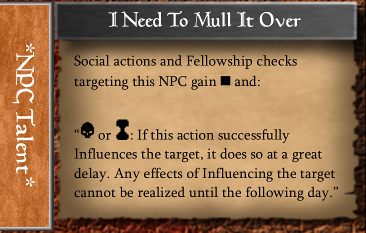
Here's more Talent cards intended for NPCs in Warhammer Fantasy Roleplay 3rd Edition. As with the Social Talents I posted the other day, it's my intent that you apply no more than 2 of these to any given NPC, in the same way that most PCs have only 2 Talent Slots. Nemeses, Organization, and Monster Group cards may provide additional Slots for special encounters, but don't go overboard or it'll just complicate your game.
I made these a long time ago, so I don't have a lot to say about them. Some are intended for ordinary human NPCs, but others would only make sense on monsters or at least followers of the Ruinous Powers. Some of them are just shorthand ways of simplifying the game (such as abstracting equipment details or entire bodyguards down into a single card), while others provide new powers that can't really be acquired in any other way. Some of them have seen extensive playtesting, but there's at least a few here that I never used. Feel free to print them out for your own Warhammer gaming, and please let me know if you find them useful.
Dangerous assumptions about how gaming relates to life. Also a place for r_b_bergstrom to keep an archive of things he flung out into the gaming fora and wikis of the world.
Sunday, April 5, 2015
Saturday, April 4, 2015
NPC Social Talents (Warhammer Cards I Forgot To Blog, Part 2)
Here's a big batch of Social Talent Cards for NPCs in Warhammer Fantasy 3rd Edition.
NPCs don't typically have Talent Slots in the game. Some of the Organization and Nemesis cards do, but I don't recommend restricting yourself (as GM) to only those frameworks. Adding one NPC Social Talent to any given NPC won't break anything, and will feel about on par with the Talent options that PCs have. NPCs that are meant to be a major social obstacle, such as jaded nobles, might have 2 or even 3 Social Talents, but this should be fairly rare just to keep it in line with the limitations players face re: Talents.
These cards are intended to "spice up" Social Encounters in Warhammer 3rd, helping to bring a little depth and variation to your social conflicts. Feel free to print these for your personal use, and please let me know if you find them helpful.
Several of those cards alter the difficulty of certain social skill rolls, such as the one that raises the difficulty of Charm and Guile while simultaneously lowering the difficulty of Leadership checks. The idea there is to mix things up a bit so the PCs can't just rely on a single skill for every situation. When I ran these, I tended to keep the cards hidden because as GM I like to be mysterious. In retrospect, though, it's probably better to point those cards out to the PCs early in the scene, to encourage them to swap tactics. Otherwise, you'll find the same high-Fellowship character attempting to power through using the same Skill again and again, and they'll completely miss your attempt at adding depth to the scene. My recommendation now is that you read the card out loud to the players the first time (in any scene) where the card is modifying a die roll. Preserving a sense of mystery is all well and good, but you need to give the players enough data for them to make meaningful decisions at least starting with the second attempt to influence any given NPC.
Some of the Talents are designed to slow down Social Encounters or discourage the PCs from ganging up en masse and overwhelming the NPCs by sheer volume of low-quality die rolls. Those are especially good cards to use if there's only one NPC in a scene, as otherwise the rules as written favor the brute-force approach to group Charm checks.
The cards above were made with the Strange Eons program. I've got a few dozen more (non-Social) NPC Talents sitting around on my hard drive, and hopefully I'll find time to post them soon.Of course, I said the same thing about these Social Talents way back in February, so who knows how long it will take me to get around to it.
NPCs don't typically have Talent Slots in the game. Some of the Organization and Nemesis cards do, but I don't recommend restricting yourself (as GM) to only those frameworks. Adding one NPC Social Talent to any given NPC won't break anything, and will feel about on par with the Talent options that PCs have. NPCs that are meant to be a major social obstacle, such as jaded nobles, might have 2 or even 3 Social Talents, but this should be fairly rare just to keep it in line with the limitations players face re: Talents.
These cards are intended to "spice up" Social Encounters in Warhammer 3rd, helping to bring a little depth and variation to your social conflicts. Feel free to print these for your personal use, and please let me know if you find them helpful.
Several of those cards alter the difficulty of certain social skill rolls, such as the one that raises the difficulty of Charm and Guile while simultaneously lowering the difficulty of Leadership checks. The idea there is to mix things up a bit so the PCs can't just rely on a single skill for every situation. When I ran these, I tended to keep the cards hidden because as GM I like to be mysterious. In retrospect, though, it's probably better to point those cards out to the PCs early in the scene, to encourage them to swap tactics. Otherwise, you'll find the same high-Fellowship character attempting to power through using the same Skill again and again, and they'll completely miss your attempt at adding depth to the scene. My recommendation now is that you read the card out loud to the players the first time (in any scene) where the card is modifying a die roll. Preserving a sense of mystery is all well and good, but you need to give the players enough data for them to make meaningful decisions at least starting with the second attempt to influence any given NPC.
Some of the Talents are designed to slow down Social Encounters or discourage the PCs from ganging up en masse and overwhelming the NPCs by sheer volume of low-quality die rolls. Those are especially good cards to use if there's only one NPC in a scene, as otherwise the rules as written favor the brute-force approach to group Charm checks.
The cards above were made with the Strange Eons program. I've got a few dozen more (non-Social) NPC Talents sitting around on my hard drive, and hopefully I'll find time to post them soon.
Friday, April 3, 2015
Highlights from Emerald City Comic Con
I went to the Emerald City Comic Con last weekend. My wife joined me on Friday, but due to illness she had to skip out on the other two days of the con (and three days of work after that). Cons are better when you've got a friend to gawk with, but I still had a lot of fun despite being on my own for the weekend.
I ran two sessions of Psi*Run for the Games On Demand / Story Game Seattle booth. The first was a little disjointed and didn't really come together until the third hour of play. That happens sometimes with the game, due to its highly improvisational nature. The second session found its footing immediately, and just took off. One of the players posted "playing my new favorite RPG, Psi*Run" to her Facebook page. So that's definitely a success. Both games were over-the-top crazy, but I suspect the first group might have enjoyed it a little more if I'd reigned in the zaniness a bit early on and given them a more coherent faction of Chasers.
While at the con, I made frequent visits to the Flying Frog Productions booth. The Frog continues to impress me with their customer service, friendliness, and with the immense fun their games provide. They told me a lot of what's coming up in future Brimstone expansions, which deserves a post of its own here sometime soon. Now that I'm not nursing my wife back to health, I should be able to find time to type that up.
Other purchases I made last weekend included:
EDIT: Oops, forgot to mention the expansion deck "Curse of the Werewolf" for Dark Gothic. It's a very small expansion, but solid. I had to build an entry for it on Board Game Geek it was so new.
I ran two sessions of Psi*Run for the Games On Demand / Story Game Seattle booth. The first was a little disjointed and didn't really come together until the third hour of play. That happens sometimes with the game, due to its highly improvisational nature. The second session found its footing immediately, and just took off. One of the players posted "playing my new favorite RPG, Psi*Run" to her Facebook page. So that's definitely a success. Both games were over-the-top crazy, but I suspect the first group might have enjoyed it a little more if I'd reigned in the zaniness a bit early on and given them a more coherent faction of Chasers.
While at the con, I made frequent visits to the Flying Frog Productions booth. The Frog continues to impress me with their customer service, friendliness, and with the immense fun their games provide. They told me a lot of what's coming up in future Brimstone expansions, which deserves a post of its own here sometime soon. Now that I'm not nursing my wife back to health, I should be able to find time to type that up.
Other purchases I made last weekend included:
- 4 expansion decks for Shadows of Brimstone, including much-needed new artifact cards for Targa and Jargono and some more blanks just in case we burn through those in a hurry too.
- 2 expansion decks for Fortune and Glory.
- A die-rolling tray to reduce dice-related clutter when playing big board games. I've had one for years, and decided it would be useful to get a second one.
- Two expansion decks for Super Fight that add Locations and Scenarios to provide some context for the ridiculous battles in the game.
- A handful of custom Lego minifigs and accessory pieces. I have plans to use these in an RPG I'm running called BrickerWorld.
- An album by local nerd-rock group Kirby Krackle. Got it signed by the song-writer.
- The goofy godzillesque board game Terror In Meeple City.
- Crazy game and science themed nail art (for my wife) from Espionage Cosmetics. She can decorate her fingers in nebulas and dice.
- A gift for an out-of-town friend that I probably can't talk about until it shows up in his mailbox.
EDIT: Oops, forgot to mention the expansion deck "Curse of the Werewolf" for Dark Gothic. It's a very small expansion, but solid. I had to build an entry for it on Board Game Geek it was so new.
Labels:
Conventions,
legos,
Links elsewhere,
Psi*Run,
Seattle,
Shadows of Brimstone
Tuesday, February 24, 2015
Social Actions (Warhammer Cards I Forgot to Blog, Part 1)
I made these cards for my Warhammer Campaign (that wrapped up two months ago). I apparently forgot to post them to the web at all. Oops.
I thought about them today because of a thread over in the Fantasy Flight Forums about how to encourage players to actually invest in Social Actions.
So, here's a number of new Social Actions for Warhammer 3rd Edition. Feel free to use these in your game. None of them have been tested much at all, because these were made available very late in the campaign, at a point where the PCs had become very accustomed to solving things violently. I think I'll just post them here alphabetically:
"A Second Of Doubt" is a Social Action in name only. Really, it's just a way to penalize one NPC's initiative roll, and/or buy your whole party a moment to get into position. There's nothing here that stops you from using it in physical combat, though green side is just a little better in Social encounters than either side is in an actual fight.
"Evil Eye" lies somewhere between Social Action and Hedge Magic. It's a quick way to bury someone in Stress and Shame. It inflicts the Ill-Fortune Condition, which if memory serves correctly can be very potent should the social conflict later devolve into actual physical battle. The double-chaos-star line is rather disastrous, so you need to be very pick about choosing targets with a low Willpower. The action itself uses Willpower, so it may be appealing to characters other than those typically making the social checks in your group.
"Hidden Mean Streak" relies on a variety of Condition cards to do its dirty work. It's for characters that are normally very Charming and noble, but who can unleash unexpected temper when pushed too far. The Reckless and Conservative sides of the card play very differently.
"Holier Than Thou", like "Evil Eye", lets you influence the target with your Willpower, and the Thunderstruck condition softens them up should the situation later devolve into combat. It doesn't deliver quite the beating that "Evil Eye" does, but the downsides of a bad roll aren't nearly as dangerous, either.
"Muse" is unlikely to see much use by PCs, but it was kind of a fun idea to try to model in-game. You'd need a pretty unusual campaign for it to be worth the XP. It's stronger when being used on an NPC, since rarely do you want to Influence a fellow PC. The bonus dice are fairly low, but most of the time you'll also be able to add 1 or 2 Fortune dice for the "Assist" manoeuvre, and they'd certainly stack with this.
"Shift The Blame" lets you redirect trouble so that your rivals go down in your sinking ship. It's actually pretty potent, but requires just the right situation to use. If the social encounter has some mook support for the villain, this is a good way to break them up. And since it's a reaction, it doesn't stop you from engaging in more shenanigans in your own turn as well.
"This Could Get Ugly" is a Strength-based Intimidation check that drains A/C/E from NPCs and breaks up Henchman groups on a good roll. I made it specifically to address the way that the existing Intimidation actions (like "Fear Me") were unlikely to actually reduce the effectiveness of packs of mooks. The majority of the power lies in the comet effects, to make it worth spending your XP on yellow dice in Intimidate.
"Unwanted Attention" is an aggressive use of Charm to "out" someone that's up to no good. It's meant to be a way to apply pressure to suspected villains. It's a contested check against their Skullduggery, so experienced criminals will resist it better than common street thugs or misbehaving noblemen.
The Reaction cards above are just guesses at an appropriate power level, because there's few Social reactions to use as a template or guide.
The normal Social Actions in the above are pretty well balanced against existing Social actions like "Flirt" (not "Inspiring Words" which is arguably over-powered with it's area-effects and low difficulty). I did this big number crunching about the relative value of various effects at a variety of different triggering (1 boon, 2 boons, 1 comet, etc) levels. I wanted cards that were good, but not out of line with most of the official Social actions.
The red sides of the cards are (more often than not) a little "better on paper" than the green sides to compensate for the green dice generating better boon/bane results than the red dice do.
I had a few more Social Action ideas I'd sketched out but didn't make cards for. I just glanced over the text file where I did all the math on trying to balance them, but I don't feel the others were close enough to done to be worth sharing here. At the time I'd planned to come back to them later, but today my math notes like daunting and I'm not even GMing the game any more. So, "don't hold your breath" is what I'm saying.
But this did remind me of a whole lot more cards I made (not just for Social Encounters, but mostly NPC-only cards), that I've never posted here. If I find time in the near future, I'll stick them up on the blog.
I thought about them today because of a thread over in the Fantasy Flight Forums about how to encourage players to actually invest in Social Actions.
So, here's a number of new Social Actions for Warhammer 3rd Edition. Feel free to use these in your game. None of them have been tested much at all, because these were made available very late in the campaign, at a point where the PCs had become very accustomed to solving things violently. I think I'll just post them here alphabetically:
"A Second Of Doubt" is a Social Action in name only. Really, it's just a way to penalize one NPC's initiative roll, and/or buy your whole party a moment to get into position. There's nothing here that stops you from using it in physical combat, though green side is just a little better in Social encounters than either side is in an actual fight.
"Evil Eye" lies somewhere between Social Action and Hedge Magic. It's a quick way to bury someone in Stress and Shame. It inflicts the Ill-Fortune Condition, which if memory serves correctly can be very potent should the social conflict later devolve into actual physical battle. The double-chaos-star line is rather disastrous, so you need to be very pick about choosing targets with a low Willpower. The action itself uses Willpower, so it may be appealing to characters other than those typically making the social checks in your group.
"Hidden Mean Streak" relies on a variety of Condition cards to do its dirty work. It's for characters that are normally very Charming and noble, but who can unleash unexpected temper when pushed too far. The Reckless and Conservative sides of the card play very differently.
"Holier Than Thou", like "Evil Eye", lets you influence the target with your Willpower, and the Thunderstruck condition softens them up should the situation later devolve into combat. It doesn't deliver quite the beating that "Evil Eye" does, but the downsides of a bad roll aren't nearly as dangerous, either.
"Muse" is unlikely to see much use by PCs, but it was kind of a fun idea to try to model in-game. You'd need a pretty unusual campaign for it to be worth the XP. It's stronger when being used on an NPC, since rarely do you want to Influence a fellow PC. The bonus dice are fairly low, but most of the time you'll also be able to add 1 or 2 Fortune dice for the "Assist" manoeuvre, and they'd certainly stack with this.
"Shift The Blame" lets you redirect trouble so that your rivals go down in your sinking ship. It's actually pretty potent, but requires just the right situation to use. If the social encounter has some mook support for the villain, this is a good way to break them up. And since it's a reaction, it doesn't stop you from engaging in more shenanigans in your own turn as well.
"This Could Get Ugly" is a Strength-based Intimidation check that drains A/C/E from NPCs and breaks up Henchman groups on a good roll. I made it specifically to address the way that the existing Intimidation actions (like "Fear Me") were unlikely to actually reduce the effectiveness of packs of mooks. The majority of the power lies in the comet effects, to make it worth spending your XP on yellow dice in Intimidate.
"Unwanted Attention" is an aggressive use of Charm to "out" someone that's up to no good. It's meant to be a way to apply pressure to suspected villains. It's a contested check against their Skullduggery, so experienced criminals will resist it better than common street thugs or misbehaving noblemen.
The Reaction cards above are just guesses at an appropriate power level, because there's few Social reactions to use as a template or guide.
The normal Social Actions in the above are pretty well balanced against existing Social actions like "Flirt" (not "Inspiring Words" which is arguably over-powered with it's area-effects and low difficulty). I did this big number crunching about the relative value of various effects at a variety of different triggering (1 boon, 2 boons, 1 comet, etc) levels. I wanted cards that were good, but not out of line with most of the official Social actions.
The red sides of the cards are (more often than not) a little "better on paper" than the green sides to compensate for the green dice generating better boon/bane results than the red dice do.
I had a few more Social Action ideas I'd sketched out but didn't make cards for. I just glanced over the text file where I did all the math on trying to balance them, but I don't feel the others were close enough to done to be worth sharing here. At the time I'd planned to come back to them later, but today my math notes like daunting and I'm not even GMing the game any more. So, "don't hold your breath" is what I'm saying.
But this did remind me of a whole lot more cards I made (not just for Social Encounters, but mostly NPC-only cards), that I've never posted here. If I find time in the near future, I'll stick them up on the blog.
Wednesday, February 4, 2015
Better Bunker Bureau
Cortex Command is a computer game I've enjoyed in spurts off and on over the past 5 or 6 years. It's been in beta that entire time, and is far from complete or bug free, but it's pretty amusing. Link to publisher.
In a nutshell, in Cortex Command you control a brain in a jar (or sometimes in a robot body) that in turn controls mobs of stupid little soldiers. You build bases and blow people up. The terrain is very destructible, with huge fortresses being demolished appallingly quickly, as every gunshot knocks stray pistols off of the landscape. There's a short campaign game, that can be pretty arbitrary and punishing, and it also comes packaged with a number of little one-shot scenarios. Delightful mayhem in a cartoony 8-bit retro aesthetic. It is stupid fun.
However, I feel like the base-building part of the core game is poorly balanced. It's a huge part of the metagame, and completely out of whack. Tiny little blocks of concrete cost as much as large pre-fabricated bunkers of concrete and steel. Whenever I play it, I feel compelled to spend time designing unique bases, but doing so involves a lot of frustration over the in-game economics. There have been a few mods that addressed it (and I took a stab at it myself back in 2009), but they were all for previous versions of the game, back when it was a pain in the butt to install mods. Nowadays, the game is available via Steam, and mods published via Steam Workshop are easy to install.
As much fun as it is to complain about things on the internet, sometimes I actually feel compelled to do a little work to improve the things that bother me. So, this week I uploaded a mod, the "Better Bunker Bureau", to Steam. Download Link
It's pretty straight-forward. For starters, I took the existing elements from the base game, and re-organized them so they'd be easier to find the things you wanted during the campaign (stairs and ladders together, tunnels organized by size and shape, etc). I adjusted the in-game prices on all the terrain pieces, so if one wall was clearly superior to another their prices would reflect it. (Though this does break down a little amongst the cheapest items.) I also tweaked the materials files so the pre-fab bunker sections now have rubberized floors that better survive the normal wear and tear of heavy robots tromping around (and falling from the rooftops) all day.
While I was at it, I added a few new terrain elements and pre-fabricated construction modules for base building. Some of these were obvious holes the game was lacking, such as making mirrored and rotated versions of existing bits so you didn't have to orient your fortress in a particular direction. Other new bits were a little goofier, like wooden walls and platforms, and piles of old tires, mostly included to provide a bit of set dressing and variety. (Seriously, if concrete and metal get nibbled away with every bullet, wood walls vanish in the blink of an eye.) If it's not obvious by now, my goal was to make the game more playable, not necessarily more winnable.
Most of the work was stuff I did back in 2009, with a bit more in 2012, and some finishing touches this week (2015). Just like playing Cortex Command, this mod is something I've toyed with from time to time over past several years.
In a nutshell, in Cortex Command you control a brain in a jar (or sometimes in a robot body) that in turn controls mobs of stupid little soldiers. You build bases and blow people up. The terrain is very destructible, with huge fortresses being demolished appallingly quickly, as every gunshot knocks stray pistols off of the landscape. There's a short campaign game, that can be pretty arbitrary and punishing, and it also comes packaged with a number of little one-shot scenarios. Delightful mayhem in a cartoony 8-bit retro aesthetic. It is stupid fun.
However, I feel like the base-building part of the core game is poorly balanced. It's a huge part of the metagame, and completely out of whack. Tiny little blocks of concrete cost as much as large pre-fabricated bunkers of concrete and steel. Whenever I play it, I feel compelled to spend time designing unique bases, but doing so involves a lot of frustration over the in-game economics. There have been a few mods that addressed it (and I took a stab at it myself back in 2009), but they were all for previous versions of the game, back when it was a pain in the butt to install mods. Nowadays, the game is available via Steam, and mods published via Steam Workshop are easy to install.
As much fun as it is to complain about things on the internet, sometimes I actually feel compelled to do a little work to improve the things that bother me. So, this week I uploaded a mod, the "Better Bunker Bureau", to Steam. Download Link
It's pretty straight-forward. For starters, I took the existing elements from the base game, and re-organized them so they'd be easier to find the things you wanted during the campaign (stairs and ladders together, tunnels organized by size and shape, etc). I adjusted the in-game prices on all the terrain pieces, so if one wall was clearly superior to another their prices would reflect it. (Though this does break down a little amongst the cheapest items.) I also tweaked the materials files so the pre-fab bunker sections now have rubberized floors that better survive the normal wear and tear of heavy robots tromping around (and falling from the rooftops) all day.
While I was at it, I added a few new terrain elements and pre-fabricated construction modules for base building. Some of these were obvious holes the game was lacking, such as making mirrored and rotated versions of existing bits so you didn't have to orient your fortress in a particular direction. Other new bits were a little goofier, like wooden walls and platforms, and piles of old tires, mostly included to provide a bit of set dressing and variety. (Seriously, if concrete and metal get nibbled away with every bullet, wood walls vanish in the blink of an eye.) If it's not obvious by now, my goal was to make the game more playable, not necessarily more winnable.
Most of the work was stuff I did back in 2009, with a bit more in 2012, and some finishing touches this week (2015). Just like playing Cortex Command, this mod is something I've toyed with from time to time over past several years.
Monday, January 26, 2015
Fully Cooperative
My wife and I played 5 games of Shadows of Brimstone in this past week. Three 2-player games, and two games with other couples. While I’ve only recently been keeping track on the exact count, I’d guess that I played the game at least 20 times before this week. I haven't paid much attention to the clock, but my instinct is that they've probably averaged around 3 to 4
hours a piece. So I’ve got at least 100 hours of play under my belt, plus an unhealthy amount of time thinking about it and a day or two spent assembling minis. So I clearly like it a lot, is what I'm saying.
For the two most recent sessions, we tried out making the game _fully_and_actually_ cooperative (as opposed to _just_fully_cooperative_, as the game is written). Meaning that we divvied up the XP and $ rewards of the mines evenly. Artifacts and Darkstone, too, though that sometimes required some negotiating. For the main part, we handled it like an old D&D party, giving everyone fair, if not exactly equal loot. (You know how it works. If your party only has 1 fighter, but the only two magic items found were a bastard sword and platemail, you give those to the fighter and reduce his share of the gold somewhat to compensate.)
I was amazed how much more satisfying an experience this was. I've really enjoyed Brimstone, but there's always this little bit of either envy or guilt tainting the experience every time we play. If I personally had a bad game, I was envious of the XP or Wealth that others were getting instead of me. Conversely, if my dice were hot while someone else was struggling with bad luck, I always felt really guilty about it. It’s because I’d look ahead at the big picture and the long campaign.
This dissatisfaction was basically unique to Shadows of Brimstone amongst all the cooperative games we own. Other co-op games don't trigger this emotion in me.
Brimstone is different, because XP is awarded individually per attack roll or skill check. Each session in which you underperform makes it more likely you’ll have subsequent bad sessions (or at least relatively bad when compared to the other characters) in the future. Someone scoring a little more XP or cash than another in one session is no big deal, but if it enables them to level up sooner and buy more potent equipment it could compound and lead to an ever-increasing power gap between the Heroes.
Because it's in my nature to look at the big picture and evolving patterns, I rarely felt completely happy with the way Brimstone played out. Fear that the XP disparity would eventually get out of hand was sometimes distracting me from enjoying the game. Not enough to ruin it, but enough to undermine the fun just a little every single session. Splitting up the rewards equally fixed that entirely. We played two games yesterday with the new reward system, and even though my Bandido flopped horribly and got KO’d in the second game, I still had fun cheering on the other player as she fought valiantly over my not-dead-yet body. A good game, now made better.
We tracked XP with poker chips, and divided them out evenly at the end of each fight, during the Catch Your Breath phase of each turn. Cash went into a common pool, and was split up right before the Traveling step at the end of the Adventure. Dark Stone gained during the adventure was counted as $75 towards your share of the cash. Realistically, it sells for about $90 on average at the Frontier Outpost, but it comes with extra risks (Corruption check, Town Events, etc) that caused us to settle on a figure that compensates you a little for those dangers. Gear and Artifacts found were also counted against cash share. It worked well. We did all the splitting up before heading to town, and didn't split up rewards (or consequences) from Traveling or Town Events. While this did leave some room for variation that could theoretically matter in the longest of runs, it was a small variance and a lot less work than trying to divvy up again every day in Town.
For the two most recent sessions, we tried out making the game _fully_and_actually_ cooperative (as opposed to _just_fully_cooperative_, as the game is written). Meaning that we divvied up the XP and $ rewards of the mines evenly. Artifacts and Darkstone, too, though that sometimes required some negotiating. For the main part, we handled it like an old D&D party, giving everyone fair, if not exactly equal loot. (You know how it works. If your party only has 1 fighter, but the only two magic items found were a bastard sword and platemail, you give those to the fighter and reduce his share of the gold somewhat to compensate.)
I was amazed how much more satisfying an experience this was. I've really enjoyed Brimstone, but there's always this little bit of either envy or guilt tainting the experience every time we play. If I personally had a bad game, I was envious of the XP or Wealth that others were getting instead of me. Conversely, if my dice were hot while someone else was struggling with bad luck, I always felt really guilty about it. It’s because I’d look ahead at the big picture and the long campaign.
This dissatisfaction was basically unique to Shadows of Brimstone amongst all the cooperative games we own. Other co-op games don't trigger this emotion in me.
- If we're playing Pandemic, and I’m the Researcher while the other two players are the Dispatcher and the Medic, I don’t feel any envy. Those two characters acting in combo is brokenly good, but having it at the table makes the win more likely for everyone. Go team!
- In Space Hulk: Death Angel, I’m naturally a tiny bit more protective of my own fireteams than others', but if something bad happens to my guys I don’t take it personally, and I often sacrifice my marines for the sake of the mission (or to save someone else's character whose special power I feel is vital to our success).
- Even in other Flying Frog Productions games, there was rarely a sense of envy or guilt. If you have terrible luck when drawing cards in A Touch Of Evil you might end up with only hardship instead of building up stats and equipment, but even with the worst possible draws you at least know that the next time you break out the game it will all reset to a level playing field. You might feel a little bad that you’re not carrying your weight in the cooperative game, but if someone else is having a good run of luck you can still be excited for them (and hope they’ll do well enough to carry you to a victory).
Brimstone is different, because XP is awarded individually per attack roll or skill check. Each session in which you underperform makes it more likely you’ll have subsequent bad sessions (or at least relatively bad when compared to the other characters) in the future. Someone scoring a little more XP or cash than another in one session is no big deal, but if it enables them to level up sooner and buy more potent equipment it could compound and lead to an ever-increasing power gap between the Heroes.
Because it's in my nature to look at the big picture and evolving patterns, I rarely felt completely happy with the way Brimstone played out. Fear that the XP disparity would eventually get out of hand was sometimes distracting me from enjoying the game. Not enough to ruin it, but enough to undermine the fun just a little every single session. Splitting up the rewards equally fixed that entirely. We played two games yesterday with the new reward system, and even though my Bandido flopped horribly and got KO’d in the second game, I still had fun cheering on the other player as she fought valiantly over my not-dead-yet body. A good game, now made better.
We tracked XP with poker chips, and divided them out evenly at the end of each fight, during the Catch Your Breath phase of each turn. Cash went into a common pool, and was split up right before the Traveling step at the end of the Adventure. Dark Stone gained during the adventure was counted as $75 towards your share of the cash. Realistically, it sells for about $90 on average at the Frontier Outpost, but it comes with extra risks (Corruption check, Town Events, etc) that caused us to settle on a figure that compensates you a little for those dangers. Gear and Artifacts found were also counted against cash share. It worked well. We did all the splitting up before heading to town, and didn't split up rewards (or consequences) from Traveling or Town Events. While this did leave some room for variation that could theoretically matter in the longest of runs, it was a small variance and a lot less work than trying to divvy up again every day in Town.
Chasing Brimstone
Over at Board Game Geek, someone was asking for ideas for Shadows of Brimstone scenarios that wouldn't just play out as the same "stumbling about in search of clue tokens" feel that is the default experience for most of the published missions.
Here's the rough idea I threw at him. I figure I might as well cross-post it here, since I haven't blogged much lately.
I propose a mission that is a chase through a tunnel, where you place ~4 tiles in a row at the start. Place the Corrupt Sheriff token (or an unused red mini) at the far end from where the Heroes start. Players are trying to catch up with him.
How far he moves each turn depends on the Hold Back The Darkness rolls / Depth Track, or a custom chart. Some rolls trigger him to jump ahead to the start of the next tile, and other rolls just send him a number of spaces forward.
You could avoid Exploration Tokens entirely, so no clues at all. Maybe the only Encounter cards drawn are ones that correspond to the "Advanced" block at the bottom of room tiles. Threats are produced by the same chart that governs the Corrupt Sheriff's movement. Instead of being Threats determined by your Posse level, it'd be only Low Threats entering via side doors, and the frequency (instead of Threat Card color) is determined by your posse level.
They want to bring the Corrupt Sheriff back to justice, which requires getting adjacent to him and making a 6+ Strength check to wrestle him down. Once he's down, no more monsters spawn, and the players win if he's down and they've killed all the monsters that had appeared during the chase.
Stopping to fight the monsters while the sheriff is still on the loose is counter-productive. There'd be a rapid pace forced on the players, with optimal play being about punching a hole through the monster formation, not fighting everything to death (which would only allow the Corrupt Sheriff more time to run away).
Catching Your Breath wouldn't be triggered by eliminating all the monsters, as there's never a moment without at least that one Enemy (the Corrupt Sheriff) in play. So instead Catching Your Breath comes from some entry on the Sheriff's movement chart, which also provides the Loot rewards, and can happen even if there are monsters still in play.
The Corrupt Sheriff is himself carrying a Lantern, so if a Hero is faster than the rest of their posse, they could risk running ahead and try to use the villain's light instead.
The idea would be to reward characters with Move bonuses, since they'd be able to catch up with him fairly quickly. In one of the posses I play with, there's a character with +3 movement, that's pretty much always wasted as she can't safely move ahead of us slow-pokes. In this scenario, she'd excel, provided she can slip around the Low Threats as they come up.
It would also make "discard and redraw the map tile" powers somewhat better than they are in most missions. You'd use them to redraw large rooms (since the Corrupt Sheriff can sometimes jump the whole length of a room in a single turn) in favor of short passages and small rooms.
Building the chart and getting the timing right on the Sheriff's movement and monster spawns would take a lot of playtesting and number-crunching, but it's a starting point.
Here's the rough idea I threw at him. I figure I might as well cross-post it here, since I haven't blogged much lately.
I propose a mission that is a chase through a tunnel, where you place ~4 tiles in a row at the start. Place the Corrupt Sheriff token (or an unused red mini) at the far end from where the Heroes start. Players are trying to catch up with him.
How far he moves each turn depends on the Hold Back The Darkness rolls / Depth Track, or a custom chart. Some rolls trigger him to jump ahead to the start of the next tile, and other rolls just send him a number of spaces forward.
You could avoid Exploration Tokens entirely, so no clues at all. Maybe the only Encounter cards drawn are ones that correspond to the "Advanced" block at the bottom of room tiles. Threats are produced by the same chart that governs the Corrupt Sheriff's movement. Instead of being Threats determined by your Posse level, it'd be only Low Threats entering via side doors, and the frequency (instead of Threat Card color) is determined by your posse level.
They want to bring the Corrupt Sheriff back to justice, which requires getting adjacent to him and making a 6+ Strength check to wrestle him down. Once he's down, no more monsters spawn, and the players win if he's down and they've killed all the monsters that had appeared during the chase.
Stopping to fight the monsters while the sheriff is still on the loose is counter-productive. There'd be a rapid pace forced on the players, with optimal play being about punching a hole through the monster formation, not fighting everything to death (which would only allow the Corrupt Sheriff more time to run away).
Catching Your Breath wouldn't be triggered by eliminating all the monsters, as there's never a moment without at least that one Enemy (the Corrupt Sheriff) in play. So instead Catching Your Breath comes from some entry on the Sheriff's movement chart, which also provides the Loot rewards, and can happen even if there are monsters still in play.
The Corrupt Sheriff is himself carrying a Lantern, so if a Hero is faster than the rest of their posse, they could risk running ahead and try to use the villain's light instead.
The idea would be to reward characters with Move bonuses, since they'd be able to catch up with him fairly quickly. In one of the posses I play with, there's a character with +3 movement, that's pretty much always wasted as she can't safely move ahead of us slow-pokes. In this scenario, she'd excel, provided she can slip around the Low Threats as they come up.
It would also make "discard and redraw the map tile" powers somewhat better than they are in most missions. You'd use them to redraw large rooms (since the Corrupt Sheriff can sometimes jump the whole length of a room in a single turn) in favor of short passages and small rooms.
Building the chart and getting the timing right on the Sheriff's movement and monster spawns would take a lot of playtesting and number-crunching, but it's a starting point.
Subscribe to:
Posts (Atom)