Monday, March 9, 2009

Two small hurdles with Deadlands

The second actual session (not counting character creation) of my Deadlands: Reloaded campaign is scheduled for this weekend. There's two snags, though:
  1. One of the players is out of town this weekend. Later in the campaign, that wouldn't be an issue - his character has the hindrance Ailin', so I could just say he's too sick to help. It's the second session, though, and in the first session we downplayed the illness, and the PC may not be intending to let the others know he's sick yet. The characters aren't established as fully as we'd like, and the backstory is still being fleshed out as we go - so that makes me a little nervous about playing without someone at this stage.
  2. Deadlands: Reloaded is a little more complicated than I like. Love the setting, but I'm not completely enamored with the mechanics, just yet. It's based on Savage Worlds, which is a game I like, but Savage Worlds occupies a niche just shy of the upper limit of the complexity I'm willing to put up with. If you were to get much more complicated than Savage Worlds, I'd probably say "no thank you". So, of course, Deadlands Reloaded is more complicated than vanilla Savage Worlds - the subsystems for magic and dueling are both much more fiddly than SW normally is, but they're also dripping with flavor and would be a shame to lose them. What I'm not sure of yet, is whether Reloaded is at, above, or just below the actual maximum complexity I'm willing to put up with. I need to decide whether to run it as-is, trim it down a little, or replace the system completely.
The obvious thought there is, I could solve both problems by delaying the session. If I waited till John got back in town to run session #2, I'd be buying myself the time to figure out what I wanted to do with the rules. Of course, taking a month off from a game comes with a certain danger of it's own, and I don't want to hamstring the campaign just as it's getting going. After all, I really like the setting and the characters we've seen so far.

Another option would be to try it again with the current rules-set and a notebook. This way I could get more feedback from the players on where to trim the rules fat. Problem with that is that the most vocal detractor (of the rules complexity) in our group is also the person who's out of town. He's also the only person without a spellcasting character. So, everyone else would be focused on streamlining parts of the rules that don't even apply to him. I'd hate to get feedback, make a bunch of changes, and then discover that we'd missed something vital to making it the sort of game he'll most enjoy.
When I started my last post, I nearly wrote "maybe I'll swap over Deadlands to F#" since it's super light and I need to do some serious playtesting for my friend that wrote F#.

But then I thought about that a bit more: I like F#, I'm excited to play/run F#, but I don't think it's a good match for the setting. With it's Western roots, and really nasty Supernatural villainy, the Deadlands setting needs a solid, semi-crunchy, tactical ruleset, where forgetting to take cover gets your hat (or head) shot off. While I house-ruled the potential for one-hit-kills right out of Savage Worlds, I still want a significant threat of death should the players decide to hunt Finnegan before they're ready. This is a game where characters can afford to be brave, but not brave and stupid.

F# is a lot more freeform - it gives players a lot of narrative freedom, coupled with very little chance of death. While I think that's a great match to my style of GMing, I don't think it's quite right for a game with the feel of "The Devil came to the Old West". I probably wouldn't be likely to run Wushu for Deadlands, either, for that matter. My ideal level of crunch is a little less than normal Savage Worlds, say 80% to 90% of SW's complexity, whereas Deadlands Reloaded runs about 115% of Savage Worlds, and F# is (to it's credit) only about 10-15% as crunchy as Savage Worlds.
If possible, I'd also like to keep to a system that uses playing cards and poker chips, since those mechanics are very flavorful. I'd also like the system to be at least semi-compatible with miniatures (since I bought some Lego injuns), and use the gamut of dice (since two of my players only had d6s and d10s before buying a 7-set expressly for this campaign).

Yeah, what I need is clearly Savage Worlds lite. I could probably create such a thing, if it's not out on the web already. However, I'm a little scared to do so.

I learned two things from running Scion:
  1. If the game system is more complicated than I want to run, I won't enjoy the game nearly as much. (On a related note, if I'm not enjoying the game, the quality of the campaign will suffer, and no one will enjoy it as much).
  2. Adding a bunch of spot-rules doesn't make a game less complicated, even if the individual rules you're adding are less complicated than the things they replace. (In other words, it's better to start over from the ground up then to apply more than a couple of simple patches.)
It's that second part that could foul up a Savage Worlds lite. A large number of houserules just mucks things up as you try to keep everything straight, and renders the published books almost dangerous to the players. I'll let you know if I find a solution.

Go check out F#

An ol' buddy of mine recently wrote a super-short RPG system called F# (pronounced "Eff Sharp"). [download link] It's based on Fate, which in turn is based on Fudge, and it trims both down quite nicely into an extremely elegant core. The rules fit on 1 page, and he includes about a dozen extra pages of in-depth explanations (and one optional rule). I'd like to encourage you to check it out - it's a fun read, and looks like a very flexible system. It's easy and light enough for con games and a variety of one-shots, and has decent character-development rules that tempt me to try running a campaign of it.

Trail of Cthulhu Session Recap

Synopsis: The Trail of Cthulhu campaign I'm running is a one-player game. Sarah (my wife) is playing a newspaper reporter named Ginny Malone. She's the new girl working at the Arkham Gazette, circa 1935. Her primary Drive is curiousity, and her Pillars of Sanity include such things as her Journalistic Integrity, and the belief that "bad things don't happen to good people".

The emotional map of the second session went like this:
  • Brief shock/creep-factor, quickly denied.
  • Angry fight, with Ginny winning the debate through the use of low-down-dirty tactics.
  • Minor frustration over bureaucratic hurdles and delays, solved by clever thinking.
  • Encouragement and gains via reconnecting with an old friend. A chance to rest.
  • Social ambush, off-kiltered to the defensive, and having to scramble to find a good cover story.
  • Relief as an acceptible compromise is reached.
  • Finally leading to more creepiness as she perused the ancient tome.
It was great fun going through the myriad forms of emotion for the session, and throwing dramatically different NPCs at her. Sarah responded in kind, putting a beautifully nuanced performance and some great key-turning moments. She was on fire last night, definitely some of her best gaming ever, and it provoked me to some great GMing, if I do say so myself.

The long form of the above:
Ginny Malone has an on-again-off-again tempestuous romance with a traveling perfume salesman named Charles. In game mechanics, Charles is one of her "Sources of Stability" meaning that comforting interactions with him can refresh her Stability pool. However, should he ever get tangled in the Mythos and killed or driven insane, it'll have some serious impact on her characters Stability and Sanity stats. This complicated relationship, and the fact that there were non-distracting mechanical reinforcements behind it, prompted the first of several really good scenes in our second session.
Backstory: In the first session, she'd been called by the Mayor, who offered her a scoop on a story he didn't want to talk about over the phone. They arranged a meeting over dinner, but the Mayor never showed. She got brave / curious enough to go check his house, and found his body. Curled up in a fetal position in the house was a man with amnesia, and a blood trail indicated this fellow had crawled from the scene of the Mayor's murder. Like any reporter would do, she called the police, and then snooped around and took photos while waiting for them to show up. Evidence she found indicated the Mayor lead a rather shocking secret life, which just confirmed her belief that good people don't wind up murdered.

The Mayor died clutching a journal, and that book was full of occult references and pornography. More disturbingly, it included a list of women's names, of which the only one that hadn't been crossed off yet was Ginny Malone (the PCs name). Needless to say, she removed the journal from the scene before the police arrived. The session concluded with her developing still and motion film taken from the site, and skimming the journal. The clues found there-in were deeply disturbing, and she'd compulsively cleaned her apartment (having failed a minor Stability roll) trying to shake it off. It was a neat little improv on Sarah's part.
Session Two started the next morning. She'd had creepy dreams involving the occult proceedings she'd seen on the film the Mayor had shot, and was awoken by a hand on her face. Turns out it was just Charles Harrington, her (currently ex-) boyfriend. Charles had the read the morning paper with her exclusive article about the Mayor's murder, and rushed over to check on her. She was upset that he must still have a key, and we immediately started exchanging verbal blows in-character.
In the middle of the argument, she notices that her carefully cleaned apartment is no longer so neatly organized. The 8mm projector is out again and reels of film are everywhere. She accuses Charles of snooping, and he insists it was like that when he arrived. "When'd you get into the Nickelodeon business, anyway?" Claims the Landlord had heard the sound of a projector running all night, like she'd been obsessively watching films. Implication being either someone else had broken in and watched the films without waking her, or she'd set the projector back up in her sleep. Either implication is kinda creepy, so she suggested Charles take her out to breakfast.
Sarah and I almost never fight - we're one of those sickeningly sweet couples that everybody else hates - but man did we have a blast pretending to be at each other's throats. The fight continued in Ginny and Charles car ride, and then round 2 at Velma's Diner, with us improvising old points of contention and things they'd done wrong before thier most recent break-up. She had an opportunity to reconcile, but at the risk of Charles becoming aware of this unspeakably bizarre occult mystery she was just starting to unravel. She chose to shelter him from it, but doing so made the fight that much more volatile, as she wouldn't explain her headspace or what she was so spooked by. Very much a soap-opera scene, obviously, not a common scene type for most RPGs. It was a lot of fun to play out thier fighting dirty while trying to keep a public face on it at the restaurant. Eventually, Charles storms out.

Now way too unnerved to go home, Ginny decides to go track down some other leads. She heads to Miskatonic University, to search the card catalog for anything referencing this Goddess named "Mormo" that was mentioned in the Mayor's journal - as understanding whether he'd been a harmless goof or a dangerous maniac would depend on what kind of cult he'd been tied up in. I wasn't expecting her to pursue that clue above various more-pressing ones, but as it turns out, I'd known that an old, half-burned manuscript on the subject was within the rare book room. It took some Library Use skill and minor social finagling, but she was able to get a dottering old professor to arrange a few hours with the manuscript if she came back later. There'd been a recent break-in at the rare book room, and a manuscript stolen, so the University staff was being very cautious now. Arranging to come back at 3:00 when there'd be an extra librarian available to control her access to the rare book room, she headed off on a diferent lead.
There'd been a dozen women on the list in the Mayor's journal, but only one (other than herself) that Ginny really knew: Rosina Tsura. Rosina had attended college at the same time as Ginny, they had taken a couple classes together and frequently gone to the same parties. Two months ago, Rosina invited Ginny to the grand opening of her new art gallery. Rosina had hoped Ginny would be writing a review for the paper, and Ginny had felt a little used. They exchanged only a few uncomfortable sentences at the Opening, and hadn't spoken since. This backstory was delivered as a semi-out-of-character synopsis, where Sarah was allowed to contribute details to their friendship and the events of the opening, as long as it ended with two months of not talking to each other.
Moving into the scene, Rosina was now very happy to see her, and very apologetic for her ill manners that fateful day two months back. She'd been unlucky in love, and the Opening wasn't going the way she'd wanted, etc. Many factors had contributed to her lack of patience at the time, but the Gallery was scraping by now, and she was willing to admit her part in the unfortunate conflict they'd had. This was, of course, designed to strongly contrast against the previous scenes where clues had been dangled just out of reach. Rosina was friendly, ammicable, and revealed a great deal of useful information of a non-sinister nature. After coffee and catching up, Ginny took photos of the gallery, and promised to write up a favorable review. She spent a couple valuable resource points making the article really good, so the Gallery would prosper - and I rewarded her with a two-point Dedicated Pool that could be used in future stories to call in favors and support from her dear friend Rosina. I think this lighter humanizing scene was really important to "selling" the session, and getting the character invested in the setting. Cthulhu can devour humanity any day he pleases, but that's only horrifying if there's at least a couple humans you kinda like.

It turns out, by the way, that Rosina had been involved in a wildfire secret romance with the Mayor for about a month. In that time, he'd plyed her with money and favors, even kicking in the money (and donating a Gericault sketch) needed to make her dream of opening a Gallery complete - but then he broke up with her earlier in the day of her Grand Opening. Rosina was ignorant of the greater implications of this tale, but it wasn't lost on Ginny. Or lost to Sarah, who seemed to be parsing my subtext quite well.

Coupled with some things she'd learned by reading the Mayor's Journal, I believe Ginny has concluded that the list of women the Mayor was crossing off indicated those he'd seduced in a search for a woman with a particular birthmark - a birthmark her character has. He'd gone to great expense to earn Rosina's trust, and then apparently dumped her once he'd gotten what he wanted. He'd reached the end of his list, and the night he was about to put the moves on the last woman (Ginny herself), someone killed him. Obviously, I can't comment on the accuracy of those conclusions - as figuring these things out is part of what makes mystery/investigative game fun.
It was getting close to her 3 o'clock appointment back at the Library, so Ginny bid Rosina adieu. She arrived at the University, expecting to have some more quality time with this old hand-written occult Tome. Instead, what she got was ambushed by the head of the Department, who had not been present on her initial arrival in the morning. Dr. Armitage took her aside to a private room, and applied the screws. Suddenly, she was being interviewed, and not the other way around. A loud in-character interrogation, full of bluster and bravado. Feign ignorance, and he'll write you off as just some pathetic child - go read Poe if you're just looking for a good scare! Show too much knowledge, and he'll decide you're a some crazed cultist. At either extreme, he won't let you near that Tome again, and if you really answer wrong, you just might end up tied to a chair.

I lit the fire under her feet, and watched her dance. She squeaked it out, but it was pretty choppy at a couple points, and she ended up having to give out more information than she wanted to. She has provisional access to the first 11 folios of the tome, provided that Armitage or someone he trusts is present, and she must give him a copy of any articles referencing Mormo before she sends them to her editor. The 12th Folio, and, indeed, the mere knowledge that it even exists, goes nowhere, young lady!
This compromise will, of course, lead to further conflicts both in- and ex-ternal, since her Journalistic Integrity is one of her Pillars of Sanity. That's okay, though, as Sarah indicated before the campaign began that she was looking forward to playing the descent into madness of the traditional Lovecraftian lead character. More fun ahead, no doubt.

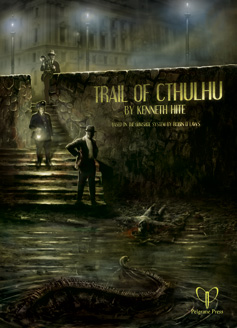
I'm really digging Trail of Cthulhu

When I bought Esoterrorists, nearly a year ago, I was excited by the possibilities of the system. Reading the Cthulhu version of Esoterrorist's GUMSHOE system a few months later, I really enjoyed the fresh take on the mythos, and was hopeful I'd get to run it some day. Since then, I'd happily lifted GMing advice from it for use with other games. However, my first session of Trail of Cthulhu was a little shaky, and events in life kept us from getting to the second session until this weekend, so the fate of the campaign was a little iffy.

I'm happy to report that despite that uneven start nearly a month ago, and despite having a lot on my plate this past week, the most recent session freakin' rocked! I'm on a roll.

Seriously, this was probably my favorite RPG session in just over two years. Most of the really good sessions I've run lately were very light and mostly humorous games, and it had been a while since I'd pulled off a more dramatic session that I was really truly proud of.

Those of you who've gamed with me for years are well aware that the style I most like to run is artsy and character-driven, with some pretty weighty method-acting and frequent moral dillemas. Since moving to Seattle some 20 months ago, I've really only successfully achieved that in a single session of a campaign, and I was missing that style of gaming. Since Continuum, I'd been running games that were more about problem solving then character dynamics, and more often over-the-top than fully-realized. Mostly featuring briefly sketched-on-the-surface characterizations instead of the deeper theatre-in-the-round experience. Continuum, too, while featuring very cerebral multi-layered plotlines, had fairly shallow character studies. Trail of Cthulhu, however, is a perfect match for the style of game I'd been wanting to run. The mechanics are really minimal and easy to remember. They mostly fade into the background, and never seem to conflict with gut instinct or real-world logic, so you can focus your energies on setting, story, and character portrayals.

Our session involved only a single die roll - but don't interpret that to mean nothing happened. Most skill uses (in the system) don't involve dice, they just involve reminding the GM that you have the relevant skill, and possibly spending a point of it. It's just like CSI or Sherlock Holmes - they never fail to collect the finger prints or find the bloody murder weapon, as long as they take a moment to search the room where the clue is. At the same time, there's a decent chance the Player Characters will be preoccupied and forget to search the room. First session, I hadn't quite figured out all the implications of how that works, but having several weeks between sessions let me process if further, and better refine how I structured the clues.

It worked like a charm this time. The system is so light, you can concentrate on the clues, the characters, and the scenes - and not worry about balancing monster stats, looking up lengthy combat options, or setting the difficulty and consequences of a search roll so that success isn't guaranteed but failure doesn't completely derail the plot. It was liberating.

The downside is that a fair amount of prepwork goes into the game. That's less a function of the rules, and more a function of the format of mystery scenarios. Building an investigative plotline that holds water and is bolstered with the proper amounts of verisimilitude isn't easy. There's a delicate balance to be achieved. 95% of the time, you want to give the players just the clues, let them draw their own conclusions. The danger of that is that sometimes they'll jump to some idea that is completely at odds with the connection you expected them to make. In those situations, you need a way to get them back on track, prefferably via an organic and in-character means. Not only do you prep the scenes you're hoping to run, but you also have to put a bit of thought into scenes you hope to never run, scenes where even the unintended red-herrings eventually somehow lead back to the main plot.

And yet, at the same time, failure needs to still be possible - if the players ignore your subtle attempts to redirect and pursue the wrong threads repeatedly, or worse yet, spin their wheels ineffectively or dither, there must be some sort of consequence. The trick, then, is to come up with consequences that add to the drama, instead of short-circuiting it. Trail of Cthulhu and Esoterrorists, with their rules-light approach and solid narrative-building advice, make that whole mystery-crafting process a lot easier than in most games.

Friday, March 6, 2009

GM set to overload

That whistling sound you hear in the background is just me, not a Phaser set on self-destruct / overload. Close enough, though.
  • Sunday: 1st Session of Deadlands Reloaded, which I'd never run before. It's a big step up in complexity from vanilla Savage Worlds.
  • Monday: Wrote a rough draft of a Robot Chicken RPG. Later that day, an old friend sent me a copy of his new RPG, F#, asking for feedback (and eventually a playtest). [By the way: F# reads pretty damn sweet. I'll let you know more when I've actually played it, which I'm definitely looking forward too.]
  • Late Tuesday: realized I might just run Robot Chicken the next day, which would mean a bunch more "adventure" prep the next morning.
  • Wednesday: Ran Robot Chicken RPG at my own birthday party.
  • Thursday: Ran Og for the weekly coffeeshop group. It was my second time doing so, and the first time was way back in October. I had to reread the rules before running it.
  • Saturday: I'll be running Trail of Cthulhu for the second time ever. It uses the very prep-intensive GUMSHOE mystery system.
Feeling spread a little thin at the moment... I know, I know, it's a pretty good problem to have.

Fine tuning via the Law of Three

Yesterday, re: Robot Chicken RPG, I wrote:
The point system didn't work as smoothly as I'd hoped. There were scenes where players did hilarious things, but scored hardly any points at all. In the future, I'll lighten up the scoring a little bit. If you make the whole group laugh, that should be worth 25 points, and probably every time you roll a d12 (in other words, every time you use your Depth Card) it should be another 5 or 10 points.
Thinking about that in the context of the Law of Three*, it now seems obvious how to handle this. The first three times in any given scene that you use your Depth Card, it's worth +10 points. After that, it's not worth points any more. This motivates players to use their powers/skills, but only as often as it's adding to the fun. If the power is one that's still fun or beneficial after the third use, it'll get leaned on naturally, but if it's just something that grows old quickly, you won't get points for over-emphasizing it. Since you can stop counting at three, it's pretty easy to know if someone deserves the full benefit - even the worst cheater can't squeak more than 20 or 30 extra points out over the course of a game, so you can safely run the honor system even if you do care who won the session that night.

*: The Law of Three: Our brains intuitively make the leap from "it happened three times" to "it can happen an infinite number of times, and is to be expected." That gap is much smaller than the processing gap between "happened twice" and "happened three times". This is why professional running gags mostly use the pattern of once, twice, pause, three times. Once something's happened a third time, it's crossed from exceptional to accepted. More on this subject.

Thursday, March 5, 2009

Bawk!

Last night, I invited a couple friends over, and ran my Robot Chicken RPG. OMG! It was riotous time! We laughed really hard.

A few highlights:
  • Cornelius of the Apes won the Beauty Contest - not because he was any sexier than the other competitors, but because his "talent" eliminated the competition. It was a painful-looking form of breakdancing, augmented with a d12 in the Horrendous Flatulence skill. When quizzed about it by the judges he said: "Talent competition? No - I, I was just walking."
  • Jesse Ventura seduced the Red Z-G figure that we claimed was Mark Rein*Hagen. Should I ever see Mark again (not terribly likely, since I'm no longer working in the industry), I probably owe him an apology for the things done to him in effigy at my game. It started as respectful and well-intended "homage" / faux-cameo... but this was Robot Chicken, after all. Amy took the initiative by undressing the Jesse Ventura doll so he could show up wearing nothing but a strategically taped-on sock. Mark was an NPC, and thus only got a d8 to resist his advances.
  • Ben Franklin sold Lizards on kite strings to the British Army, but they still invaded the Colonies once tea-time was over.
  • Pimpzilla did not destroy Tokyo, but he did get his Ho (aka Marion Ravenwood).
  • Turns out that's not a saddle on the Carrion Crawler, it's a bike helmet his mom makes him wear in case he falls over again. He's a little slow... and he likes to pet furry or soft things. Which, with him being a carrion crawler, doesn't go over so well.
  • Blue Squadron was having relationship problems. I guess that's why some folks don't agree with Ewok-on-Rancor love. Magic Beans were eventually dropped down the Death Star's heat port, which resulted in a huge spiraling beanstalk growing out in an ever-expanding circle. It's unclear whether or not that stopped the rebel base from getting destroyed.
Despite using just two dice and no character sheets, the game takes a lot of space. The toys absolutely made the game. Ridiculous nonsense occurred that would not have without them, such as Cornelius' "walking" and Governor Ventura wearing just a sock to Mark's place. Everyone used their toys like toys, not just miniatures or a character sketch. Funny voices, shaking them a little when you talk, hitting the other toys with your toy to attack, etc. It's like we were all 8 years old again - except with dirtier humor.

Much fun was had by all, but there's a few changes I'm tempted to make for next time:
  1. The point system didn't work as smoothly as I'd hoped. There were scenes where players did hilarious things, but scored hardly any points at all. In the future, I'll lighten up the scoring a little bit. If you make the whole group laugh, that should be worth 25 points, and probably every time you roll a d12 (in other words, every time you use your Depth Card) it should be another 5 or 10 points.

  2. Celebrity Guest Stars are really important for making the game feel like Robot Chicken. I'll need to go down to Archie McPhee and pick up an Edgar Allen Poe, a Sigmund Freud, and a Marie Antoinette action figure sometime. Then poor Z-G Mark R-H will be safe. (Again, I'm very sorry, Mark.)

  3. Each skit starts out crazy, and then slowly winds down. The more structured the skit was, the better. While nothing actually ran overlong, and everyone had a blast, it felt like there was some danger of a skit wearing out it's welcome. One option is to put a TV remote in the middle of the table. If anyone is getting bored with a Skit, they just grab the remote, which signals one of the "Channel Flips" the show does (and thus ends the Skit). With that in mind, the GM should probably have one or two instant gags prepared he can throw in between scenes to be the channel flips.

Monday, March 2, 2009

Unofficial Robot Chicken: The Role-Playing Game

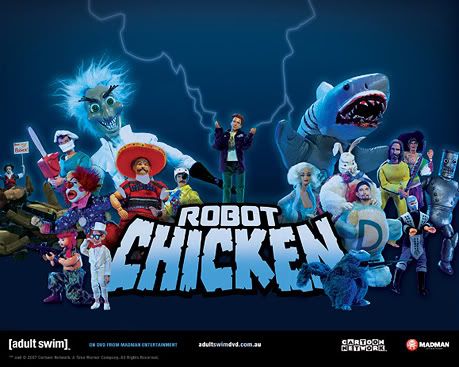
Another installment of my very-brainstormy "DVD to RPG" posts about how I'd go about converting a TV series to an RPG. This time, I'm going to tackle a show that screams to be one-shot gamed, but yet at the same time has nothing in terms of traditional gaming (or narrative) structure: Robot Chicken.

Now, obviously, this show is bizarre and frequently offensive. It's also the product of (and is geared towards) short attention spans.

That said, I love it. It's irreverant, absurd, and funny as hell. And I think it has some gaming potential. You wouldn't try to run a full-blown campaign of it, but as an occasional one-shot it'd be pretty sweet.

Robot Chicken defies traditional narrative structure, and thus this RPG will defy traditional gaming structure. Most roleplaying games tend to fall into two categories: miniatures-esque games about killin' things, and story games about angsty character development. A Robot Chicken RPG wouldn't be too concerned about either of those ideas, it'd be about short scenes involving insane situations and unexpected perversions of our beloved childhood memories.

So, let's get started brainstorming. Right off the bat, I know we want this to be rules light. We also want it focused on toys-as-player-characters, with each person playing multiple toys/characters in a session. Didn't take me long to dream up the structure, and other than assembling toys and making a buttload of cards, this post has nearly an entire RPG in it. Heck, my birthday's tomorrow, maybe I'll invite a few friends over and run it.


Toys:
So, we start with a pool of toys, and a number of Skits. Everyone (players and GM) should bring a number of toys equal to the number of participants (counting players and the GM) you're expecting, and the GM should bring extra toys beyond that equal to the number of Skits (see below) he or she plans to run.
So T = (P x P) + S. T is number of toys, P is number of participants, S is number of Skits.
The toys will be the PCs and NPCs, so they should be mostly action figures, dolls, stuffed animals, plastic dinosaurs, lego minifigs, etc. One or two stranger things in the mix will be fine, but if you bring nothing but squirt guns and an Easy Bake Oven, you're just making it hard on the group.

Toys are drafted out or assigned randomly. No one should end up playing more than maybe 1 or 2 of the toys they brought, as the point is to totally desecrate the memory of these toys, and your friends can do that for you better than you can. To make it feel like Robot Chicken, you should draw little mouths of varying sizes on paper, cut them out, and attach them to the toys with tape or that blue poster-tacking goo. You've been warned - don't bring your mint chase figure that's worth a 100$, and don't bring the teddybear that you've slept with every night since you were 8. Bring toys that will be no great loss to you should half an hour be spent discussing their irritable bowel syndorme, or if tape peels the paint off their face.

If you draft toys (that's my preferred method), the GM shouldn't get to draft. Instead, once each player has drafted P toys, the GM gets the P+S that are left over. Or, maybe the GM gets one pick to start the draft, and then just gets the slop afterwards.

There's a chance that toys may end up being used as miniatures should combat break out, but that's not really the point. There's also a possibility that some player will find it easier to role-play through the toy, moving it about like a kid would, and shaking it when the character is talking. That's not really the point, either, but shouldn't be discouraged. The main purpose to toys is to just provide an instant character concept that is outwardly obvious to the players.


Skits:
Rather than being set up as a flowing narrative, the game is staged as fairly disconnected Skits. Each Skit has a Skit card, sort of crib notes for the GM. It'll provide just enough details of setting/plot/joke to get his improvisational motor revving. The main use for these cards is to set up goals and point structures.

How many Skits to run? Well, that's to be determined by GMs devilish plans, and the time you have available. In general, though, the formula/format should work best when P is one or two integers higher than S, so not quite all the toys get used. A really high S means super-short Skits for those with minimal attention spans. A really low S means longer Skits that could result in nuanced character-development, but probably peter out. For a game this crazy, I tend to favor the automatic/shotgun approach, but you'll adjust to flavor.

For Skits, the GM will need to do a little prepwork. What actually happens in the Skits will no doubt be mostly improvisational, and strongly colored by what toys get hauled to the game, and what Depth cards (see below) get assigned to them. But, you're gonna need something of a framework - a bunch of crazy Skits to kickstart the game and set the tone of play.

Robot Chicken is pretty cut-throat, the toys do horrible things to one another and many Skits have someone getting the short end of the stick. So let's make this a competitive game, to get everyone in the right mood. There will be a winner at the end of the night, as players will score points for doing things appropriate to the Skit. Scores accumulate from Skit to Skit, and there should be some prize for the winner at the end of the night. I'd probably make a crappy trophy by gluing together some custom toy, and give that to the winner.

So, the GM should prep for "S" Skits (per the equation in the toy section), by making a Skit Card for each of them. One side of the card should feature a roughly one-sentence description of what the Skit is about. When the Skit is about to start, this side is read to the players, and they will choose which Toy and Depth combo they'll play that Skit based on the description. What sort of Skits the GM wants to run is wide open: a beauty pageant, a horror film, a public service announcement about genital warts, the carpool to work gets stuck in a traffic jam, a scene from the bible, etc. A small portion of the toys the GM brings should be particularly appropriate for certain Skits, but not all of them, or else they might overshadow the toys the players brought.

The back of the Skit card documents scoring. The front of the Skit card gets read to the players, but they don't get to see the back of the card till the Skit is over. Most Skits should have around 100 points that are likely to be achieved by most players, and another 100 points or so that can only be claimed by the first player to achieve some specific goal. At the end of each Skit, you reveal the card and calculate scores.

Example Skit Card:
Front:
The PCs are contestants in a beauty pageant, complete with introductions, swimsuit competition, and talent contest. There will be 3 NPC judges.
Back:
+10 points If you choose a feminine/female toy for your PC this Skit.
+20 points for lampooning beauty contestants by playing your character as flighty or bitchy.
+20 points for each judge you manipulate via some immoral means, such as bribery, seduction, blackmail or threats of violence. You score these points for the effort, even if the judge chooses not to vote for you due to someone else's actions or a bad die roll. +20 extra points (per judge) if your method of manipulation is tailored to match the toy that represents that judge.
+10 points for getting one or more of your fellow PCs disqualified or eliminated from the competition. Disqualify them all, and it's still just +10 points total.
+30 points to whoever wins the actual contest.
+50 points for having the most outrageous talent in the talent competition.
On that card, there's about 30 points that most players will score practically automatically, with the potential for everyone to score 80-150 points, and if one person did everything right they alone could walk away with 240 points.


Dice Mechanic:
We want simple mechanics, that resolve easily. Characters are mostly defined by what toy they are. The system will use d8s and d12s exclusively.
Why? 'Cause d6s aren't nerdy enough, d10s and d20s are the backbone of enough systems already, and d4's annoy me. Not everyone owns d16s and d34s, so I guess I'll have to settle for 8s and 12s.
If a player says his character is doing something that could logically be done by an animate version of that toy, the GM typically just says it happens. If the announced action seems particularly difficult, or if there's potential for humorous consequences if you fail, the GM will tell you to roll your d8. A 5 or better is a success.

If you're taking an action that directly harms another PC, both players roll a d8, and the higher roll gets his way. You can't kill a character with a single attack - winning once gives them a wound. A second wound (from a later attack) incapacitates the character. Other than that, wounds have no impact - there's no penalties for being hurt other than the risk of being KOd if you're hit again.

Social powers, such as World's Greatest Lover, can be used to manipulate other PCs and force behavior from them. As with the wounds rule, something that removes another player from the Skit should take two successful "attacks" to accomplish. One intimidation roll will make them run away, but they'll come back a minute later and have to be chased off a second time. The same goes for horrible degrading humiliation and forcing behavior at odds with their character type - you'd need two successful seduction rolls to bed a Nun doll against her better judgment, for example.
You'll note that I said the game uses d8s and d12s, but all my examples involve rolling only a d8. That's because d12s are granted by Depth cards (see below).


Depth Cards:
Robot Chicken doesn't just feature Celebrities, Smurfs, and Autobots. It features celebrities that secretly aliens, Smurfs that are psychokillers, and Autobots with protstate cancer. The game needs to reflect that. Therefore, everyone is dealt P+1 Depth Cards at the start of the game.

Depth Cards add that extra something special to your character. Most are just skills, broadly defined, which let you roll a d12 whenever you're doing something akin to that. This could be "World's Greatest Lover" or "Nerdly Super-Scientist" or even "Induce Vomiting" and "Drunken Wobble" since this is Robot Chicken, after all.

Mechanically, skills and powers granted by Depth Cards work just like normal actions a character can take, except you roll a d12 instead of a d8. Difficulty remains a 5 for uncontested actions, and an opposed roll if doing something unpleasant to a PC. This means the benefits of rolling a d12 are most pronounced when acting against a PC who only has a d8 to defend with - a third of your rolls will beat their best roll. That's an intentional decision designed to promote disunity amongst players. Go on, mess with each other.

Some Depth Cards should be more complicated and bizarre. Here's a few examples of cards that are more complicated, but worth putting in a deck:
  • You might be a were-toy, and when the moon is full you turn into one of your other toys, which has an additional depth card of it's own.
  • Wonder Twin Powers, activate! You can turn into water or ice, and the player of your choice can turn into animals.
  • You might have a horrible disease, which lets you roll a d12 to spread it to anyone you contact, but if you ever roll a "1", for anything, you take a wound.
  • What if Jesus came back like that? Includes any and all biblical powers you care to improvise.
  • The PC of your choice is in love with you, and you get a d12 just for wrapping them around your finger.
  • Play two characters this Skit, using an extra Depth Card that applies to both toys.
  • This toy's voice is provided by a famous celebrity guest-star. Pick a star you can do a good impersonation of. While playing that role, you get a d12 to do anything you've ever seen them do in a movie.
  • Recurring character. Instead of playing a new character, reuse a toy (and corresponding Depth Card) you used in a previous Skit.
Obviously, the GM is going to have to make a stack of Depth Cards before the game. I'd suggest P x (P+1) cards for your first session, where P is the number of Participants in the game. Deal out P+1 cards to each player at the start of the game, either before or after they've drafted their toys. Cards are kept secret until used.

I'm guessing the right mix is 1/3 usable skills, 1/3 useless character quirks disguised as skills, and 1/3 bizarre powers that break the rules, but I won't know for certain till it's been playtested. It's worth mentioning that there's very little need for cards to be balanced, as you're only playing any given character for 10 to 45 minutes.


Starting a Skit:
The GM reads aloud the short description from the front of the Skit card. Everyone picks one of their toys, and one of their Depth cards. Starting with the second Skit of the night, there should be a time limit to picking your character. If it takes you five minutes matching a card and toy before the first Skit, it's no big deal, but if it's taking you more than a minute at the start of Skit 3, it's time for the GM to step in and assign one randomly.

Each person should have more toys than the GM has Skit cards, and more Depth cards than they have toys, so some just won't get used. That's fine, it lets you skip out on your least interesting possibilities. Cards should be kept secret at least until the Skit starts. If you think the Depth Card functions best with surprise value, you can keep it hidden till you use it's power or make a roll related to it. If it's something that should be obvious, or will help with roleplaying if it's revealed early, do so as soon as the Skit starts.

The GM has more toys, and can use however many he wants per Skit. However, he doesn't get Depth Cards. It's possible a Skit description might give powers to an NPC, but most of the time the GMs job is narrator and straight-man for the much more bizarre PCs to riff off of.


End of the Night:
When the last Skit is done and all the points have been tallied, declare a winner. If possible, the GM should give them a prize for winning - could be a toy or trophy, some candy, bonus xp for the main campaign of a real RPG you run most of the time, etc.
Then, before everybody goes home, offer them a chance to write up a couple of new Depth Cards to insert into the deck for next time. Not scene cards, as something has to be saved for the GM, who has less power in this game than most RPGs.

Alternately, you could decide (now that everyone has a feel for how the game works) to split up the GMing duties next time. In that case, everyone would show up to the game with not just a set of toys, but also one Skit Card for a Skit they planned to run and a dozen Depth Cards to shuffle into the deck.


Session Report from the first time this was played.


Credit where it's due:
Used without permission, and no challenge is intended to any copyrights or trademarks. The main influence on this game is (obviously) the TV show Robot Chicken, which in turn steals from various toy manufacturers and other icons of pop culture. The ideas and system presented above also draw inspiration from the TV show Who's Line Is It, Anyway?, the quasi-RPG Pantheon published by Hogshead, and the quasi-CCG 1,001 Blank White Cards. I've also made various pop culture references: Sith were created by George Lucas, Wonder Twins are copyright DC comics, and Jesus is a registered trademark of Matthew, Mark, Luke and John, Inc.

I wish I'd thought of that

I'd like to take a moment to nod to a couple of one-shots I did not come up with, and did not participate in in any way, for which I am very sorry. Both sound like great concepts. Lots of fun and easy to wrap your brain around. Friends of mine played in them, and they've come up in conversation recently, making me envious.
  • Savage Lorax - Dr Suess characters, using Savage Worlds mechanics
  • Dr Dworkin's Sing Along Blog - Joss Whedon meets Roger Zelazny

Blessed Be

Sunday afternoon was the first session of my Deadlands Reloaded campaign. A few observations:
  • Blessed freakin' rock. I knew that they were pretty buff on paper, but I really wasn't prepared for just how potent they were. In theory, they're kept in check by not being able to sin, and getting penalties for attempting miracles that aren't direly needed. Given the questy nature of the campaign -the PCs are hunting supernatural evil- that second restriction isn't going to factor in as often as the rules may be assuming. This session, for example, the two Blessed in the party were the dominating force in the game, and the penalties I applied weren't even effective speedbumps. Who'd a thunk Clerics would be such powerhouses? This will take some getting used to.
  • Savage Worlds is "Fast! Furious! Fun!", but Deadlands Reloaded definitely notches up the complexity. Poker hands, magic rules, and 3 flavors of fate chips seem to be the tangled roots of it. It's a little more fiddly than I'd like, to be honest.
  • One player maintained it was more complicated than d20, but I have to strongly disagree there. What the player wasn't taking into account was that this wasn't the equivalent of a 1st-level d20 game. The Blessed each cast multiple of what would be a 5th level spell in d20, and the nasty they were battling was a pretty huge challenge. If 3 out of 5 players have no previous d20 experience, and you handed them 9th level D&D spellcasters to play, and then threw them up against a CR13 vampire, I dare say your first session would be rather painful. (Especially if the GM had never run D&D and had only 20 hours of d20 Modern GMing to handle things - which is roughly my situation, except in regards to Deadlands Reloaded and Savage Worlds.) Compared to that, this was a pleasant walk in the shade while a comforting breeze blew at my back.
  • Next time, I'm carrying the lego minis to the game in a hard-sided tub, not a cloth bag. Within that tub, everything will be ziplock-bagged. When the fight started, I was shocked to discover I had to fish for pieces and put my pre-made terrain back together, which rather sucked. Once that delay had been solved, things went pretty smoothly, but the rocky start to combat had me scared for a bit.
  • Blessed kick butt. I know I already said that, but it bears repeating. I'm gonna have to play hardball when enforcing the sinnin' rules, as that's the only easy way to maintain/restore balance. If I don't, then Blessed are the best character archetype, no contest.