Friday, May 14, 2010

+1, -1, +1, -1 ≠ 0

Yet another post on the interesting dice pools of Warhammer Fantasy RPG 3rd Edition. This time, we'll be taking a look at Fortune and Misfortune dice (the white and black d6's that are half blank, and which represent situational modifiers).

GM Tip: If your players do something crazy in character, that might just work but could also backfire, the proper reward for that is to add 2 white and 1 black die. It's mostly a benefit, but has a small chance of making things fail spectacularly.


We're going to start this one off with a graph that's not even Warhammer. Here's your standard graphs of normal rolls of ordinary 2d6, 3d6, or 1d20, the cornerstones of many a gaming system.

Now, let's say you were rolling one of these systems, and there were a lot things going on. The GM applies a bunch of modifiers, and they just happen to be an equal number of positive and negative modifiers. Maybe it's an archery roll, and you're shooting a top-quality bow (+1) with a magic arrow (+1) at a stationary target (+4), but it's kinda windy out (-2) and the sun is low on the horizon (-2) and it's beyond your first range increment (-2). What would that do to the graph of your odds to hit a particular target in one of these kinds of systems?

The answer, of course, is nothing. The graphs would look exactly the same, because the equal modifiers balanced out. Despite all these crazy details being in play, it ends up with you having the exact same odds of making the shot that you would normally if none of the modifiers were in effect. In most systems, conflicting modifiers just cancel each other out (sometimes literally, sometimes just effectively, but the result is the same). If a truly complicated situation comes up, you can end up doing a fairly large amount of math only to discover that the end result is the same, or very similar to, the unmodified default roll. I don't know about you, but I find that a little frustrating.


In contrast to that, Warhammer fantasy role-play involves less math, and makes sure the conflicting modifiers actually have an impact. Nearly all modifiers in Warhammer are abstracted out to either one Fortune Die, or one Misfortune Die. It's easy to remember, and the GM is free to tweak it on the fly. If something crosses your mind as a possible modifier, you throw another die into the pool. As you can probably guess from the tone of my description, I'm inclined to like this. I'm a sucker for elegant flexible systems, so I'll acknowledge that bias before going on.

One area I was worried about though, was whether or not these dice would effectively just cancel each other out. I know that in general with normal numbered dice, the more you put into a pool, the steeper the bell curve gets. I was a concerned and suspicious that a big handful of fortune and misfortune dice would just make the average result happen a lot more often. Much to my surprise, the exact opposite occurs. Additional dice leads to greater variance in the dice pools.

On the right is a simple graph of a very small dice pool (3 Characteristics dice vs 1 Challenge Die). The blue line shows what happens when we add an equal number of Fortune and Misfortune dice to the pool. Odds of basic success and failure barely changed at all. Success dropped 2 points from 59% to 57%, a variation that's hardly going to be noticed. At the same time, however, the chance of scoring the important triple hammer uber-success line of most action cards nearly doubled, shooting up from 6% to over 12%.

How exactly that happened is better illustrated by the next graph, which also shows the same die pool, but breaks out the possible results a little differently. Instead of showing the odds of scoring a particular result or higher, it gives the percentages for every discrete number of successes possible. Here we can see where those extra results are coming from. The odds of getting exactly one success have actually dropped rather far, but the improved odds of scoring the bigger hits have compensated for most of it.

Extrapolating from the 2 charts, we see that with the Fortune and Misfortune dice added, you're only 25% likely to score exactly 1 success, but you're 32% likely to score 2 or more successes. Without the extra modifier dice, the numbers are essentially reversed, and you're more likely to score 1 success than 2 or more.


Of course, as I noted in last week's articles about the Challenge Dice, looking at successes is only half the equation in Warhammer 3rd. To get the full picture, we have to look at boons. Here's a pair of graphs of a somewhat larger pool of dice. I've graphed what it looks like as an unmodified pool, as well as what it looks like with 1, 4, and 7 sets of matched Fortune and Misfortune dice. Not that I have any desire to roll a 20+ dice pool that's been loaded down with 14 situational modifier dice (on top of the realistic pool of Stance, Characteristics, Skill and Challenge dice) but since the Warhammer probability tool made it easy for me to calculate those odds, I thought I'd share them. They do make for some interesting graphs.

All the graphs I compiled for all the pool sizes shared a few traits in common. In general, more black and white dice meant more extreme results. They increased the chance of triple-hammer successes, but also the chance of failure. They increased the odds of scoring banes, but also increased the odds of scoring 2 or more boons. Reckless dice (the red d10's) are a little more complicated, and probably deserve a blog post of their own, but the charts shown here are very representative of a wide array of pools composed using Conservative Dice or Neutral Dice. In many of the pools, adding more black and white dice (at least in the quantities likely to be seen in-game) would have almost no impact on the odds of scoring at least one boon, but would pump up the more extreme boon and bane results. It would accomplish this by reducing the odds of scoring a "boon neutral" roll where the boons and banes didn't come up, or came up in equal numbers and cancelled each other out. The odds of a single boon goes down at the same rate that the odds of multiple boons goes up.


Ultimately, the amount of variance provided by the Fortune and Misfortune dice wasn't huge. The green lines on these last too charts look impressive, but that represents 14 dice of modifiers being added to the pool. You're just not likely to use enough modifiers or dice to get to the point that the numbers really get interesting.

I find that I'm happy that the dice don't just cancel each other out, and that they lead to increased chance of the more extreme rolls occurring. At the same time, I'm a little let down that it takes so many dice to achieve these effects.

Warhammer 3rds die rolls get interesting because of the Boons and Banes, they provide the subtle nuance of the system, the extra oomph that other rules sets lack. Boons and banes are also more sensitive to large variance. There's very few cases in the default rules where getting 5 successes is functionally better than getting 3 successes (mostly just for first aid and recovery rolls). But, there's often something useful to do with a 4th or even 7th boon, and frequently some horrible side-effect waiting to be triggered by yet another bane. Looking at it from that perspective, there's plenty of reason to want boons and banes to be the most likely result of the Fortune and Misfortune dice. Sadly, they're not. Each such die has 2 Success or Failure symbols, and only 1 Boon or Bane symbol. They're twice as likely to impact success as boons. I see them as a step in the right direction (since a ton of modifiers actually does something, instead of just canceling out), but they strike me as being a little bit of a missed opportunity. If they had it all to do over again, I would encourage FFG (the publisher of Warhammer 3rd) to swap the Boons and Successes ratios on these dice. That way more modifiers on a roll would result in a more dramatically increased chance of side effects stemming from the roll.


One last observation (and this is where I stole the GM tip from for the start of the article): Let's say a PC at your table does something really risky, but which might just pay off. Swinging across a chandelier and kicking an enemy, for example. Throwing themselves against a foe on or near a clifftop. Muckraking and name-calling during a social event. Having seen these numbers, I'd feel pretty comfortable "rewarding" such behavior with both a Fortune and a Misfortune die - the net result will be about a percentage point or two against them, but with a big impact on the odds of making the likely result more extreme either way.

If you want to genuinely reward such behavior, and encourage it in the future, then I'd consider giving 2 Fortune and 1 Misfortune die to the action. That will probably help them out a bit, but also open up a small chance of it backfiring. I think this is a lot better than the example in the rulebook where a PC dives out of a tree at a beastman. In the book, they just give him two Misfortune dice (and no Fortune) because it's tricky and dangerous, which is just going to discourage your players from taking such colorful actions again in the future.

2 Fortune and 1 Misfortune is also fun because it mirrors the effects of being drunk. The "intoxicated" condition card gives 1 Fortune and 2 Misfortune. The subtle difference of these pools shades the distinction between bravery with a side of foolishness, or foolish with a side of bravery. Plus, if a PC is ever drunk, and the player does a good job of hamming it up with outrageous actions, they'd stand to roll 3 Fortune and 3 Misfortune total, which as we've seen does a great job of making something unusual (for good or ill) come out of the roll.

Thursday, May 13, 2010

Two By Three

In yesterday's analysis of the dice from Warhammer Fantasy Role-Play 3rd Edition, I came to the conclusion that 1 Challenge die was worth 2 Misfortune dice. That was, as it turns out, an over-simplification.

Let's look again at the chart that shows the relative impact of challenge dice and misfortune dice. Here it is, a very typical starting character dice pool, 4 trait dice, 1 skill die, and 1 fortune die. The graph shows how that pool performs against various difficulty ratings.
As you'll recall from yesterday's post and can see today, 1 challenge and 2 misfortune is almost identical to 2 challenge. The math of it gets a little complicated as you try different dice pools, but this chart sums it up nicely, being represented by the way the yellow line and brown line overlap, and the way the green line overlaps with the light blue line.
The impact on the success or failure of the action is essentially the same whether you add 1 challenge or 2 misfortune.

But this Warhammer 3rd we're talking about, and success is only half the picture. The game also has boons and banes, which represent silver linings and nasty side-effects. A roll can "fail" but still generate some sort of minor beneficial effect. An attack can hit, but fatigue the attacker. You can save the day, but still make things worse while you're at it. That's part of the charm of the system.

Let us now examine the boon and bane odds of those same die rolls.

For ease of comparison, I kept the same color coding of the lines, and kept the chart oriented where the better rolls are on the right. But since we're looking at Boons and Banes now, the chart doesn't run from 0 to 3. It runs from -3 to +3, essentially. The middle column of the chart represents rolls where either no boons or banes come up, or where equal numbers come up and they cancel each other out.

Two things become obvious about this.
  • One, the brown and yellow line no longer overlap, which tells us that 2 challenge dice is worse than 1 challenge and 2 misfortune, afterall.
  • Two, the green line is still hidden. Except now, the green line is hidden behind the brown one, instead of the light blue. That suggests a challenge die has a similar impact on boon/bane odds as three misfortune dice.

So I ran the numbers quite a ways up (as well as down to just misfortune with no challenge), and discovered that yes, the boon and bane numbers for 1 challenge die are about equal to the boon and bane numbers on three misfortune dice. I'm not posting the full chart here as it became an eyesore of overlapping rainbow colored lines, and to get any useful information out of it you have to keep turning various columns and dice pools on and off so they don't obscure the data layered beneath them. The edited version above should convey the general point clearly enough.

Does 1 challenge die equal 2 or 3 misfortune dice? The answer is "yes".
  • For purposes of affecting whether your action succeeds or fails, it's worth two misfortune.
  • For purposes of determining whether the side effects that go with your action are positive or negative, it's worth three misfortune.
That has an interesting effect on those Improved Active Defenses we were talking about yesterday. Taking "Improved Parry" does not improve your odds of completely avoiding an attack, at least not significantly. But it does reduce the quality of that attack, and make it more likely the enemy will suffer some sort of drawback or side-effect. How much of a boost that is, and how dire the side effects will be, depends entirely upon the action card you're being attacked by. It's beyond the player's control, and even beyond their ability to know in most situations.

It will definitely impact how I design monsters and NPCs for my own campaigns, though. I'll make certain I include plenty of juicy bane lines on monster actions to benefit the PCs who took the improved defenses.

One more interesting observation: As you add more and more negative dice to the roll, the odds of getting boons goes down, but after a certain point the odds of getting a net-zero roll stops advancing as well. If you roll the die pool above against 3 challenge dice, for example, you end up with a 45% chance of getting boons, a 30% chance of getting banes, and only a 25% chance of getting neither. You can see it starting in the second graph in this post, where the light blue line shows equal odds of getting 1 bane or zero. That plateau turns into a peak (or a capital "M" shape), and then grows ever more extreme as you throw more dice at it. In a future post, I'll revisit this interesting aspect of variance in the warhammer dice, and how it differs from what you'll find in most other RPG mechanics.

Credit: In my previous post, I did all the math myself, but for this one, I saved myself some trouble and lots of drudge work by using a wonderful internet resource, John Jordan's WHFRP 3rd Probability tool. It saved me hours, and allowed me to test graphs up into dice pools you'd never be able to fit in your hand.

Wednesday, May 12, 2010

Purple Is The Two Black

This post is about the dice in Warhammer Fantasy Role-Play 3rd Edition. Specifically, the Challenge Dice and Misfortune Dice. This will probably be the first in a series of posts looking at various aspects of the often-opaque mechanics of Warhammer 3rd.

Rather than save the big surprise for the end, I'm going to put the most important conclusions of this article right up front where you can't miss them:
  • 1 Challenge Die is about equal to 2 Misfortune dice. For the past month and a half I thought it was nearly as potent as 3 Misfortune dice, but I was grossly mistaken.
  • Improved Active Defenses barely improve your defensive stats over the "non-improved" versions. They are a tiny bit misleading in that regards, because the real benefit isn't what you'd think it is.

The Challenge dice are purple 8-siders, and the Misfortune Dice are black 6-siders. The challenge die is decked out with various penalty symbols, and has only 1 blank side. The misfortune die has half it's sides blank. Clearly the challenge die is much nastier than the misfortune die.


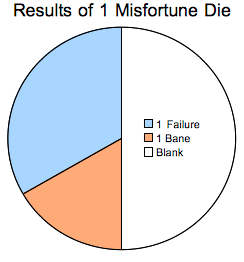
These pie charts show us the distribution of failure symbols and banes on a single die of either type:


On those pie charts (and the ones below), blue represents failure symbols (the little crossed swords that cancel out successes / hammers), and orange represents banes (the little skulls that cancel out boons / eagles and thus cause negative side-effects). The white region is the blank sides, and the black region is the dreaded Chaos Star (which sometimes counts as just another bane, but often presents much nastier side effects of its own). To generate the charts, I just entered in the percentages of each possible outcome into a spreadsheet, and had Open Office generate charts for me. The larger the area, the greater the percentage of rolls it will come up on. A quarter of the circle corresponds to 1/4 of all rolls, etc. As an extra note, the darker I colored the area, the stronger the effect (i.e.: Medium blue is 2 failures, but light blue is just 1 failure).

It's obvious that one challenge die is much worse than 1 misfortune die, but just how much worse is a little harder to figure out. Is it worth 2 misfortune dice? 3 misfortune? Let's look at a few more charts to figure that out. Here's the challenge die pie chart again, but this time we'll set it next to a chart that shows the combined results of 2 misfortune dice:


With charts like this, comparing the dice becomes a relatively simple matter of eye-balling it. I kept the colors the same, but added in purple to represent mixed results of both failures and banes. If you want to know what percentage of the rolls will result in one or more failure symbols, look at the blue and purple blocks. If you want to know what percentage generates bane symbols, look at the purple, orange, and black blocks.

In this case, the blue section of the challenge die chart is smaller than the blue and purple section of the two misfortune dice chart, so we know that you'll be more likely to get at least one failure symbol on the misfortune dice. However, the challenge die generates more banes (and chaos stars) as evidenced by the size of the orange and black sections of that chart being bigger than the orange and purple section of the 2 misfortune chart. Exactly which is worse, 1 Challenge Die or 2 Misfortune Dice, largely depends on the situation. In some Location cards, and for some Action cards, a Chaos Star can be devastating. In those cases, the Challenge die is worse. In all other situations, they're about equal.

(For those who are oriented towards numbers instead of visuals, the challenge die has a 37.5% chance of generating at least one bane. Two misfortune dice rolled together have only a 30.56% chance of generating at least one bane. Failure odds on the dice are 50% for a challenge die, and 55.56% on the pair of misfortune dice.)


The equality of 1 Challenge die and 2 Misfortune was a big shock to me. There's numerous points in the rules (and cards) of the game that imply 1 Challenge is the next step after 2 misfortune. That would suggest it's worth either 2.5 or even 3 misfortune dice, but it's not.

The best example of this implication is the Advanced Defense cards. They all turn your existing Parry or Dodge from 2 misfortune dice into 1 challenge die, and provide some other minor benefit almost as an afterthought. It turns out the minor benefit is actually the lion's share of the bonus provided by upgrading to an Advanced Defense card. Don't take Advanced Parry because you want your parries to do a better job of protecting you from enemy attacks, as the growth in that area is minimal. Instead, if you take Advance Parry, it should be because it will sometimes make one of your attack cards recharge faster. That's the only real benefit over the normal Parry.

The chart to the left illustrates my point about the Improved Parry. This graph takes a typical attack roll (4 Characteristics Dice, 1 Expertise Die, and 1 Fortune Die) and charts the odds of scoring 0, 1+, 2+, or 3+ successes. The different colored lines correspond to various levels of defense.

In particular, pay attention to the brown and yellow lines, which overlap significantly. The yellow line is vs 1 challenge and 2 misfortune, essentially an attack against a target in leather armor who uses Parry and has Weapon Skill Trained. The brown line is vs 2 challenge, essentially an attack against a target in leather armor who uses Improved Parry (and thus also has Weapon Skill Trained, since it's one of the prerequisites). The target with Improved Parry will be hit 70.37% of the time, and the target with the normal Parry will be hit 72.78% of the time.

A similar relationship exists between the light-green and light-blue lines on that chart. They're against a target with 1 point of Defense, so he's got slightly better armor. Again, having an "improved" active defense only shaves a tiny bit off the odds of being hit (down from 65.42% to 63.25%), and the two lines are practically on top of each other. The challenge die is just a hair's breadth more potent than 2 misfortune dice. Adding one more misfortune die has a lot more impact than converting two misfortune into a challenge (about 7% improvement, instead of about 2.5%, in the specific dice pools shown on the chart).


For the sake of completeness, I'll provide one more pie chart, this time a picture of the results of rolling 3 misfortune dice. I'll again set it side-by-side with the familiar 1 challenge die graph for comparison:


Interestingly enough, three misfortune dice have exactly the same odds of all coming up blank as does a single challenge die. That, coupled with the challenge die's strong chance of rolling 2 failures, were both factors in my over-estimating the power of a challenge die when I first started playing with the game.

Another non-obvious "advantage" to the 3 misfortune dice comes in the form of "mixed" or "overlapping" results, represented by the purple regions of the above pie charts. Rolls that fail because of a challenge die are likely to have a "silver lining" in that they'll score boons, but rolls against a handful of misfortune dice are likely to negatively impact both your successes and your boons.

Monday, May 10, 2010

By the time you read this, it will probably be too late...

...to get the Humble Indy Bundle at the amazing price of "Pay what you want". Sale ends tonight, and I just found out about it twenty minutes ago. If it's still Monday when you're reading this, it's worth popping over to http://www.wolfire.com/humble

It's a bundle of five computer games in a bundle that you set the price on. You can even decide how much of what you pay goes to the developers, and how much goes to charity. I paid $20 total, divided evenly. The friend who told me about it had paid that much, and it sounded reasonable to me. I've never played any of them, but $20 seemed worth risking to support this business model, and get to try 5 games I know next to jack about (the only one on the list I'd even heard of before was World of Goo). Zero downside to me, not like $20 is gonna break the bank or anything.

Friday, May 7, 2010

Filling up the tablespace

Last night I GM'd Warhammer 3rd for 6 players, 5 of whom had never even looked at the game before. It wasn't without its bumps, but overall I was pleased with the way it went.

6 PCs, with all their cards and sheets really eats up some table space. A friend showed up half way through the night, and we really couldn't free a place for him to sit at the table. Even before his arrival, I had to move my GM screen to a nearby empty chair, and I kept track of A/C/E pools in my head instead of with tokens because there wasn't room for them on the table. Likewise, I couldn't use a progress tracker for the beastman's morale like I wanted to, because most of the puzzle pieces ("event" markers in particular) were being used by players, and there wasn't much space to lay anything out.

We didn't get very far narratively, a tiny bit of role-playing followed by one encounter, and then another scant round of role-playing and wrap up after that. That was mostly about time constraints, though. Two of the 6 players had card problems and arrived late. Laying out the character sheets and explaining the rules ate up a big chunk of time after that. So, the actually adventure was only from about 7:45 to 10:00 pm. So while we didn't get far, the truth is that you really can't expect to get a lot done in 2 hours and 15 minutes with 6 players who are learning the new system. Second round of combat went around the table in about half the time of the first round, so it felt like we were getting over the learning curve pretty quickly. I think with a little more familiarity with system and characters, I think it'll run pretty well.

A few observations:
  • The system is pretty bloody, a direct result of the high success rate on attacks. Our fight lasted less than 3 complete rounds. This is a system where one mistake puts you in grave. None of the PCs went down, but most were within one more hit of being down, despite some great support and defensive actions being used at the right time. All 6 of the monsters went down, including the three who tried to escape.
  • Speaking of high success rates, if my count is correct (and I could be off because I tallied after the game instead of during), we had 27 die rolls during the night, and only 6 of them failed to generate net successes. 78% success rate is pretty heroic for fresh starting characters.
  • The abstract movement really shined. One of the PCs started the fight by launching an arrow while the others approached. If we were playing a game with a more rigid movement and range systems, his bit of showboating probably would have resulted in 2 or 3 rounds of just him firing arrows while everyone else closed ranks. Instead, everyone that wanted to was swinging swords in the very first round.
  • The ratcatcher's SBVD (Small But Vicious Dog) is a total bad-ass. Peter sent the dog in after the main bad guy, and got a good roll that essentially pinned the Wargor (beastman leader) in place for the whole fight. They peppered him with arrows, and then the troll-slayer ran in to finish him off. But that little dog was what kept him from using his best moves. So, while I honestly think the fight would have been a little more exciting if they didn't pull that off, I can't fault the players for identifying their character's strengths and using them to the fullest. They did exactly what they were supposed to.
  • The fortune refresh mechanic feels really different with a large group. When there's fewer PCs, you get your points back faster, so you're more motivated to spend them. Plus, the points accumulate based on clever actions and role-playing flourishes. But with a large group turns get long enough, you're less inclined to put those flourishes into your actions. Double-whammy. I suspect it probably works best with 3 or 4 PCs.
  • I love the flexible nature of the white and black dice. Being able to throw reward and penalty dice onto actions so freely was sweet. The big nasty Beastman leader had a special battle cry action, and I narrated that it was so loud and nasty, it shattered limbs off of trees. It was total fluff, just trying to put some color into the action. Then I realized I could penalize all actions for a full round with a black die because of branches and pinecones falling on people. That was kinda fun.
All in all a good night, even if it was a little rushed and light on plot.

Thursday, April 29, 2010

Savagely Tricky

Here's what the Savage Worlds rule book should have said about Tricks, but didn't:
Tricks are only really worth it if your character has a low Fighting die but a high Agility or Smarts, and the enemy has a Parry higher than your average attack roll.

Despite what you might have inferred from the concept and fluff text of Tricks, they are not actually intended to model crafty or sneaky fighters. Any character who has actually invested points in their Fighting score and related combat stats will be more effective making normal attacks than wasting their time and actions throwing sand in the opponents eyes, or telling the enemy to look behind them.

What tricks do well is they enable typically non-combatant characters (such as gadgeteers, healers, and spellcasters who've run out of power points) to contribute to the group's success during a fight scene. Tricks are most effective against foes with a low Agility or Smarts, so they're better against Extras and henchman than against a named criminal mastermind that's intended to be a challenge for the whole party.

Even then, the best benefit of a trick will be felt only if someone is prepared to follow it up with a normal attack before the tricked foe acts again. Players should coordinate tricks so that one PC sets it up, and someone else acting right after them takes advantage of it. If you cannot guarantee this sort of situation, only use Tricks if you're the last PC acting in the round, as then a lucky initiative draw may allow the trick to be in effect when yourself of an allied character acts next round. If no one is positioned to follow up on your trick, the low-Fighting character is generally better off firing a pistol at a distant foe than using a trick on an adjacent one.

One exception to needing teamwork, however, is when a character that is not combat-oriented at all is stuck in melee and just wants to flee. With a lucky back-to-back initiative draw, you might be able to use a trick followed by an attack to shake a foe and get away without provoking a free attack. This is of course a desperate move, one best used when the alternative is probably the death of your character. If you succeed at the Trick escape, the GM should proceed to use the Chase mechanics instead of normal movement rules, as without the special Chase rules most foes will be able to automatically catch up with you again if they successfully unshake on their turn.
Honestly, no one writes rule books like that, but I really wish they did. If every game book discussed mechanics so frankly it would improve performance at the table for the casual gamer, and eliminate much of the advantage that can be gained by rules lawyering and munchkinism.

My buddy Erik recently did an amazing mathematical analysis of the Trick mechanic in Savage Worlds. Here's the link. Go ogle his charts and probability graphs for yourself. My proposed text above is really just a straight-forward summary of his discoveries and hard work. I've been meaning to provide a link for the past two weeks, but wanted to find the best way to summarize the heart of his findings. Thank you Erik, it was really helpful to me to see these things spelled out clearly!

Monday, April 26, 2010

Actions Wanted

Brainstorming a short list of action cards that I think Warhammer 3rd could really use. Most of these would be actions you can buy with XP, not new basic actions.
  • Hold Them At Bay - a card that makes it tricky for people to engage you, or get past you. This sort of thing can be done with existing Location rules, but it's a little fuzzy, and someone who rushes you will always get to attack first. This could be an on-going effect that causes fatigue or penalty dice to anyone trying to get close to you while it's recharging. Since Fatigue=Wounds for most NPCs, that would work pretty well, I think.
  • Set To Receive Charge - a card that does bonus damage if it's your first attack since the opponent engaged you. (Alternately, this might actual be some sort of interrupt / pre-empt type action, but the game doesn't do much of that. Fake Out is the only such card I can think of.)
  • Feint - Strikes me as odd that they made Parry, Dodge, and Block into action cards, but didn't include the other assumed part of melee combat: the Feint. This would probably be a card to let you boost other attacks later. The trade-off would have to be pretty good, since you'd be losing an attack in one round to boost the later attack. Or maybe it could work like an active defense that gives bonus dice instead of penalty dice, but doesn't use your action?
  • Double Parry - The one extra black die given by a Main Gauche seems a little under-powered. Perhaps that's for the best since it doesn't require any skill or investment to get it. There's certainly room for a better (or more frequent) two-weapon parry.
  • Trample - An attack card that uses your Riding skill, with damage based on your mount. There's attacks that use Observation, Skullduggery, and even Leadership, so why not Riding?
  • Trick Riding - Currently, any sort of Trick Riding would be done with the Perform A Stunt card. I feel that it's an oversight to not have any cards in the whole game that make you roll Riding. You can be generically "good" at riding, but not have any specific tricks that give a real benefit or showcase your talents, which is pretty odd given how many other cards there are that give tricks and special moves for various skills.
  • Something good for Roadwardens - This probably overlaps with the last two, since riding is one of their skills. There's just nothing special for Roadwardens at the moment. They have an odd combo of attributes and skills that just don't apply collectively to very many action cards. If there was an Intelligence + Weaponskill card, it'd be great for them, but no such thing exists.
  • Boating Tricks - The Boatman Career has the special power of reducing a black die of penalties suffered for being on a boat. Which really only matters if you can talk the rest of the PCs into getting onto a boat with you. If you want to make the boatman stand out a bit more, you could easily add some sort of Master of the Tops or similar swashbuckling actions. Crazy flamboyant actions along the lines of the Roger's pirate swordsman school from 7th Sea.
The game already has a lot of actions, so the demand for actions in general is perhaps not great. At least not unless someone wants to make a particular character type. Coachmen and Boatmen, for example, don't have much to make them special, so the riding and boating tricks could be really useful if someone in your group drew one of those for their starting career. I could easily see how a Watchman or Soldier character might want the ability to hold a spot of ground.

High Scoring Vulgarity

Last week while my wife was convalescing from a back injury, we tried out a new little video game. It's called Clockwords. It's a little bit like Scrabble or other word games, but with a timer element that is represented by a battle between a steam-tech robotic weapon system and invading insects. It's actually pretty cool. Here's a link. She was bedridden much of the week, but she could still shout words at me.

Fun game. Very different from the sorts of games we usually play.

The majority of words you spell score probably around 50 points of damage. But I got vulgar, and it paid off. :) 394 damage from "Vulgarity". The yellow "R" is what did it, it made the 4 bronze letters explode while the evil insects were crossing each others trails.

Friday, April 9, 2010

Clash of the Plot Holes

This scathing movie review is a cross-post from my non-gaming blog. The movie is so stinky, I felt compelled to place the review here as well to maximize exposure.


If Peter Jackson had attention-deficit disorder, and was doing a lot of meth while making the Lord of the Rings films, we now know what the results would have been like. They would have been just like the new remake of Clash of the Titans.

It's kinda pretty at times, but that's the most I can say for it. It's not so much exciting as it is spastic. Within this film, things happen for arbitrary and senseless reasons, and they do so as quickly as possible. Most of the fight scenes are the action-movie equivalent of a Jackson Pollock painting. It may be pretty, and it sure has a lot going on - but what looks from a distance to be detail, on closer examination turns out to just be random splatters without meaning.

"Let's put Treebeard in the desert! Then we'll have him ride around on the back of one of those giant elephants. When he gets off the elephant, he'll do some kung-fu, then we'll wrap a giant snake around him, and then he'll explode!" It's like that, except the giant elephant has been replaced by a Scorpion of variable size, and Treebeard is wearing Iron Man's neon-blue heart implant. Don't ask me why, none of it made any sense. I still can't figure out why the freaking Ents were even in Clash of the Titans. They're not in the 1980's version, and they're not in Greek myth either, and their inclusion is completely random - but the same thing can be said about almost every element of this movie.


The film is really shallow, too, and it features characters we neither care about, nor believe in. At no point during the film did I want Perseus to succeed at his stated goal, but neither did I particularly want him to fail. Most of the time, I just didn't care. It's not like he was fighting against a villain. The film pointedly has no villains. I mean, there's Calibos, he seems pretty bad, but when you think about it, he's just angry because Zeus raped his wife and Hades took advantage of him. His actions are deplorable, but his motivations are basically the same as the Hero - he's rebelling against that bastard Zeus. But Zeus isn't the bad guy either, as the film ham-handedly reminds us during its hard-to-swallow happy ending. So that must mean Hades is the villain, except the film points out to us again and again that Hades is only so bitter and manipulative because Zeus tricked and betrayed him.

I'm a big fan of "shades of gray"-style moral ambiguity in a film, but in the Clash remake, this is done really sloppily and never fully explored. We're never torn over what is the right thing to do, and neither are any of the characters. Instead, we're just given mixed messages about who really is the monster, and then quickly distracted from contemplating any of it by yet another incomprehensible action sequence. Hey look - a harpy! WTF?


In this film, the main character, Perseus, has 3 fathers:
  • There's the mortal fisherman who raised him as his own. Shortly before he dies, he tells Perseus that what he really wants his son to do is to stand against the Gods, and change the world so that mankind will no longer be enslaved by Olympus. Perseus starts off to fulfill his father's last wish, and then kind of abandons that goal without ever saying why.
  • There's Zeus, king of the Gods, who raped Perseus's mother, and then abandoned the resulting child. But he's not the bad guy, we are told again and again. After 20 years of being a dead-beat dad, he's now trying to make up for it. His wish is for Perseus to take his rightful place in Olympus, but Perseus declines that opportunity both times it's offered to him.
  • His third father is the asshole who killed his mother and tried drowning him as a child. Later, he turns into a real (as opposed to just figurative) monster, and tries to slay the adult Perseus. Obviously, that won't do, so he's killed by his step-son Perseus. His dying wish is, strangely enough, for Perseus to not become a God, and stay away from Olympus. It's delivered very oddly, practically "I know I've been trying to kill you, but it's for your own good. Please don't become a God, because that'd be really bad for you, and I'm worried about your future and the fate of humanity." It's a really lame attempt at a Darth Vader redemption, made all the weaker by the fact that the director doesn't feel compelled to give it more than 3 seconds of screen time.
So, of course, the mutated, mother-killing, trailer-trash monster of a father gets his dying wish fulfilled by Perseus. The film tries hard not to draw attention to this fact, though, and instead just sweeps it under the rug. It's like they're playing thesis-statement roulette, with a new winner every five minutes.


The worst part of the film, however, is the hackneyed attempt at foreshadowing that then gets abandoned and forgotten at the end, ret-conning itself into a red herring. I'm talking about the warning of the Stygian Witches. They go to see the witches, these three inhuman blind seers of great wisdom and insight. On the way there, Io (Perseus's shallow and unbelievable love interest) spends several minutes ominously warning Perseus not to ask any more questions of the witches beyond the obvious "how to kill the Kraken" question. She says he won't like the answer he gets, and it's really played up as a big deal, like there's something nasty in his destiny.

Sure enough, the witches drop a doozy on him. They prophecy that he's going to die while fighting the Kraken. The music swells dramatically, and Io says something like "Oh, Perseus! I told you not to ask them anything else! This is so tragic!"

Then the end of the movie rolls around, and he doesn't die. In fact, he's never even wounded, and you don't feel he's actually in a lot of peril. Apparently, the all-knowing magically gifted witches were just screwin' with him, not actually foretelling the future. Despite the prophesy scene having be played up like it was a really important plot point, there's no mention of it at the end of the film, it too is just swept under the rug.

Now, it's possible that the film is just being unexpectedly subtle at the end. I doubt it, because everything has been in-your-face and beat-over-your-head before that point, but there's a remote chance it was actually a clever ending that was just so subtle it failed. Because, frankly, the last 5 minutes of the film would make a lot more sense if it were actually a far-subtler version of the end of Brazil (or the recent movie Repo-Men). Here's what I mean:

Maybe, just maybe, the Kraken actually kills Perseus. At the very end, he dives into the water in a harbor to save some girl that's almost certainly dead. After expressing her willingness to be a human sacrifice, she's fallen hundreds of feet into the water, and 80 tons of rock is falling on her. The harbor is between two steep cliffs, with a city built into them. The scenery and location were a prominent part of the scene.

He and the girl are next seen on a flat and featureless beach, and rescue ships are on the horizon coming to take the girl home. Maybe Perseus rescued her, swam several miles away to some nearby island, and somehow signaled the survivors in the devastated city that they needed a rescue. That seems to be what the film is saying. But I suppose it's also possible that he and the girl both died, and the featureless beach is Elysium / Heaven / etc. If that's what the movie was trying to convey, it did a piss poor job of saying it, but I can't completely rule it out. At least it would have made a lot more sense than the happy ending they seem to be trying to shove down our throats.


I could go on like this for a few pages more, there's just so much wrong with film. Io's supposed backstory didn't match her on-screen powers. Hades make-up was inconsistent and laughable. The CGI critters kept changing size relative to humans. The Kraken came from Cloverfield. Etc.

I suppose maybe I should have put some spoiler warnings at the top of this post... but I think if I just "ruined" the movie for you, I was probably doing you a favor.

Wednesday, April 7, 2010

A Tale Of Two Forums

"A couple years ago, White Wolf released this RPG called Scion. I started a campaign the first chance I got.

At first, I loved it, but I was really bummed how long it took them to release new material for it. Six months out, all they had was one rulebook, and a super-short demo adventure. Their release schedule kept falling apart, and it was frustrating, too, because that first book was at best 1/3rd of the setting and rules. PCs in Scion have a primary stat called that can be rated from 2 to 12, and the first book only covered characters with a rating of 2 to 4. It took them nearly a year to get the second and third books out, IIRC.

Anyhow, I was running the game for that whole time, and a good while later. There were things I loved about it, but the more I analyzed the game, the more it fell apart. I eventually came to the conclusion that the core mechanics were broken, and that later books just compounded those problems. Of course, I was emotionally invested in the game by then, so when I thought about these things, I got fired up.

I spent a lot of time at the Scion forums, posting various house-rules and what have you. What I noticed though, was that I spent less and less time coming up with cool new things to improve my gaming experience (and those of others I interacted with on the forums) and more and more time just venting about the rules and the company. There were things they were doing wrong with Scion, and I just had to let everyone know.

Every topic that came up on the forum, I figured out some way to bring it back around to the things that pissed me off about the game and the direction it was going. I got quite cynical. I knew that I was no longer being helpful to others, and that I was probably just coming off as troll. There they were, trying to post all their cool ideas about a game they loved, and I'd just come along and rain on everyone's parade.

Then, just over a year ago, White Wolf rebooted their forum software. Everyone that wanted to post on the new version of the forum had to build their account all over again. Knowing, as I did, that I had long before ceased to gain enjoyment or serve a useful function at that forum, I declined to make a new account. I just walked away.

Ever since that, I've felt better. Other facets of my life improved, because I was no longer voluntarily subjecting myself and others to my own negativity."


I typed that up at the FFG WFRP forums today, and have not yet decided whether or not to post it. The WFRP 3rd Edition forum has several rather obnoxious posters, who just troll the place, taking every opportunity they can to bitch about the new edition. Half the time they're screaming about how angry they are because the game has only had three releases in 6 months, whereas 2nd Ed has years of sourcebooks. The rest of the time they bitch about how "it's a board game, not an RPG" because it uses colorful cards. Edition wars are part and parcel of the gaming experience, but this is pretty extreme.

And I'm left wondering why the hell do these people think we care? I wish they would just move on, and not linger around a forum that is intended for the enjoyment of a product they don't like. I mean, it's not like there isn't already a really good forum for 2nd Ed WFRP, and for people who just want to rant about how much they hate 3rd Ed. It's called Strike To Stun. And yet, even when they're getting me all fired up by trolling at the only good 3rd Ed forum, I can understand where they're coming from, because my own Scion experience was so like what they are doing.

Eventually, you just need to break the cycle.

I'm glad I finally found the strength to move on and leave Scion behind. I hope they find the strength to do the same for Warhammer's forums. If you hang out at places where people like the same things as you, you'll enjoy your life a lot more, and feel much better about yourself. If you insist on trolling places where other people enjoy things you hate, you can only make everyone (yourself included) feel worse. That's my 2 cents, anyway.