Showing posts with label Mystery Plotlines. Show all posts

Tuesday, September 1, 2020

A Sneaky Little Thing With The Birds

 I should have put this in the Amber post last night, but forgot to mention it then. It's okay, that post was mostly about how great my players are, and in this post I'm going to beam some arrogant pride about a fun thing I did.

When I got to first scene for one of the players, I told him that he'd just gotten back to his office from a short vacation, and asked him to tell us what he'd done to relax on that trip. He said that his character, who does falconry and raises birds, had found a wild bird of a species he'd never seen before, a big hawk with a beak longer than any he'd seen before in a bird of its size. He then a few moments later showed the bird to a minor improvised NPC who shared his love of birds. I had that NPC gush over it, and reinforced his description by having them say that its beak was at least a full inch and a half larger than he'd ever seen on a bird of that size. I put just a little bit of extra emphasis on the words to make them stand out.

I did this, because I knew that I was leading in to a scene later where someone else was going to receive a messenger bird. In Amber, these are usually a semi-magical "bird of my desire" found via the use of the Pattern, they don't have to be a species you'd normally use for sending a message. 

So when a messenger bird arrives in another scene, for another player, with a note tied around its leg, I describe it as a large hawk, "with a beak a full inch and a half larger than you've ever seen on a bird of that size". Suddenly, the fun little detail that the player had improvised to describe what their character did on their vacation became invested with extra meaning and connection. Does this mean the message-sender was in the other character's world? That seemed clever, but too easy to get forgotten. Thankfully, I had another plot element ready in my toolbox.

Earlier, in a previous scene that neither of those characters were in, a different PC found a black unicorn, that was wounded and being chased by nasty cat-monsters. They saved it from the creepy cat-monsters.

When I got back around to the PC who introduced the bird again, I now narrated that one of these same cat-monsters had somehow managed to get into his building, and tried to get to his new bird. Thereby making the detail the player introduced somehow now tied directly to three characters' plots, one of them by way of a thing that happened before the 1st player improvised the bird detail. It's a little thing, but I'm really proud of myself for weaving this together like that. The birds are clearly linked, the cats are clearly linked, but how does the unicorn tie in?

The players picked up on it, despite the three characters having not yet met, and therefore not had a chance to compare notes. I'm looking forward to that connection in a future session. It feels like something straight out of a carefully structured novel, not stitched together in largely-improvised RPG sessions, so please allow me a moment to show-off and gloat about it. 

Mwa-ha-ha-ha-ha! 

Thank you.


I love my new Amberites!

Ran the first session of my new Amber campaign tonight. I love my players! They're really engaged and give a damn about the NPCs already. They've got developed personalities, and some solid back stories, and they just all feel like bonafide Amber characters: several of them are cagey, nearly all of them have oversized egos, and the players have taken to the setting like fish to the River Oisen. Only 3 of the 7 players have read any of the novels before, and only 1 of the 7 has played the game, so I'm blessedly lucky that they've picked up the feel and the tone so quickly. 

I will claim a tiny bit of assisted credit there, as I did handle the Attribute Auction very differently this game (and will do so likewise for all Amber campaigns going forward). We did Powers first, so people were all-but-guaranteed to have enough points available for Pattern if they wanted it, and I really leaned into how great Pattern is for first-time players, instead of trying to "trick" them into overbidding on Attributes like the rules encourage. So this is the highest number/percentage of genuine Amberites I've ever had in a campaign. It seems like every Amber campaign I've run before has always had at least two players who wanted to be Shadow Sorcerors with zero links to Amber or Chaos, at least one player with Advanced Shapeshifting but no other links to Amber or Chaos, and at least one character (usually one of the previous three) with zero ability to move through worlds (not even Trump Artistry). It's a pretty serious stumbling block to getting the plot going if half the player base has no reason to interact with the NPCs or each other. This time, we avoided that better than ever before, and I think it's playing out really well.

But I can only a tiny thimble-full of the credit for helping set that up, because my players are just generally awesome and all I did was not screw them over during the Auction. The rest is all them.  Everyone already has their 1st session's Pledges up on the site. All the journal entries, campaign log, and quotes page are top-notch. (I want to share some of those here, but should probably check with the players first to get permission.) My players are doing great work, and really diving in head-first. I cannot sing their praises loudly enough. Great job, folks!

The plot is off to a rollicking start, with a couple good fights already, and lots of scheming plots and mysteries. I got most of the characters to meet each other in the first session, in a way that's got a little tension going between various parties, but not got any PCs gun for each other just yet. 5 of the 7 characters ended up in the middle of the city of Amber during a bit of diplomacy gone bad. 

The 2 that didn't get involved in that each got their own interesting mystery subplot, which show some signs of being interwoven with each other, and also possibly with what was happening with one of the characters.

Here's some other random plot points:

Uncle Caine is up to something nefarious, and faced a bad setback already when the envoy from chaos escaped what sure seems to have been an attempted ambush.

Aunt Fiona is feeding clues to one PC that all seem to be pointing towards some sort of presumably-unrelated doppleganger mystery. She refused to talk directly about it, but the clues would have been really hard to miss.

Strange birds have arrived at two characters worlds, one bearing a message from dead Aunt Deidre, the other possibly pursued by a cat-monster.

A black unicorn arrived in a different characters world, definitely pursued by two cat-monsters. After the monsters were slain by the PCs, the unicorn fled.

And just to add a little more complexity, Eric's weir have been stirring up trouble in Arden. 

I was very pleased to pack all that in to a single session. I am incredibly excited for the rest of this game!


Sunday, October 20, 2019

The Great Pumpkins

I played in an 11-hour halloween one-shot last night, run by my friend Jeremy Hill. It was a solid game, lots of fun. Every player had 2 PCs, college students who were going to a Corn Maze and Pumpkin Patch. Each of your two PCs would arrive in two different car pools.

Scenes bounced back and forth between these two groups. One group ran into bloodthirsty ghosts at the pumpkin patch. The other group's car broke down, and they ended up asking for help at a creepy old house a few miles down the road... a house full of cannibal cultists. They seemed to be two entirely separate adventures taking place on the same night but just a few miles apart, but we eventually learned that the cannibal cult were actually the ones responsible for stirring up the ghosts that the other groups was battling.

It was pretty nifty way to tell the story. Jumping back and forth between the two groups allowed some cool "cliffhanger" cuts. Because each player had a two characters (one in each group), every time we hit a dead end in one mystery investigation, we could cut away to the other group for a little while.

When we'd come back to the previous "dead-end" later, in the intervening break one player or another would always have come up with another option that we hadn't tried before. I feel like there were places where we would have otherwise gotten frustrated or locked up, but the scene-hopping just naturally shook us free of that every time. It organically encouraged us to think outside the box. What's more, switching between our two characters worked to give you a break, so the nearly 12-hour session seemed to flash by super fast. Without exception, each player chose radically different personality and character types for their two characters, which probably amplified this rejuvenating effect. It worked really well.

I'm seriously considering stealing this trick for my own games going forward. 

Saturday, May 19, 2018

Hard Drives Full of Ripper Letters

SPOILER ALERT: May contain tree nuts and spoilers for Night's Black Agents / Dracula Dossier.

Last weekend's session of my Night's Black Agents / Dracula Dossier campaign went smashingly well. We started with a battle between a group of PCs and Mina Harker on a helicopter. That led to a controlled crash that everyone survived thanks to quick thinking and aggressive point spends on the part of the players. They hoofed it north from the wreckage to cross Hadrian's Wall and the old Scottish border beyond it, having come to the deduction that Mina might be stronger on her native English soil and might have a hard time crossing a border uninvited.

Feeling a bit safer on the other side of the wall, they decided there was finally time to bring the newest Player Character up to speed on what she'd gotten herself into. So they broke out the Adversary Map and summarized each person, place, and organization on the giant interconnected web of strings and suppositions. This gave me a good feel on what parts of the mysteries the players had understood and internalized well enough to retain despite the two long breaks that have disrupted the campaign. Which meant it also pointed out to me which bits of the mystery were too vague or obfuscated for their own good, and the handful of important clues they had either forgotten or undervalued. So then I chimed in with some refreshers and emphasis where needed. I know I've beamed about it in many previous posts, but I'm just going to reiterate my love for NBA's Adversary Map, the Dracula Dossier's main prop/resource, and other organizational tools this game provides. Most detective RPGs with a long-term ongoing metaplot would have been irrevocably scuttled by the long dry spells that were caused by everyone's busy schedules and some out-of-character drama. That this campaign has bounced back twice pretty much effortlessly is a testament to what Night's Black Agents / Gumshoe System brings to the table.

 We left off this session with the PCs just starting to prep their next Op. They feel responsible for unleashing Jack the Ripper on the modern world several sessions back, so they are planning to track and target him next session.

In preparation, I spent a few hours tonight making Jack the Ripper props for the game. All new letters From Hell to be the trail of breadcrumbs for the Player Characters to detect and follow. Once the PCs find them, I'll post some here. Tangential to that, I just gotta say, the stuff that accumulates on the hard drive of a horror-game GM or DM can get pretty damn crazy at times. Sometimes anxiety-brain questions the wisdom in making and storing such madness, even though it is clearly for gaming purposes.


Sunday, April 29, 2018

Back From The Dead. (Again.)

A year ago, I suddenly returned to this blog after a long absence, posted for a few weeks, and then vanished again. I had just moved closer to work (so a much shorter commute), and started a new Night's Black Agents campaign, and thought for sure I was going to be blogging a lot more. It didn't work out that way. I started a new relationship, which is going along wonderfully, but as the early stages of a relationship often do, it tends to re-prioritize your free time.

On a completely un-related front, there was simultaneously a falling-out between two of the players in the NBA campaign that nearly ended the game, so I suddenly had a lot less regular gaming to blog about. Moving closer to work meant moving away from a lot of my old haunts and social circles, which further reduced my access to a regular game night for a while. Things have stabilized, and I thought it was time to poke my head out and shout "hello" to the world.

(An aside about work: I'm still working on Shadows of Brimstone, Forbidden Fortress, and other games for Flying Frog, but that work is covered by an Non-Disclosure Agreement so I can't really blog about it much, if at all. That's a bummer, as there is some seriously cool stuff in the pipe that I'd love to blab about if I could.)

The Night's Black Agents campaign went over 6 months without a session. That would have been the death of nearly any campaign, and you'd expect that to be doubly true for an RPG with mystery and detective roots. Not the case here at all. Night's Black Agents has amazing tools for keeping the narrative cohesive and preserving the clue trail, and the Dracula Dossier doubles down on that. I was very much impressed at how easily everything came back together.

About a year ago I blathered on about the Adversary Map, so I'll keep my praises of it brief today. Keeping a cork-board covered with strings and photos in the spare room gathering dust for 6 months was a small price to pay to preserve a snapshot of how all the NPCs and plotlines interconnected. Between that and a similar flowchart I have on my hard-drive (basically the same thing, but it also has all the secret connections and off-camera NPCs that the PCs haven't met yet), it was easy to reconstruct all the mysteries and pick right up where we left off. 

As I said, the Dracula Dossier features even more tools toward that end. The special annotated copy of Bram Stoker's novel, with marginalia in the voices of three generations of MI-6 NPCs, is a uniquely useful prompt for the players. Having a hard time remembering the clues and leads from 6 months ago? Just open the novel to a random page, and there's almost certainly something there to jumpstart the adventure.

Anyhow, just wanted to let you know that I'm still here, I'm still gaming, and I hope to blog more soon. Of course, I have to acknowledge that I said the same thing 14 months ago, only to vanish for a year immediately thereafter.

Tuesday, February 21, 2017

Mapping Your Adversaries in Night's Black Agents

As mentioned last time, I've recently started my third Night's Black Agents campaign. Today I'm going to talk about one of my favorite mechanics in NBA, a mechanic which builds you an awesome in-game prop as you go.

I'm talking about the Adversary Map. You know that crazy photo-and-thread "murder board" of suspects, victims, leads and connections that shows up in many a detective film. It is to Night's Black Agents what sheets of graph paper were to old school D&D. I love it. You hand the players some push pins, surveillance photos, and colored yarn and ask them to start mapping out the opposition.

It's not just a prop, it's also a mechanical reward. At the start of every Night's Black Agents mission the PCs get bonus points (that can be spent to improve die rolls) based on the connections they have successfully drawn between the mission's target and various other assets and locations in play. This is genius.


For one thing, it perfectly captures the feel of the genre. The PCs are basically trying to identify and pick-apart a giant conspiracy, and this provides some truly excellent immersion into that mindset. Having used this now in multiple campaigns, I can't imagine running a "detective genre" game ever again without using it.

Along with that oh-so-tasty immersion in the setting, it also helps the players visualize what they are up against. The existence of this player-built map forces the PCs to have an ongoing dialog about the clues they've gathered and the avenues of investigation still open to them. It's a mystery game, so you want the players to take it seriously and try to figure out the big picture. The Adversary Map provides a guiding structure for those efforts, and it's damn awesome that the game rewards that good behavior in play.

More importantly, it gives the GM a clear image of what parts of the scenario the players have actually figured out, which bits have them stumped, and where they have drawn entirely the wrong conclusions. It helps the GM nearly as much as it helps the players, because it brings to your attention the parts of your mystery where you're being too successful with your plotline obfuscation. Sometimes, you hear the players talking about some random photo tacked to the Adversary Map and it brings to your attention a red-herring you didn't even mean to drag across their path. Armed with that knowledge, you know which plotpoints still need associated clues or thematic reinforcement, and can figure out how to rearrange things behind the scenes to improve your game.


I tend to enjoy running complicated and mysterious plotlines, and fully-fleshed sand-box settings with lots of nuance and considerable PC freedom. When a GM does that, though, you always run the risk that players will feel overwhelmed, or get mired in the detail. The Adversary Map generates a big-picture view so you've always got some common ground to start from. It also keeps people from focusing in on one small subset of the plot or setting to the exclusion of all else, because they get a subtle weekly reminder that there's a lot more out there on the edges that they haven't explored yet. Should the players get stuck anyway, it's an easy thing for the GM to point at two or three different pins or photos and say "if you start shaking the clue tree in one of these spots,  I guarantee you something interesting will fall out". That's a little heavy handed, so I wouldn't do it unless they'd really hit a wall, but it's nice to know that you've got that option hanging on the wall to refocus them if the PCs are feeling lost or caught up in analysis paralysis. I love this this mechanic. It's both an immersive tool and a safety net for when I get too clever for my own (or my players) good.


Monday, December 22, 2014

All of our wars have now been thoroughly hammered

Late last night, my play group completed the last session of our Warhammer Fantasy Roleplay (3rd Edition) campaign. It was an epic session, of nearly double our normal length, but the thrills and reveals were so engaging none of us realized how late it had gotten until we were already 3 hours past our usual quitting time.

Of the four PCs in the campaign, one died and another contracted Nurgle's Rot, two became mutants, and two gained permanent insanities. No one escaped completely unscathed, but the party Wizard avoided all the worst of the consequences that befell her comrades. At great personal cost the group accomplished all their goals, however, saving the Empire from existential calamity (and preserving the personal fortune and family name of the PC whose father was secretly the big bad).

I was running The Enemy Within for 3rd Edition, expanded a little with some content from the 2nd Edition books for certain cities, and further enriched by some great sub-plot material the players brought to the game with their engaging character backgrounds. We played this campaign for over 50 sessions, lasting nearly two years (minus a few short breaks here and there for vacations and/or medical reasons).

I would now like to share a few thoughts, observations, and GM-ing advice specific to this campaign. I've had a love-hate relationship with this game and this campaign for a while now. There's tons of stuff I admire and enjoy in both, but some rough edges and pot holes that have been driving me crazy for months now.


***SPOILER WARNING: the following contains MAJOR SPOILERS for The Enemy Within (for 3rd Edition WFRP)***    

 If you are playing in The Enemy Within currently, or think there's any reasonable chance you'll be a player in it in the future, you should turn back now. The SPOILERS that follow will ruin major plot points and mysteries.


Playing for Laughs

The adventure is split into four "books" that each deal with a separate region, and all the many plots and mysteries that the players get tangled up in while on a mission in that region. You start in Averheim, then travel to Middenheim and Altdorf, and then, if you use the optional fourth book, the plot takes you to the Chaos Wastes and back again. It's a 200 page book, the last 1/4 of it is an optional epilogue, and it's all very compartmentalized and broken up geographically. So I imagine quite a few GMs start prepping for the campaign by thoroughly reading the first book, while only giving the last three books a light skim for major plot points.

Here's the most important thing that you might miss if, as GM, you focus mostly on that first book initially:  this adventure is a comedy.

In book three, that comedic nature becomes very obvious. The book has a subsection called "A Farce In The Fog", which offers GMing advice on how to catch the correct tone. Specifically, a light-hearted, satirical, comedy of errors.

At a casual read, it's easy to assume this advice, buried so deep in the book, is meant only for that one day of the character's lives, a few frantic scenes of comic relief right before the big climax of the non-optional storylines.

In hindsight, that really should be the tone of the campaign overall. The advice should not come on page 147, it should be on page 5. There are numerous points in the campaign where the plot hinges on some NPC making a poor decision. Nobles being impractical, out-of-touch, ambitious and callous. City watch being ineffective or outright corrupt. Great scholars failing to note fatal flaws in their application of metaphysical theory. Witch-hunters running kangaroo courts to satisfy their own personal passions. GMs might assume they are meant to play this straight-faced, grim and gritty. Doing so will seem satisfying at first, but result in a weird disconnect where a veneer of cynical realism sits atop a core of gross incompetence. From the start of the campaign, the only people making smart decisions are the big-bad and maybe the PCs. Regardless of their actual success rate, the players will eventually feel that they and the Black Cowl (the villain) are the only competent characters in the entire setting. PCs as "big damn hero" empowered protagonists is refreshingly better than some GM's-Pet-NPC-Ex-Machina, it will at times strain ones disbelief and make the players feel contempt for everyone (except perhaps the villain). That's less than ideal for a serious work of gritty realism, but perfect for a Shakespearean Comedy or a black satire.

If I had to do it all over again, I would note all the little moments of ridiculous incompetence or jaded cynicism in the plotline, and dial them up to 11. If you hit those hard (and early on) I think you can improve the experience for the players.

Let's look at book one. When Clothilda Von Alptraum hatches a ridiculous scheme to needlessly imperil herself and her diamonds for the outside chance that the PCs will capture a highwayman, that should feel like a punchline, not a plot hole.

A few pages later the PCs are hired as security for a big celebration that is almost certainly going to be marred by at least one murder and a theft even if the PCs do everything perfectly. Yet the later plot hinges on the person who hired them as security deciding to employ them again on a vital long-distance mission with zero supervision. That works in a comedy of errors, but not so much in a realistic drama. Any sensible employer in the real world would fire them and recruit some other band of mercenaries. Killers, thugs, and messengers are a dime a dozen in the Old World.

For the most part, my GMing instincts kicked in in the heat of the moment to save scenes that would have otherwise imploded. Mostly, I played up the right bits for humor once I noticed that my players were starting to get contemptuous or incredulous at the NPCs and situations in any given scene. Then having patched over the immediate problem with a good joke or bit of exaggerated characterization, I would generally return to trying to portray the setting as grim, serious and realistic. If only that tonal advice on page 147 were earlier and more prominent, I would have had a more consistently-flavored campaign.

Don't get me wrong, Book One (and the campaign as a whole) is for the most part brilliant. There's some really clever plot developments, and memorable scenes and situations. It just could have been better if there'd been more overt advice up front about playing things up for satirical yucks. Like I said, page 5 (and in bold) not page 147.

The campaign (like the main boxed set and core-rules) assumes your party is three characters with random starting careers and thus unlikely to be very proficient in combat. It's not impossible that your party could consist of a dockhand, a courtier and a rat-catcher.

Instead, my group had a trollslayer, a fire mage, a knight, and a priest of the God of Thieves. Three of the characters were die-hard bad-asses, and the two very mathematically-inclined players had a bit of a rivalry about how much damage they could dish out.

So every time a fight scene came up, I upgraded the bad guys to give my players a meaningful challenge and keep the setting dark and perilous. It seemed necessary, as my players had probably 250% of the firepower the module assumed. I don't regret that decision, despite the time and effort it took (both in pre-game prep-time and in longer battles at the table). Them being so potent is largely my fault. I let them choose their starting careers (instead of using the recommended random draw) and I knew that I was inviting the sort of players to the game that would quickly master the system and figure out how to get the most out of their XP. My friends are really smart, and they like to win. That's cool.

I had another option, though, and the thing is, I didn't even realize it. Because it is a comedy of errors, there was no need for the fights to be challenging. They could have been speed-bumps and slapstick cakewalks. Heck, thanks to the ridiculousness of the chaos-star lines on some terrain cards, there were occasional slapstick moments in battle. One PC fell into the river like three times. In another fight much later, the knight fell off his horse in two consecutive turns. If I'd embraced the craziness of those mechanics and played the campaign as a comedy, those moments would been hilarious. Instead, because most of the game was so serious, that those failures felt jarringly awkward. I made house-rules and decisions to prevent them from recurring, but in the process I really toned down the mechanics that make 3rd Ed's funky dice so interesting.

If I'd embraced the comedic nature of the game and not dialed up the fights, I bet the campaign would have been done in 20 sessions, not 50. We spent a lot of time resolving combats, and the PCs felt so imperiled that they frequently slowed down their investigation to proceed with caution. While that's perfectly fitting for Warhammer, it's not necessarily what the authors of The Enemy Within had in mind.

Man, that's a lot of words for a single complaint that's not really a complaint. Like I said, I don't regret the campaign, I just wish I'd realized earlier that there was another option. Had I internalized page 147 a year earlier than I did, the campaign would have felt a lot more cohesive and even, and I would have saved myself a lot of work. It might have been a much better game, or maybe just different as opposed to better. I don't know.


Background Cards

The Enemy Within introduced a new mechanic called Background Cards that is probably one of the main reasons why GMs read the first chapter and fall in love with the campaign.

Each player gets one of these 6 cards, which provides you with plot-hooks for your new character. There's a series of questions on the cards that the player gets to answer. These will color and inform the setting, and connect that PC to various NPCs and subplots in Book One. As a reward for answering those questions, the PC gets a small stat boost, and a very potent once-per-session special power derived to which of the 6 broad character concepts they chose.  I rewrote parts of the adventure based on the player's answers, even changing the main mystery so that the Big Bad was now the abusive father from one of the PC's background.

These Background Cards are so cool! I will almost certainly steal the concept for use in other games and campaigns in the future. The cards united the PCs right out of the gates, and established setting and characterization details before we'd played a single session. Amazing.

That said, I later realized these cards don't go far enough. They're a great start, but there's a couple places where they fall short.

For starters, they only tie you in to Book One. Every PC starts out well-connected in Averhiem, having answered multiple questions about local NPCs. But then later the plot of Book Two takes you to Middenheim. Just 1 of the 6 Background cards includes a direct link to an NPC in Middenheim. Just one. And none of the Backgrounds tie in to characters introduced in Book Three at all (though to be fair, 4 of the NPCs from Book One do show up again in Book Three). So you've done all this cool world-building that anchors your characters to Averhiem, and then you abandon all that collaborative world-building for 1/3 to 1/2 of the adventure.

Even in Book One, there's a missed opportunity with the NPCs Curd Weiss and Graf Von Kaufman. Von Kaufman is the guy who wants to hire the PCs for security at the party, and to escort Clothilda and her diamonds, and to run another big errand that is the majority of the plot of Book Two. It's vital that the PCs end up working for this guy. Per the scenario notes eventually Von Kaufman sends his agent Curd Weiss to find the PCs and offer them a job. Several of the Background Cards have subtle links to Von Kaufman, via his business the Red Arrow Coaching Inn, or the academic group The Sun Society which meets at one of his Inns. So once these NPCs contact the PCs, it's likely that's enough of a background connection for the PCs to accept the job offer (especially since there's a cash reward). The problem is there's only the most tenuous implication in the cards or the scenario notes for how and why these NPCs ever hear about the PCs. Not a problem if the PCs are high-profile doing heroic things around town... but that's not guaranteed.

The plot needs Curd Weiss to seek out the PCs on the third day of the campaign. If the PCs spent the first two days quietly gathering clues or attending to personal subplots (as my players did) then there's no explicit reason for Weiss or Von Kaufman to even know they exist. So when Curd Weiss shows up with a job proposal, it comes across as very arbitrary and a little suspicious. This could have been solved easily by mentioning Weiss by name on a couple of the Background Cards and asking the PC what sort of unusual problem-solving they'd done for him previously.

The last place where the Background Cards fail is in the event of needing replacement characters later in the campaign. All 6 cards tie you in to Book One, but what if a PC dies and needs replacing in Middenheim or Altdorf? I realize there's printer costs and page count limits on what was already a large and expensive campaign, but it sure would have been smart for the module to include a couple of mid-campaign replacement Background cards that linked the new PC to the group but gave some inkling of why this old friend was so far from Averhiem. Sure, you could use one of the existing cards at this point, but the questions would no longer be as relevant and you'd be limited in how you could answer them now that the setting's been known and explored for several sessions.

As it turned out, our only PC death was late enough in our campaign that it didn't matter. We were two sessions from completion when he went down and basically journeying through Hell, so the "dead" character could just stand back up and help his friends escape the underworld. He himself was doomed to keel over again when they left, but he was only out of the action for a short time. He got three death scenes in total, and still played to the very end.


Intuition Checks and The Black Cowl

This is a small quibble about the scenario, but it's a critical one.

The adventure has the PCs trying to figure out the identity of The Black Cowl, an Averhiem-based criminal mastermind who later in the story tries to take over (or destroy) the Empire.  To keep the big mystery from being spoiled on the internet, the adventure provides three best options for who The Black Cowl is, and lets the GM choose between them, or even provides a few paragraphs on adapting the adventure to making just about any other NPC be the secret Big Bad. It's pretty cool.

It's a largely cerebral mystery adventure, with a lot of interviews/talking and a bit of investigative legwork.

Many of the "scheduled" conversations with NPCs in the campaign include bullet points or boxed dialog coaching the GM on what those NPCs should say. Many of these sample dialog responses include statements to use if the PCs ask any given NPC about The Black Cowl.  So far, so good.

The weird thing is that quite a few of the NPCs have officially never heard of the Black Cowl prior to the PCs asking about him. This includes most of the likely candidates for the Black Cowl's secret identity.

This wouldn't be a problem except that the game has built-in lie-detector mechanics. The "Intuition" skill can be used, per the rules, to suss out whether or not someone is lying. So if the PCs ask their suspects "what do you know about The Black Cowl?" and the answer they get is "I've never heard of him" they can make a simple die roll to see if that's BS.  Nearly every NPC in the adventure will answer that way, the few who don't are really clearly not suspects (as they're usually his victims). These are opposed checks vs the stats of the NPC being interviewed. The innocent NPCs have no reason to lie, and as written know nothing about the villain. They also typically have low enough Fellowship scores to set the difficulty at around 80% success if even one PC has a strong Intelligence rating and asks that simple question.

The villain himself won't fall to this, as he can avoid lying by sharing things about his own reputation, and he or she gets a big upgrade to their own mental stats. So you won't pinpoint in-character who the villain is this way. But you will handily eliminate the vast majority of suspects, and know that only one major NPC had ever even heard of the bad guy. That's not really "admissible in court" but when has that ever stopped Player Characters?

Even worse, they'll know out-of-character that the difficulty for lie detecting nearly everyone was 1 to 2 purple dice and maybe 1 to 2 black dice. Except the one guy that did know a little about The Black Cowl. When we tried an Intuition check on him (on some statement that seemed mildly suspicious, but isn't as conclusive as "I know nothing about the criminal or his crimes"), the difficulty shot up to 4 or 5 purple and 2 to 3 black dice (or more if they spend A/C/E). The best player in the world would have a hard time not being influenced by the information in those dice pools.

Easiest solution here is to override the boxed text. Decide that all the major suspects have heard at least rumors about The Black Cowl, and/or pick one to be a minor accomplice or a blackmail victim who has something to hide. Then you can have multiple characters be evasive when questioned, and spend A/C/E on those rolls to cloak the dice disparity.

Alternately, you could secretly roll the difficulty dice, apply hidden modifiers, or engage in other mechanical shenanigans to obfuscate the player's ability to know their characters success rates. I discussed a related topic in depth a year ago, in Brainstorming About Observation Checks.  Given how many resources established PCs have to modify their own rolls (Fortune Points, Human once-per-session boost, rerolls from blessings/spells/runes/gambler-ability/etc, bonuses from Assist Another, etc) it strikes me as a little unfair to hide difficulty unless it's really necessary (which it kind of is at one point in Book Four, but we'll get to that). If the player knew the actual difficulty, they'd throw more dice at it. That's some murky grey area, though, and I'd avoid it whenever possible.


Same Hammer-Time, Same Hammer-Channel


This post is getting a little long, and I'm only about half way done with my rant. I'm going to stop here for today, and tomorrow blog a few thousand more words about other parts of The Enemy Within that I feel could use some polishing or revision.

Friday, July 25, 2014

Old-School Conspiracy-Mapping with Night's Black Agents

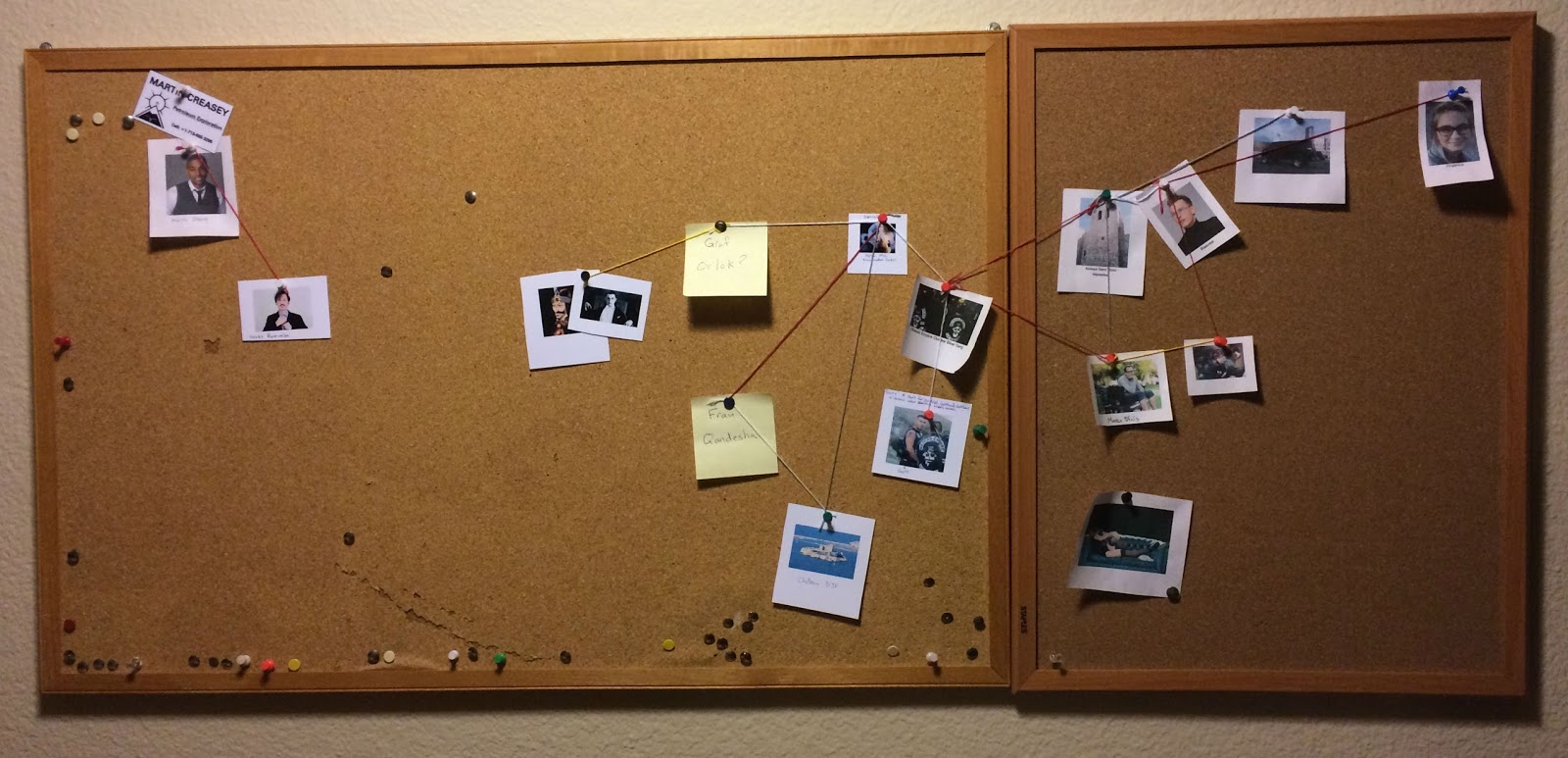
I think I need a bigger corkboard. Here's what my Night's Black Agents PCs have uncovered of the conspiracy as of session 3 (and that third session was only about 2 hours of play). Mostly stolen from The Zalozhniy Sanction: Russian mafiya in the top and left, undead in the the middle and creepy locations below that, plus a subplot or two over on the right. NBA's mechanics actually give the PCs bonus points for every piece of string linking people or places.

When non-gamer visitors come over they see that wall and immediately start asking if I'm investigating a murder. (Note to the surveillance team in the white van that's always down the street: It's all just a game. I promise.)


Monday, July 8, 2013

The Enemy Within - Campaign Log - Part 6 - Session 5 - Day 4

SPOILER ALERT: This is the campaign log for the new The Enemy Within for Warhammer 3rd Ed. Most of this is early stuff (day 4 of the adventure) but 1 paragraph in particular reveals things from much further into the scenario as written. If you haven't played that far yourself, consider this fair warning. Here be SPOILERS.

I wrote this nearly a month ago, and never got around to formatting and publishing it. Even then it was late and untimely. These notes are 6 sessions (and more than 2 full months) behind. Man, have I been lazy and unfocused lately.

PC List/Reminder:
    •    Burgolt the Nobleman Pistolier
    •    Hrulgar the Dwarven Runesmith
    •    Ninewise the Initiate of Ranald
    •    Lina the Bright Wizard


This session alternated between solid plot advancement and bitter frustration. There were some reasonably good character moments, and one heck of a fight. However, every single scene was either slow to start, or got kicked in the teeth by one eccentricity or another of the Warhammer system.
Love the setting, but Love/Hate the mechanics.

Day 4 begins with a business meeting between the PCs and Sir Curd Weiss, personal agent of Graf Friedrich von Kaufman.

Sir Curd Weiss Sidebar: Per the scenario notes, Weiss is a veteran of the Pistolkorps, but there's no mention of him every becoming a Knight. Just before the session in question, one of my players mentioned that she was probably going to aim for Knighthood as her 2nd or 3rd Career. Her character, Burgolt, is already a nobleman and a Pistolier, and the career cards mention that most Knightly Orders recruit heavily from the Pistolkorps.  She had a lot of questions about how one qualifies for knighthood, and whether or not there were any opportunities in the scenario to impress (or even interact with) any existing knights.

This lead to a conversation about the Knightly Orders, and I broke out the Omens of War book to reference the details. We got as far as the Knights of the Blazing Sun, whose background seemed like a good fit for Burgolt. As it turns out, their colors are black and either gold or yellow, and their symbol is a stylized sun. Just like the coat of arms of the von Kaufman family, and the device emblazoned on Curd Weiss's outfit in his picture. Admittedly, that also describes the sign of The Grand County of Averland in general… but it was certainly a noteworthy coincidence. Especially since I knew that the very next scene I was planning to run was Curd Weiss offering the PCs a job. It's a pretty small tweak to the character's background, and easy to implement. The PC will still have to impress the NPC to qualify, but it at least gives the player a lead on doing so.
Getting that scene started was a little rough. Technically the meeting was between Curd and Lina, and only Burgolt chose to accompany her. The offer to the PCs is supposed to start at 5 silver shillings each, but half the party wasn't there. I needed to prompt the PCs to mention they had cohorts to add to the job. My in-character attempts to have Curd ask about Lina and Burgolt's working relationship were, sadly, too similar to something I had another NPC say to them in the previous session. Since flighty Luminary Mauer implied last week that Lina and Burgolt were romantic, that's how the players took Curd's innocent questions. First they assume he's making the same mistake Mauer did, and then they thought he was hitting on Lina himself. Not at all what I intended. I regret trying to handle that conversation in-character, I should have just summarized. Anyhow, after some amount of stumbling, I eventually go to the job proposal. 

Don't Split The Sidebar: My players (and to be honest nearly every group I've ever played with or GM'd for) really love to split up the party. I don't know why that is. Personally, I think splitting the party should only be done as a last-resort. A thing you do only if there's a clock ticking, or if there's a _really good_ in-character reason why it would be detrimental to include the other PCs in the scene.  Any time you split the party, it's pretty much guaranteeing that someone is going to be bored for some amount of time. It slows down the pacing, often resulting in the PCs only getting to half as much plot as they'd get to without it. It denies the party resources the GM or author expected them to have access to when encounters were designed.  It's always a handicap, but everybody does it. I'll never be able to wrap my head around that, even though I'm often guilty of this exact thing myself when I'm a player.

Curd hires the PCs (all four of them) to travel a particular road, along which some carriages and wagons have gone missing. Look for signs of banditry or accident, and return with a report. If they find this latest wagon, or the valuables it carried, return them. The most important cargo is a series of expensive Cathayan silks, but there's also some crates of wine, and several barrels of chemicals for industrial processes. If they kill some bandits in the process, there will be a bonus. At the least, they'll get 5 silver each (plus a hot meal, and a roof over their heads at the Inn at the end of the road) for a day's work.
Suspiciously Silky Sidebar:  Several things strike me as odd about this little bit of the adventure. #1: The diversion to the countryside drags the PCs away from the investigation down on the docks. #2: The silks are specifically mentioned as being shipped by carriage from Nuln, which is located due West of Averhiem on the Aver river. #3: The intended recipient of this cargo (the merchant Adolphus Starke) owns a boat and doesn't live in Averhiem. #4: Cathay is East of the Empire.   As it turns out, everything is on the up-and-up, and none of this distracted or worried my players in the least.  The coincidental intersection of those four facts could easily have turned into a huge red herring. If any of my players had chosen to look at a map of the Warhammer world at the start of this session, they may have become mired in unwarranted suspicion of Weiss, Starke or von Kaufmann. I consider that a bullet dodged, and with that as context I guess I'm thankful they just thought Sir Curd Weiss had the hots for Lina instead.
The other two players engage in some shopping at the open-air market just across the street from where the meeting is taking place. Ninewise wants to buy a couple sets of clothes. She wants to be able to pose as silver or brass tier as the mood suits her. At first this stymies me, as there's no clothing entries on the general equipment matrix… but after a moment I realize there's a price stated clearly in the armor section, and I'm eventually able to reverse-engineer brass and silver tier versions of it.
Shopping System Sadness Sidebar: Shopping is never an exciting part of any adventure. It's positively boring for any player who's not currently involved in the process of adding beneficial new equipment to their character sheet. For the GM it's usually boring, but sometimes that's spiked with frustration or concern stemming from odd pricing decisions in the rulebooks or the game-changing nature of some high-end equipment.  It's the sort of thing that should be, whenever possible, handled off-camera. Compile a list (complete with prices from the books) between sessions or scenes, and hand it to the GM for a quick approval.
Unfortunately, Warhammer 3rd makes that off-camera expediency all but impossible. There's no simple equipment list. Buying anything other than a weapon involves looking up the category on a chart, comparing that chart to more detailed text descriptions on the next page, followed frequently by asking the GM to make a judgement call when that info turns out to be incomplete, after which the player makes two die rolls (one for availability and one for haggling) and depending on the second die roll you do some percentage multiplication. WTF!? It's very tempting to skip all that availability and haggling nonsense, but doing so would deprive the adventure of some of it's flavor. There's specific rules in the scenario notes for what sort of items are cheaper or more costly in this town, further modified by day of the week and what part of town you're shopping in. It's mildly cool and very flavorful, but also a big pain in the haversack.
The PCs meet up, and there's an info dump about the job, which they all agree to embark on today.

Rather than set out at once, there's a short delay so Hrulgar can deliver bad news to his friend Captain Marcus Baerfaust. Burgolt goes with him. A second awkward introduction happens. I keep trying to cue the players to introduce and vouch for the other PCs, but they never take the hint (this same thing happened in the next two sessions at least). I clearly need to be more bluntly out-of-character about it. Since Hrulgar doesn't vouch for Burgolt, the Captain is uneasy talking in front of a von Engler, and through that I inadvertently reinforce the PCs desire to always split the party. Oops!

Despite botching the introductions, this is still rather a bit easier access to Baerfaust than the adventure technically allows for, but it matches Hrulgar's bio nicely (because of the way he answered questions on the "Battle-Scarred" background card). So I don't really want to discourage it, but I'm really not prepared for another visit, and more importantly don't want to slow down our progress at all. I know there's a big fight happening in a later scene, and I need to make sure I have enough time for it. So I decide Baerfaust is about to head out of the palace on some duty, and can only speak to Hrulgar in passing, whilst in the stable.

MAJOR SPOILER ALERT: If you're playing this campaign at someone else's table, or think you might do so one day, skip the next paragraph entirely. At best it's full of spoilers, and at worst it may be a terrible red herring depending on what "behind the scenes" decisions your GM has made.

Hrulgar conveys the news about the bodies the found the day before. He mentions their state, disfigured as part of some sort of ritual sacrifice by mythical Skaven and/or your more run-of-the-mill evil witches, then dumped in acid. He also drops the bombshell that Baerfaust's nephew Ingo may be among the as-yet-unidentified dead. The captain has no time for sentimentality, he's been summoned to the von Tuchtenagen estate concerning a legal matter with the city guard, so will have to mourn later.  (This is largely name-dropping for later use. I do a lot of that. In this case, it won't come up again for several sessions.) It's also thematic reinforcement, further solidifying the notion that though technically in charge of the Averheim Garrison and City Watch, Baerfaust serves at the whims of various noble houses and is beholden to the whole lot of them at least until a new Elector-Count is chosen. I add one more detail before he mounts his horse. Baerfaust spoke further with Lt Arta Schaeffer about Ingo's last report before his disappearance. Schaeffer remembers that he asked her how to spell two words: "jade" and "scepter" and from the way he asked she inferred they were being used in the same sentence.

Meanwhile, Ninewise and Lina hang back at the market. Having done some clothes shopping, Ninewise now wants to buy a set of pauper's clothing for her sister the wizard. There may be times where Lina doesn't want to advertise her spellcasting credentials via her official robes. I remind them that the robes of her order, while marking her abilities for all to see, do at least provide some amount of legal protection from witch-hunters and others who might be superstitious or suspicious. They still pick up a change of outfit for Lina, just in case.

The group meets back up, and heads out on the road per their agreement with Curd Weiss. Along the way, they cross the path of an old Strigany (essentially Gypsy) pedlar. I flavor the heck out of his cart: goat-drawn modified wheel-barrow with a variety of cabinets more or less nailed on top of one another and covered with trinkets and junk, think I had a cat in a bird cage on top too. It was intentionally ridiculous. As they approach, he stops, opens up the cabinets, and starts shouting "rag-a-bo!" This is a traditional call of a "rag & bone man", a fellow who gathers up the cast-offs from noble houses (or where-ever junk is being discarded) to resell second-hand. He's in the adventure notes, but not in much detail.

There's three points to this encounter:

#1: When the PCs mention to him that wagons on this route have been hit by bandits, he has a minor clue to pass on. He can draw the PCs attention to the fact that further up the road there's a spot where wagon ruts and animal tracks leave the road. This is so that we don't have to rely on a lucky Observation check to advance the plot, and have an alternate method to convey the information. This isn't Gumshoe, after all, so I applaud the scenario designers for this touch.

#2: If the PCs capture and question the bandits, their initial ruse is to get off the hook is to claim they were hired by a Strigany crime boss. This is a pretty ridiculous red herring and easy enough for the PCs to settle, so i think it's just in the scenario notes to give a touch of verisimilitude and room to improvise. They don't waste any word count on what happens if the PCs buy this story and go murder the pedlar, for example. I'm kinda glad my players didn't take the bait.

#3: Aside from his (non-)participation in the plot, this minor encounter gave me an opportunity to redress a minor unfairness to Hrulgar, the Apprentice Runesmith character in my party. Runesmithing is a weird career. It lets you imbue magic items, which is potentially really powerful. However, it's also really expensive to do so, as you have to start with a superior-quality item. There's a lot of hurdles to jump through, and my player had made no secret of how annoying he found the process. I figured this traveling pedlar would allow me an opportunity to give him a leg up on the smithing of a single runic item, without any fear of it setting a precedent.  It's a one-of-a-kind item from a traveling merchant with an unreliable supply line.

So the merchant shows them his wares, and makes some small talk.  One out-of-place amulet amongst all the junk jewelry strikes Hrulgar's eye. It's a dwarven ancestor badge, the sort of thing that should never be allowed in hands of non-dwarves, and perfect rune-fodder. The merchant can't recall where he got it, and figures he's not going to a proper dwarf fortress for months, so this is his best opportunity to unload it. He states the price as 20 silver schillings. That's a heck of a steal by itself, but I was forgetting the detailed Haggling rules when I made up that number. One good die roll later, and the price is cut in half.  I've now met my quota of kindness for one session, time to plan the TPK.

How Much Is That Runic Amulet In The Sidebar?  The price I'd previously announced for a rune-ready superior quality amulet was 1 Gold at the market in town. That's a fairly large amount in Warhammer 3rd. It's 1/5th the maximum a PC can start with, and amounts to 10 day's pay for a typical mercenary or bodyguard. However, I have no idea if it was way too high or way too low. A hand weapon that's high-enough quality to accept a rune would cost 2.5 Gold, but it's also a usable weapon that has a bonus-die on attacks. On the other hand, a "superior quality" sword doesn't imply that it's all fancied up with gold filigree and inset gems, unlike a "superior" piece of jewelry. There is a necklace available as treasure later in the adventure - but it's listed value is not particularly useful in this regards because the price given is for if you fence or pawn it, and we aren't clearly told whether or not it's "superior". From a gamist perspective, 1 Gold seems overpriced for a career features that also takes XP, time, and a workshop. But from a simulationist perspective, a Gold feels way too cheap. Months later, I'm still wrestling with this.

The PCs find the spot where multiple carriages and animals left the road and headed into the woods. They head down the trail, mostly unconcerned about stealth because they assume that the carts are just plain gone. Along the way, they find a broken end of a small barrel, sitting in a pile of dark grey sludge. The barrel probably fell off a wagon or carriage as it passed through the forest trail. The sludge turns out to be gunpowder, ruined from exposure the driving Averland rain.

I mention there's some smoke over the trees, like a campfire in some distant clearing. The PCs make note of it, and continue ahead. The assumption, I would later learn, is that since it's been several days since the carriage failed to arrive in Averheim, there's no chance of the bandits (if any) being still on-site. If there's anyone camping in the area, they are at most witnesses, not suspects.  This is actually a pretty clever deduction, but not what the scenario author had in mind at all. As it turns out, the campers are not only brigands, but also mutants.

Depending on how much investigation your group decides to do, this fight could be happening a couple sessions earlier than it did for us, so the PCs might have had 2 or 3 fewer advances under their belts. I'd read on the forums that this fight is mostly a cakewalk.  It's balanced for a party of 3 PCs (as that's how many the main box set supports) with randomly-drawn careers. My 4 PCs include a pistolier, a fire mage, and a dwarf who is technically a merchant but built to maximize melee effectiveness.  The one "non-combatant" in our group has several buff spells and a smidge of healing. Without some tinkering, this fight would probably last just 1 round and fail to do any damage to the players. Where's the fun in that?

The encounter as described in the scenario is 5 mutants, 1 of which is already badly wounded and 3 of which are drunk.  Multiple GMs before me had complained about it being underwhelming. The PCs are just about guaranteed to catch them unawares. In addition, these so-called mutants don't actually have mutant stats as-written. They don't even have actual mutation cards, just descriptions.  They use "townsfolk" stats, so their attacks are little weaker than "real" mutants, and they don't cause Fear. This is justified because their mutations are "mostly cosmetic". That strikes me as ridiculous. It would be dubious even if I hadn't been warned that the fight had been a push-over at other tables. Citizens of the Empire have a great fear and hatred for anyone different than themselves. If I say these mutants aren't very scary because they only have feathers and donkey ears, that would set a precedent. Most of the mutations in the mutation deck are "cosmetic", but the PCs will still be hunted outcasts if they accumulate a large number corruption points. Corruption and mutation are supposed to be serious dangers, and treating them so lightly really undermines this aspect of the setting. An upgrade was clearly in order.

For starters, I restored them all to actual Mutant stats. The actual Characteristic increase was very minor, but it did give them an extra point of Soak and Fear 1. In practice, the Fear turned out to be pretty trivial as well, as most starting PCs have something like a 70% chance to pass a Fear 1 test, and the consequences of failure are pretty minor for a PC. Then I gave each NPC an actual honest-to-tzeentchness mutation card, in some cases 2. As best as possible I tried to match up the cards to the descriptions of the mutants in the scenario. So Fritz' waddle becomes the (useless) Grotesque Features card, but Gerta's warty skin actually boosts her Soak. I also reduced the number of wounds on the already-injured mutant so he couldn't accidentally run himself to death just getting into melee.

To that I added the Chaos monster-group sheet. I knew not to expect the Eye of the Gods or Chaotic Fury tracks to actually trigger in a battle this short, but it came with juicy Tactic Talent slots. I filled them with Exploit Weakness and Push It Till You Drop. This boosted their damage and combat effectiveness, but in a way I could easily fine-tune on the fly. If the PCs were winning, I'd have the mutants gang up, and trigger both tactics. If the PCs were having problems, I could easily make tactical decisions that would render either or both tactics powerless. Rather than rely on the boring old Basic Actions, I gave them Brutal Assault, Rampaging Mutation, and Revel in Corruption. Again, this gave me a lot of control over the pacing and threat level of the battle.

Towards that end it worked really well, but there was still some unexpected general weirdness to the fight.  Once the PCs and Mutants saw each other, we rolled initiative. I based this on Agility, but the first two PCs to act actually took Social actions, trying to Influence the mutants. I wasn't about to let them talk their way out of a fight with mutants entirely, but I did let this convince the two sober mutants to abandon their drunken compatriots and flee. This worked out okay in retrospect, but at the time it meant the fight started slowly and no one quite got what they wanted out of the scene.

Eventually a bonafide melee broke out. 3 out of 4 characters were heavily wounded by the end of the fight. The remaining 3 drunken mutants provided plenty of challenge, and one of them got to unleash the Rampaging Mutation and have his arm melt off while attacking. It was a crazy hard fight. I suspect I may have over-compensated for the reported weakness of the battle, but it's hard to say for certain. Ninewise stayed out of the fight entirely which meant the others had to pick up some slack, and Lina got really screwed by the miscast deck.

Lina had been standing in the woods, flinging attack spells to support Hrulgar and Burgolt who were being pounded on by the mutants. Lina blasted a target (who coincidentally has the Brightly-Colored mutation) with a arching bolt of fire… and scored two chaos stars in the process. So we flip over a miscast card. For 1 chaos star, it says an item in the casters possession gets stained a bright color. So I narrate that her fire strikes the mutant and sets him ablaze, but the flames turn the same green hue as his mutated skin and then arc back into the woods to discolor Ninewise's robe. The red trim turns green on one side of her robe. With his dying words the mutant cries out to his unholy god "Thank you, Lord Tzeentch, Changer of Ways! Thank you for blessing me with your hellfire!"

Then I flipped over the next miscast card to resolve the remaining chaos star. Wow. The new card was "Arcing Magic." It fit the visual theme we'd just described, but it was also the worst possible single-star result in the deck for an attack spell. It makes your same spell hit a second, unwanted, target for full effect. Not too bad if you're doing a buff or a heal, but potentially PC-killing on a major attack like this. So, rather than arc again and possibly drop a PC whose already been getting smashed in melee, I just had the damage pile onto Lina.  It was a huge stack of wounds, including 1 critical… and wouldn't you know it, she gets one of the Serious Wound cards. "Bum Knee," which is not the best thematic fit to being blasted by magic fire, but I let it ride. So it's a lingering injury that will stick around for a very long time. Still technically better than "1 Chaos Star: A PC dies", but not by much. This leaves a sinking feeling in my stomach about the critical wound and miscast systems.

Eventually the drunk mutants go down, but by then the sober ones are long gone. Burgolt might have been able to chase them down on horseback, but he was stabbed multiple times in the fight so they decide not to pursue.

With the action out of the way, the PCs can search the bandit camp. Scattered amongst the tents are various unappetizing debris that you might expect from a mutant camp, including some "meat" of dubious origin (probably the missing coachmen and roadwardens) and a bunch of poorly-maintained hand weapons.
Since the site has been contaminated for a while, I have the PCs each make a Corruption check. Usually these sorts of tests are made for contact with really dangerous substances or powerful magic, not simply mutant cooties. As a result, the official minimum difficulty is 2 purple dice. That seemed a bit out-of-line with the risk here, so I had them roll vs only 1 purple, and I threw in a bonus white die for the recent cleansing rain. The dice continued to be unkind to the PCs though, just as they had through the fight. Both Lina and Ninewise picked up 1 corruption point each. It's not a huge deal yet, but it could cause trouble down the road.

Checking the camp further, they find there's only one carriage here, but  there are signs that more had been parked here previously. There's a big spot where a number of barrels were stacked for several days. Now they are gone, leaving only an impression in the trampled grass to mark where they'd sat. If you're thinking the barrels were full of gunpowder just like the broken ones the PCs found on the way here, you're correct. "Chemicals for industrial processes," indeed. The bottles of wine are here as well, but more than half of them have been emptied. The silks have been rifled through, but are mostly okay except for one or two used to clean up mutant bodily functions. We retroactively rule that that particular discovery is how Ninewise picked up her corruption point. Eww.

The next Coaching Inn is just a mile or two down the road, so they're able to go fetch some porters, horses, and wagons to gather up anything that belongs to Graf von Kaufman or his Red Arrow Coaching Company. The Inn is just a short distance from a Shallyan hospice and leper colony, so the PCs can get first-aid. It's not quite enough to heal them all completely, but it's better than nothing. They have dinner and a couple Inn rooms courtesy of the letter Curd Weiss gave them.

End of Session 5. End of Day 4.
Party Tension is at 9. I don't remember why it shot up 3 points this session, but between 2 awkward meetings and a mutant battle, that seems reasonable.
Criminal Empire: Agenda remains at 6, and Stability at 7.
Corruption: Lina has 2, Ninewise has 1.
Wounds: Lina and Burgolt each had a couple left over the next morning. Lina has a "Bum Knee" that will be really hard to recover from entirely, but at least it's effects will rarely trigger.

Friday, December 2, 2011

Information Is All - and sometimes that drives me crazy!

As some of my readers know, I'm running this time-travel game two nights a week. It's the setting of the out-of-print Continuum RPG, but with mechanics derived primarily from the Gumshoe system (Trail of Cthulhu, Esoterrorists, etc.)  It's a game where PCs can teleport and time-travel at will, in a deterministic universe where the past (and future) is unchangeable and set in stone, but you can often reverse-engineer alternate explanations to the events that have already been witnessed. (Sort of like when Doc Brown puts on the bullet-proof vest to survive that time when Marty saw him get gunned down by the Libyan terrorists. You can't stop the established events from happening, but you can finesse the unknown details.)

1. Information Is All

Upon whether I know or not know a thing, depends my existence. If I know a thing is to happen, it is my foremost responsibility to see that it happens. This is my Yet, or Required Future, and it is the price I gladly pay to span time. Change of the known is resisted by the Continuum ceaselessly so that our greater liberties and lives will be fulfilled.

- The First Maxim, CoNTINUUM: roleplaying in The Yet, by Adams / Fooden / Manui

I'm constantly working on the myriad small details of this campaign. It's got a huge cast of NPCs spanning centuries, and multiple interwoven long-term plotlines. While Gumshoe is a pretty rules-light system, converting the very heady and esoteric concepts of Continuum's "Time Combat" (not to mention Narcissist's "Mnemelos Scale" of "Map Coordinates") into Gumshoe has also produced a fairly lengthy body of text. I'm really proud of the hard work I've been putting into it for the past two years.

And yet I am continually frustrated by my inability to share most of that work Here. The bulk of the mechanical conversion work would push the boundaries of "fair use" to just post it on the wide-open internet. More to the point, the plot- and character-related material often runs into spoiler territory. Given that it's a game where the PCs can hop down to 1518 on a whim (as they've done recently to check out the dancing plague), the GM has to spend a lot of time prepping things that may or may not get used, any of which would totally wreck the mystery (of a very-much puzzle-and-mystery-driven campaign) if they were leaked to the players out of sequence. I'm sure all GMs of mystery-based games get a certain amount of this "keep the plot to myself" anxiety, but it is most definitely intensified by the non-linear nature of time travel (the PCs can pursue plot threads in any sequence and with no time-pressure to keep them on-task) and the particular deterministic wrinkles of the way Continuum's in-game consensus reality is formed. There's never really a moment where you can definitively say that a specific piece of unrevealed plot twist is no longer relevant. Every piece of information the characters have determines things that are set in stone and cannot be altered except by fiddling with the details that they clearly didn't observe. This means spoilers don't just undermine dramatic tension, they also force the wave-form of the universe to collapse into a particular resolved quantum state. Disentangling in-character vs out-of-character information is harder than in most other games, which provokes a paranoid degree of caution and silence when discussing the game other than in-character and "at the table".

Sometimes that need to play things close to the vest makes me feel like I'm going to burst at the seams. That's my recurring bugaboo that nags at me no matter how much fun the game is -- in fact this specific frustration gets worse when the sessions and plots are at their best. Despite two years of continual experience with it, I still haven't grown comfortable with the feeling, and the growing body of work I can't really share without ruining future surprises just about gets the better of me at times.

I really need to figure out ways in which I can share a larger portion of the data, work and writing without undermining the ongoing campaign. I've been saying that for two years now - it's about damn time I make good on it.

Tuesday, July 5, 2011

A good GM can save a bad system.

A good GM can save a bad system. I played several new (for me) RPGS this weekend at the Emerald City Game Fest, and I had a ton of fun. In spite of the mechanics. These games had ridiculous off-kilter mechanics, but the GMs kept the games rolling and provided more than enough color to overcome the flaws in the systems.

The first game was octaNe. The scenario was a riff on Big Trouble In Little China, and I gather that's not the usual setting for the game, but it was a lot of fun. Towards the end, the silliness meter cranked up higher than it goes in Big Trouble In Little China (and that's saying something, isn't it?). Ranma and Sailor Moon both showed up in the final scene, a couple PCs got replaced by their evil twins, things just got... odd.

All of which certainly justifies using some light-weight system (instead of, say, Feng Shui, or d20). Yet, I can't say I cared for octaNe. The mechanics were very unbalanced. The pregen I was playing had a Daring rating of 2, and (since the other pregens didn't) that meant I almost always acted first, almost always succeeded at every task, and ended every conflict with more plot points than I started with.

I can't imagine building any sort of dramatic tension in this system, given that on any die roll the PCs have at least a 71% chance of winning... the whole conflict. Because I was going first every round, I was constantly having to reign myself in, force myself to leave something for the other PCs to fight (or do). It was not easy.

I feel particularly bad for one of the players in our group whose best stat was Magic. Magic goes last each round, _and_ you have to pay plot points to activate it. In theory this is somehow compensated for by being broadly applicable and open-ended, but given the level of narrative freedom that any of the other stats already has, I can't imagine how that could possibly compensate for such drawbacks.

To add insult to injury, his second best stat was Charm... which sits in the middle of the initiative order. Ever try to make a social roll in the middle of the round, _after_ you comrades have already killed half the enemies? Oh, sure, on a success the rules let you narrate a sudden peaceful resolution, but it will rarely pass the disbelief test. "After you ambush and behead most of them, I convince the survivors that there are non-violent solutions to our disagreement." Sure.

Painfully bad system. I think the exact same scenario would have been far, far better with Wu Shu, Risus, PDQ, 3:16, F#, or any of a dozen other "fast and fun" systems. I can't think of any reason why I would want to use octaNe's system. Admittedly, I've never read the rulebook, so maybe there's something I'm missing here... but I doubt it.

Honestly, I'd rather just have everyone roll a single die at the start of a conflict and highest roll narrates how the entire conflict wraps up. It'd honestly be better balanced. As it was, I'd always go first, and nearly always had the freedom to end the entire encounter on that one roll, so spreading that around to the other PCs would have had to be an improvement. I have never, ever in my decades of gaming experience, had to fight so hard to keep myself from abusing a system. The flaws in octaNe are so obvious and horrid, it's amazing it ever made it into print (and even more amazing that there are supplements and expansions out there).

And yet we had fun. The GM did a few really interesting things outside of combat that really saved the game from its own conflict resolution system. His previous plays of the system had indicated that there'd be a plethora of plot points sitting unused, so he came up with a way to make them meaningful. He got these really fancy chinese envelopes and stuffed them with "fortunes". Clues, plot hints, solutions to puzzles, revelations of background info, and some real game-changers like "your character is actually a ghost". So, between scenes, we cashed in excess points for clues, and they really helped coax us along several possible plotlines. He also prepped color photos of all the locations alluded to in the clues (and many of the villains), so there was plenty of instant flavor and atmosphere, and a sense that we were "on the right path" even though it was free-form. Without these clever structural cues being available, I imagine our narrative freedom would have imploded the plot before the end of the second conflict scene. Well done, Mr. GM! I may just have to steal your red envelopes for my own future campaigns.

Thursday, October 14, 2010

Gumshoe Points Per Session

For the past year, I've been running a Gumshoe game with one really major house rule: All the skill pools refresh automatically at the start of every session.  It's a simple change, but made the game a lot more enjoyable.


With this rule, there's no need to track from week to week how many points you have left/available in Chemistry (or whatever other skill is critical to the task at hand).  I've found this does a great job of simplifying things, and freeing up the players to actually use their points.  There's less book-keeping, and as a bonus players spend less time and energy agonizing over mechanical decisions.

In straight Gumshoe without this house rule, I tend to see players hoard points. Usually, they start out the campaign spending freely, but eventually they burn a point on something frivolous that turns out would have been really helpful 2 sessions later. After that happens once or twice, the players hoard their remaining points for weeks on end, then wrap up a scenario with tons of unspent reserves. This is far from ideal, and tends to just leave everyone feeling like the game didn't quite come together.

My houserule nips that problem in the bud, and gets the game rolling. Players feel empowered to spend points at any time. The result is characters that feel highly skilled, proactive, and very competent. As soon as they've identified a problem, they're already on top of the solution. I happen to like that.

Of course, this freedom to spend the points without drawback, means that PCs need a lot fewer points. Default Gumshoe (Trail of Cthulhu or Esoterrorists) give the PCs 60 to 65 General Points and 16 to 32 Investigative Points, for a total of around 80 or 90 points.  I gave my PCs in the current campaign less than half that, a total of just 32 points each, split between the two categories, with lots of other restrictions on top. In hindsight, I could have trimmed that even further, probably down to 25 points per character since it's a low-combat campaign and our sessions are only 3 hours long. 

Friday, March 19, 2010

Core Clues ported to Savage Worlds

This started as a short tangent in my last post* (about using Gumshoe's "Core Clues" in Warhammer FRP), and grew long enough to need a post of it's own:

When I was running Savage Worlds on a more regular basis*, I borrowed from Gumshoe and set my difficulties for clue-gathering at a 2, usually with some added bonus/benefit if the PC got an 8+.

Didn't matter if it was an interrogation using Streetwise, or search involving Notice, the only way you could fail was by getting double 1's, and choosing not to spend a benny on a reroll. That way, the PCs either got the clue, or I was given an opportunity to narrate how some ridiculous blunder or bizarre coincidence kept them from getting the info they wanted.

It sounds better than it actually plays, unfortunately. I've found that some Savage Worlds players horde their bennies and only expend them in combat. Which means that in practice, there's still some danger of things stalling out because of a bad roll. It's still better than failing to get the clue because you rolled a "3" on a d8 and a d6, but not as much better as I'd imagined it to be. And should someone be so unlucky as to roll the critical failure, spend a benny and get a second critical failure, then you're adding insult to injury.

*: Link to the post using on "core clues" in Warhammer FRP
**: I'm still running my Savage Worlds fantasy game whenever my wife and I go visit our friends in Portland, but that only happens 4 or 5 times a year, so I hardly call that "regular".

Core Clues ported to WFRP

GUMSHOE has a concept called "Core Clues", clues that are so vital to the plot that you literally can't miss them. Whatever else you think of GUMSHOE, there is something very nice about knowing that a fluke bad die roll can't derail the plot and make the players spin their wheels for hours without a lead.

Let's face it, even when players get all the clues without the dice ever hosing them, there's still a good chance they'll misinterpret those clues, chase a red herring or accuse the wrong NPC, argue with the other players, or decide "my character wouldn't try to solve this mystery or pursue that clue". We've all seen situations where some player gets a wild idea and runs off tilting a windmills. What the GM thinks is crystal clear, turns out to be opaque to the players, and now he has to improvise some windmill stats. :)

Today, at the FFG forums, someone was asking about search checks in WFRP 3rd Ed. They were converting a 2nd Ed adventure, that relied on a lot of "A difficult search roll will reveal..." statements. I started typing up a reply about how it all depends on the nature of the clue. That if it's vital to advance the plot and make sure the players have fun, you should just give it to them automatically, but if it's a roll to find some treasure that's not a needed McGuffin, then dice are appropriate.

As I was typing that reply, though, I realized that the mechanics of WFRP are actually perfect for the whole "core clue" concept. You could make all (or the most vital) clue-gathering rolls succeed automatically, not even need a single success to get the info. Then, you just come up with some fun benefits for Boons, Sigmar's Comet or the "triple hammer line", and some nasty disadvantages for the Banes and Chaos Stars.


Here's an example of how it might play out:

The PCs are searching a nobleman's personal library, trying to see if there's any damning evidence of his guilt in some previous crime. The GM has decided that yes, there's some personal correspondence with his co-conspirator tucked behind some books. Without this bit of info, the players are unlikely to call out the nobleman, and will probably never connect the dots to the co-conspirator. Instead the game would bog down as they argue amongst themselves about whether or not he's guilty.

So the GM decides that any search roll will find the main clue, that being the letters behind the book on the shelf. However, a roll of Observation + Int is still called for, with the following possible effects based on the other symbols rolled:
  • Boon: You also find a loaded pistol resting out-of-sight and above your head on top of the same shelving unit. Taking it would be theft, but it would also prevent the sinister nobleman from using it against you later.
  • Bane: The household servants overhear your search, or notice that you've moved things around. This raises their suspicions of you. Any social rolls vs the staff or residents of the manor are now penalized by 1 misfortune die.
  • Chaos Star: The nobleman himself comes home early and walks right in on you. Everyone in the scene takes a point of Stress. He knows you're on to him. Since you've been ransacking his office, he'd be in his rights to grab the pistol from above the shelf and arrest or shoot you. It'd be foolish and dangerous, but within his rights as a nobleman, so depending on how many PCs are present, he just might do it.

Wednesday, January 13, 2010

Daybreak as an RPG

My wife and I recently Netflixed a TV show called Daybreak. It's sort of like if Groundhog Day were a serious Detective show. The lead character is living the same day over and over again, and it's a heck of a day, with murders and conspiracy aplenty.

The show could inspire a really awesome RPG campaign, especially for a single-player campaign. You'd set up two or three mysteries, all happening on the same day, all with serious consequences for the PC if they were left unattended. In the background, you probably set up an additional mystery of a more sci-fi variety, that explains why the character is stuck in time.

The PC experiences each day over and over again, with things happening on a particular course if they do nothing. They need to solve all the mysteries, and then figure out how to resolve them all positively on the same day that they undo the time loop. You'd have a campaign with a definite end-goal in sight from the start.

There'd be a big burden on the GM, and I'd say you'd want to run it with a laptop at the ready, so you could have instant access to a lengthy timeline of where every NPC is at every minute of the day.

I'd run GUMSHOE for it. Both because I really like Gumshoe, but also because it has really easy mechanics to repeat actions again and again. When something comes up that goes poorly, you can spend a point to make it work out better next time. If you get a version you're happy with, a simple point spend ensures repeat performance when you try it again the next day. Very little dice karma to complicate things.

I'd have the PCs point pools refresh at the start of every day, so they had a limited supply of points to juggle for overcoming the obstacles. Experience would be tricky - as the cyclical nature suggests you'd never get to level up. However, if you watch the show, he does find ways to change things over time, and that might result in bonus dedicated pool points in GUMSHOE.

And I'd definitely use Daybreak's precedent for damage. Your whole body is doing the time loop, so if you're shot, you wake up with a bullet hole the next morning. Health and Stability would NOT refresh daily, so getting medical and psychiatric care may prove important if things go badly early on. That helps keeps the tension, and prevents certain Bill Murray style antics.


A tiny bit more about the show:
Daybreak ran for less than a season. One season's worth of episodes were made though, and the last episode was clearly crafted knowing that they weren't gonna get picked up for a season two. It wraps up the plot neat-and-tidy, including several things that would have made a killer second season. It's really sad it got canceled, 'cause it's 5-star material, IMHO. Great acting, intelligent scripts, and plenty of unexpected twists. It's 58% mystery / detective, 40% action / adventure, with 1% humor and 1% sci-fi. If you've got netflix, it's well worth the rental.

Monday, September 21, 2009

Azathoth Upstairs, Cthulhu Downstairs


One of the other players in Fordyce Hall (a Cthulhu by Gaslight scenario I played in at Gwen Con) put up this lovely picture of me about to bash another PC's brains in. They put up a short video clip as well, and a brief Live Journal entry about it, too. Click here for their full coverage. Pretty sure that's the journal of a person named Erik, who was playing the character of the Housekeeper (or head Maid or head Cook or something along those lines - in charge of the female staff of the manor house in the game).

The big blur in the photo is me, suddenly swinging an imaginary shovel at Gwendolyn Kestrel, host of GwenCon. (In the background are Stan! and Sparky.) This image was prior to Gwen's reaction. She apparently wasn't expecting my bit of LARPing at the tabletop, and jumped. You would too if the crazy guy sitting next to you suddenly swung an imaginary shovel within a couple inches of your face. Sorry, Gwen!

The game was great fun - everybody's roleplaying was top-notch, with lots of accents and affectations, appropriate levels of in-party conflict and good humor. We were the servants of a nobleman who had just inherited some creepy old manor. It was our job to prepare the house for his arrival. It was Cthulhu, though, so only about half the staff escaped with their lives and sanity. I started the day by saving Gwen's character from an ice-cold demon-filled well, but by tea-time I'd had a full transformation. I went crazy, nearly killed Gwen's character, and ran off into the woods never to be seen again. One of the other PCs (played by Genevieve, not pictured above) ended up taking bad advice I gave her, and got captured or possessed by some powerful evil entity. All the PCs lost their jobs, at least.

My only misgiving about this very excellent and enjoyable scenario was that there was an awful lot packed in for a mere 4-hour block. By my count there were at least 7 supernatural fiends - a ghost in the manor house, a hob in cat form we managed to placate, a second hob that killed one of our horses, the clawed thing in the well, the tower-creatures that dragged off genevieve, the dark presence in the woods, and the thing at the center of the hedge maze. And I'm not sure if that list counts whatever it was that tried shoving Mary into the oven, or whatever reanimated the dead horse. The property was huge, as well, with carriage house, collapsed woodshed, hidden well, underground tunnels, hedgemaze, woods, free-standing tower, and a 3-wing 80+ bedroom manor house. Then there was a mystery about a suicide off the grounds, our surprise that the realtor wasn't awaiting us at the train station, and the fact the townsfolk wanted nothing to do with the manor. It was a pretty amazing example of highly-detailed verisimiltude-rich sandbox gaming, but there was no chance in heck of us accomplishing or unraveling anything. Luckily, it was Cthulhu, where resolution is more likely to involve madness and death than victory. Had we serious intentions toward the goal of solving or winning the scenario, it would have been way too much plot for the time.

Thursday, May 28, 2009

Using Cthulhu Mythos (aka Mythos Lore to us Old Schoolers)

The cliff hanger I left off with in monday's session of Trail of Cthulhu was the realization that a monster was creeping up behind her, and she's got a long hard sprint back to the boat. On the plus side, the PC did spend Cthulhu Mythos to figure out what the monster was, which also clued her in to a possible weapon against it if she can just escape this encounter. It cost her 4 Stability and 1 Sanity to pull that clue out of Cthulhu's butt, and she hasn't even seen the monster yet. Which is creeping up behind her.

Prior to this session, I was a little dubious about the Investigative Ability called Cthulhu Mythos. It seemed to me like a cludge, a way for the Keeper to skip out on making a well-layered mystery with interwoven clues. I understood that some GMs might need that (he says, looking down his nose as if he himself never had a plot hole, deus ex machina, or mystery that was beyond the PCs ability to solve), but it struck me as cheap. Now I understand the real purpose of it, and I wish the rules had spelled it out just a tiny bit more clearly.

As the GM, you never want to set up your mystery so that PCs have to spend Cthulhu Mythos to put clues together - that'd be cruel and unfair since doing so saps their Stability pretty hard. Neither is it intended to let PCs skip doing legwork and jump ahead of the plot. Instead the Cthulhu Mythos spend exists solely as an escape valve for PCs, who have already jumped ahead of the plot by dumb luck or clever intuition.

Normal police procedures involve raids and arrests, but that's not always an option in Cthulhu. Cops just have to figure out whodunnit, then call in the cavalry. A Cthulhu investigator has to figure out whodunnit, whatdunnit, whether or not their weapons can hurt it, how to banish it without going crazy in the process. You're on their own, and you have to work fast - or else the world might end! Once you know whodunnit, there's a lot of motivation to confront them before they can grow any stronger (or summon something stronger). When you've figured out who the villain is earlier than the GM anticipated you would, you may no longer feel any need to track down seemingly unrelated clues. In Cthulhu, though, those unrelated clues are what usually hides the means to foil the the cultists plans, defeat the monster, etc.

If, in your rush to solve the mystery you've put yourself in dangerous proximity to some nasty thing without being properly prepared for it, Cthulhu Mythos is the emergency shut-off valve. Either it gives you the weapon you need, or suggests where you can find that weapon, or points back to the line of clues you skipped over that will eventually lead to that weapon, or it just hits your sanity enough that you faint and don't have to worry about the monster for the moment.

In other words, you don't spend Cthulhu Mythos because you aren't getting anywhere - you spend Cthullu Mythos because you got too far, too fast.

Monday, March 9, 2009

I'm really digging Trail of Cthulhu

When I bought Esoterrorists, nearly a year ago, I was excited by the possibilities of the system. Reading the Cthulhu version of Esoterrorist's GUMSHOE system a few months later, I really enjoyed the fresh take on the mythos, and was hopeful I'd get to run it some day. Since then, I'd happily lifted GMing advice from it for use with other games. However, my first session of Trail of Cthulhu was a little shaky, and events in life kept us from getting to the second session until this weekend, so the fate of the campaign was a little iffy.

I'm happy to report that despite that uneven start nearly a month ago, and despite having a lot on my plate this past week, the most recent session freakin' rocked! I'm on a roll.

Seriously, this was probably my favorite RPG session in just over two years. Most of the really good sessions I've run lately were very light and mostly humorous games, and it had been a while since I'd pulled off a more dramatic session that I was really truly proud of.

Those of you who've gamed with me for years are well aware that the style I most like to run is artsy and character-driven, with some pretty weighty method-acting and frequent moral dillemas. Since moving to Seattle some 20 months ago, I've really only successfully achieved that in a single session of a campaign, and I was missing that style of gaming. Since Continuum, I'd been running games that were more about problem solving then character dynamics, and more often over-the-top than fully-realized. Mostly featuring briefly sketched-on-the-surface characterizations instead of the deeper theatre-in-the-round experience. Continuum, too, while featuring very cerebral multi-layered plotlines, had fairly shallow character studies. Trail of Cthulhu, however, is a perfect match for the style of game I'd been wanting to run. The mechanics are really minimal and easy to remember. They mostly fade into the background, and never seem to conflict with gut instinct or real-world logic, so you can focus your energies on setting, story, and character portrayals.

Our session involved only a single die roll - but don't interpret that to mean nothing happened. Most skill uses (in the system) don't involve dice, they just involve reminding the GM that you have the relevant skill, and possibly spending a point of it. It's just like CSI or Sherlock Holmes - they never fail to collect the finger prints or find the bloody murder weapon, as long as they take a moment to search the room where the clue is. At the same time, there's a decent chance the Player Characters will be preoccupied and forget to search the room. First session, I hadn't quite figured out all the implications of how that works, but having several weeks between sessions let me process if further, and better refine how I structured the clues.

It worked like a charm this time. The system is so light, you can concentrate on the clues, the characters, and the scenes - and not worry about balancing monster stats, looking up lengthy combat options, or setting the difficulty and consequences of a search roll so that success isn't guaranteed but failure doesn't completely derail the plot. It was liberating.

The downside is that a fair amount of prepwork goes into the game. That's less a function of the rules, and more a function of the format of mystery scenarios. Building an investigative plotline that holds water and is bolstered with the proper amounts of verisimilitude isn't easy. There's a delicate balance to be achieved. 95% of the time, you want to give the players just the clues, let them draw their own conclusions. The danger of that is that sometimes they'll jump to some idea that is completely at odds with the connection you expected them to make. In those situations, you need a way to get them back on track, prefferably via an organic and in-character means. Not only do you prep the scenes you're hoping to run, but you also have to put a bit of thought into scenes you hope to never run, scenes where even the unintended red-herrings eventually somehow lead back to the main plot.

And yet, at the same time, failure needs to still be possible - if the players ignore your subtle attempts to redirect and pursue the wrong threads repeatedly, or worse yet, spin their wheels ineffectively or dither, there must be some sort of consequence. The trick, then, is to come up with consequences that add to the drama, instead of short-circuiting it. Trail of Cthulhu and Esoterrorists, with their rules-light approach and solid narrative-building advice, make that whole mystery-crafting process a lot easier than in most games.