Showing posts with label DVD to RPG. Show all posts

Saturday, June 14, 2014

Ogwood

Germ of an idea: Run an RPG one-shot in the setting of HBO's Deadwood, using the rules from Og.

 Here's your (insensitive and horrible) word list. You've been warned.

  • Dead
  • Wood
  • Fire
  • Water
  • Whiskey
  • Beer
  • Drunk
  • Medicine
  • Cowboy
  • Injun 
  • Chink
  • Doctor
  • You
  • Me
  • Horse
  • Pig
  • Gun
  • Gold
  • Money
  • Cards
  • Pick
  • Axe 
  • Dance
  • Vote
  • Kill
  • Ride
  • Mine
  • Snatch
  • Whore
  • Mother
  • Fuck
  • Fucker
  • Fucking
  • Fucked
  • Up
  • Bastard
  • Cock
  • Cunt
  • Sucker
  • Indignity
  • Shit
  • God
  • Damn
  • Ass
  • Piss
  • Motherfuckingcocksucker
  • Truth
  • Gratis

Everyone gets their preferred version of the F-word for free, plus a randomly-chosen assortment of other words.

What, you're still here? That was the joke.

Okay, fine, let's pretend I'm serious, as I really do enjoy a good game of Og now and again. Instead of being stupid cavemen, the PCs are fuckin' drunken cowboys. So you use the existing Og rules with a few simple modifications. You'd rename most things, and have to create a few mechanics. Eloquent Caveman becomes Cussin' Cowboy (or perhaps Fuckin' Wordy Cowboy), for example. And it might be worth creating a new class for Sober Cowboy who never forgets how to do things, though I'd strictly limit that class to one PC per campaign.

You'll need twice as many words per character, so 2d6+4 per PC, and the Fuckin' Eloquent Cowboy gets 4 more than anyone else rolled, plus all 4 versions of fuck on top of that. PC's names are of course not on the list, but I'm sure you'll come up with nicknames from your word list.

You have guns, so damage is 1 for a punch (2 for Strong Cowboy) and 1d6 for a gunshot, reversing the default Og unfairness (where Banging isn't nearly as good a Strong). That's a much faster and bloodier combat system too, and all the more so because there's no 40-Unnnggh T-Rex's to deal with. All of which is okay as the length of combat is at times somewhat unfortunate in Og. Replace your dino and mega-fauna monster list with miners, cardsharps, goons, saloongirls and railbarons.

The hardest part would be making the economy work. Og has no economy, but Deadwood is all about the gold in them thar hills. So you let gold buy guns, property, booze and whores, all of which need mechanical benefits. Guns = damage boosts, obviously, and the others could all be mechanisms for restoring Unnnggh, or might give some other bonus (like adding +1, or rolling two dice and keeping the better one). Giving them all mechanical benefits gives the PCs something to fight over, which is kinda the point. So these resources need to be limited and tightly controlled by the GM. The system becomes crunchier than default Og, but characters die so fast once the guns come out that I don't think you'll really feel the heft of the crunch. Some groups will have so much fun cussin' up a blue streak that they won't ever roll the dice.

I just thought up the marketing pitch: "No use big words, fuck Og."   :)

Friday, January 29, 2010

They said "Dinosaurs", not giant blooming Cockroaches!

At last night's weekly one-shot, my buddy Mark ran this awesome little Risus scenario inspired by a TV show Primeval. I'd never seen the show, but the premise is pretty simple: portals open up to the ancient past, dinosaurs pour out, and the PCs have to wrangle the monsters back in. Kill a dino and you might change history.

He said for player characters, we had basically four options.
  1. Badass
  2. Scientist
  3. Badass Scientist
  4. Some combination of 2 or more of the above.
That cracked me up.

My three Cliches (the Risus system's form of attributes) were:
The team was rounded out with an ex-special forces commando, a quick-thinking facewoman, and multilayered inventor type. We built our characters to complement each other, and the group functioned great as a team.

Mark did a wonderful job of handling the game, and it's mechanics. I've found that, despite being a light and simple system, the spiral of death inherent to Risus can really be a problem. Out of probably 8 games I've played of it, this was only one of 3 where the mechanics really shined, instead of hindered. It's a deceptively simple system, that takes a good GM to make it work - and Mark was up to the task, I'm happy to report.

To start the session off, we were called down to the Pike Market in Seattle, responding to an anomaly / gate that something had come through. We all had dinos on the brain, and as the clues amounted to some smaller critter, we assumed little compsognathses or the like.

Turns out they were trilobites, instead. This was a fact we discovered when I was dangling some bait over the hole in floorboards. Instead of a little lizard popping out, long exoskeletal tentacles lashed out and tried to pull me in. "Croiké! They said dinosaurs, not giant bloomin' cockroaches!" It was a great surprise, and really shook up our assumptions. Well done, Mark!

He did a series of short encounters, spread over several in-character days, as various gates opened. When all was said and done, we'd wrestled with trilobites, commandeered a DUKW from a tour group, swam with an apatosaurus, crashed an ATV into a smilodon, and exchanged trophies with primitive hominids. The plotline was simple, and largely an excuse for megafaunal havoc in the modern day, but it was a hoot. Great game, all around.

Wednesday, January 13, 2010

Daybreak as an RPG

My wife and I recently Netflixed a TV show called Daybreak. It's sort of like if Groundhog Day were a serious Detective show. The lead character is living the same day over and over again, and it's a heck of a day, with murders and conspiracy aplenty.

The show could inspire a really awesome RPG campaign, especially for a single-player campaign. You'd set up two or three mysteries, all happening on the same day, all with serious consequences for the PC if they were left unattended. In the background, you probably set up an additional mystery of a more sci-fi variety, that explains why the character is stuck in time.

The PC experiences each day over and over again, with things happening on a particular course if they do nothing. They need to solve all the mysteries, and then figure out how to resolve them all positively on the same day that they undo the time loop. You'd have a campaign with a definite end-goal in sight from the start.

There'd be a big burden on the GM, and I'd say you'd want to run it with a laptop at the ready, so you could have instant access to a lengthy timeline of where every NPC is at every minute of the day.

I'd run GUMSHOE for it. Both because I really like Gumshoe, but also because it has really easy mechanics to repeat actions again and again. When something comes up that goes poorly, you can spend a point to make it work out better next time. If you get a version you're happy with, a simple point spend ensures repeat performance when you try it again the next day. Very little dice karma to complicate things.

I'd have the PCs point pools refresh at the start of every day, so they had a limited supply of points to juggle for overcoming the obstacles. Experience would be tricky - as the cyclical nature suggests you'd never get to level up. However, if you watch the show, he does find ways to change things over time, and that might result in bonus dedicated pool points in GUMSHOE.

And I'd definitely use Daybreak's precedent for damage. Your whole body is doing the time loop, so if you're shot, you wake up with a bullet hole the next morning. Health and Stability would NOT refresh daily, so getting medical and psychiatric care may prove important if things go badly early on. That helps keeps the tension, and prevents certain Bill Murray style antics.


A tiny bit more about the show:
Daybreak ran for less than a season. One season's worth of episodes were made though, and the last episode was clearly crafted knowing that they weren't gonna get picked up for a season two. It wraps up the plot neat-and-tidy, including several things that would have made a killer second season. It's really sad it got canceled, 'cause it's 5-star material, IMHO. Great acting, intelligent scripts, and plenty of unexpected twists. It's 58% mystery / detective, 40% action / adventure, with 1% humor and 1% sci-fi. If you've got netflix, it's well worth the rental.

Monday, December 28, 2009

Sherlock's Combat Monologues - in Gumshoe

Yesterday my wife and I saw the new Sherlock Holmes movie, and I have some ideas of how to use parts of it in the Gumshoe RPG System. What I liked most about the movie was the clever way they converted Holmes from "merely" a cerebral character to an action hero, without losing any of his genius along the way. He has these awesome internal monologues where he figures out the badguy's weaknesses and how best to fight them. He's no slouch in the Physical Attribute arena, but it's clearly his Mental Attributes that win the fights for him.

As I was watching it, I kept thinking how easy it would be to work some of that in to Gumshoe, the system used in Esoterrorists and Trail of Cthulhu.

In the Gumshoe system, one could argue that attacks, particularly gunfire, aren't quite as damaging as they could (or should) be. Your typical character can take a gunshot or stab wound and be just fine. That's great if you're running a cinematic adventure game, but most of the rest of Gumshoe is geared towards bookish investigator types and gritty realism. So, a method of situationally boosting your combat effectiveness might not be a bad thing. Putting in a Holmes-inspired system is overall pretty simple and elegant.

Here's how it works: For each NPC, the GM comes up with 1 or 2 weaknesses, and the corresponding skills that could be used to ferret them out. In the film, you might argue that Holmes only used Medicine for this (or only used Evidence Collection, depending on your point of view), but for a campaign it'd be important to spread it around so that no single Investigative Skill suddenly becomes a combat powerhouse.

For these weaknesses, the GM assigns one of the following opportunities:
  • The weakness represents a way to incapacitate, or more severely harm the NPC. On a successful hit, you may make an appropriate skill spend to get +2 damage.
    Example: A //Use// of the Medicine skill reveals that the foe has a trick knee. If you hit the foe, you may immediately //Spend// a point of Medicine, Scuffling or Weapons to further injure the knee. If you do, you deal an extra 2 points of damage.
  • The weakness represents a whole in the NPC's defenses. If you //Spend// a point of an appropriate skill while attacking, it provides a +2 bonus to hit.
    Example: A //Use// of the Outdoorsman Skill allows you to recognize the specific camouflage pattern the sniper is wearing. Armed with that knowledge, it's easier to tell him from the background as you return fire. When shooting you may now spend a point of either Outdoorsman or Sense Trouble on each shot, and if you do you get +2 to the attack roll.
  • The weakness represents a limitation to the NPC's attack capability. An appropriate //Spend// can increase your own Hit Threshold, versus their attacks only, by 2. Whenever you do this, the affect lasts until your next action, and if you wish to maintain it beyond you must continue to pay Spend points.
    Example: A //Use// of Weapons has revealed the weakness of his fighting style. He over-relies on a handful of moves, and always telegraphs his attacks. You may //Spend// Weapons or Athletics to boost your Hit Threshold to 5 against his next melee attack.
Of course, you'd need the plot or situations suggest to the PCs that using skills to size up the opponent is a good idea. In the first of my examples, you might narrate a slight limp when the character walks. In the last example, you might have part of the investigation take place at a dojo or gym, and the PCs arrive while the NPC is sparring with someone.

If the GM is feeling adventurous, and really trusts the players, you could also do this more free-form. Allow the above abilities to be something the PCs can invoke with their spends, and in fact make up on the spot, at any time. Just say to your players: "At any time you can spend a skill point to create a weakness in any NPC that doesn't already have one. Spend an appropriate skill, narrate in the NPCs flaw, and it becomes part of the character." There's some potential for abuse there, in that a player could build their PC in a very min-maxed way and then always give every foe a flaw that can be exploited with their one particular maxed-out skill. If you think that's likely to happen with your group, then fall back on the first system I described, where only the GM defines the weaknesses.

Monday, March 2, 2009

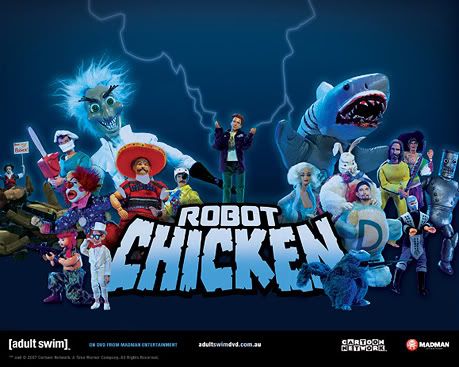
Unofficial Robot Chicken: The Role-Playing Game

Another installment of my very-brainstormy "DVD to RPG" posts about how I'd go about converting a TV series to an RPG. This time, I'm going to tackle a show that screams to be one-shot gamed, but yet at the same time has nothing in terms of traditional gaming (or narrative) structure: Robot Chicken.

Now, obviously, this show is bizarre and frequently offensive. It's also the product of (and is geared towards) short attention spans.

That said, I love it. It's irreverant, absurd, and funny as hell. And I think it has some gaming potential. You wouldn't try to run a full-blown campaign of it, but as an occasional one-shot it'd be pretty sweet.

Robot Chicken defies traditional narrative structure, and thus this RPG will defy traditional gaming structure. Most roleplaying games tend to fall into two categories: miniatures-esque games about killin' things, and story games about angsty character development. A Robot Chicken RPG wouldn't be too concerned about either of those ideas, it'd be about short scenes involving insane situations and unexpected perversions of our beloved childhood memories.

So, let's get started brainstorming. Right off the bat, I know we want this to be rules light. We also want it focused on toys-as-player-characters, with each person playing multiple toys/characters in a session. Didn't take me long to dream up the structure, and other than assembling toys and making a buttload of cards, this post has nearly an entire RPG in it. Heck, my birthday's tomorrow, maybe I'll invite a few friends over and run it.


Toys:
So, we start with a pool of toys, and a number of Skits. Everyone (players and GM) should bring a number of toys equal to the number of participants (counting players and the GM) you're expecting, and the GM should bring extra toys beyond that equal to the number of Skits (see below) he or she plans to run.
So T = (P x P) + S. T is number of toys, P is number of participants, S is number of Skits.
The toys will be the PCs and NPCs, so they should be mostly action figures, dolls, stuffed animals, plastic dinosaurs, lego minifigs, etc. One or two stranger things in the mix will be fine, but if you bring nothing but squirt guns and an Easy Bake Oven, you're just making it hard on the group.

Toys are drafted out or assigned randomly. No one should end up playing more than maybe 1 or 2 of the toys they brought, as the point is to totally desecrate the memory of these toys, and your friends can do that for you better than you can. To make it feel like Robot Chicken, you should draw little mouths of varying sizes on paper, cut them out, and attach them to the toys with tape or that blue poster-tacking goo. You've been warned - don't bring your mint chase figure that's worth a 100$, and don't bring the teddybear that you've slept with every night since you were 8. Bring toys that will be no great loss to you should half an hour be spent discussing their irritable bowel syndorme, or if tape peels the paint off their face.

If you draft toys (that's my preferred method), the GM shouldn't get to draft. Instead, once each player has drafted P toys, the GM gets the P+S that are left over. Or, maybe the GM gets one pick to start the draft, and then just gets the slop afterwards.

There's a chance that toys may end up being used as miniatures should combat break out, but that's not really the point. There's also a possibility that some player will find it easier to role-play through the toy, moving it about like a kid would, and shaking it when the character is talking. That's not really the point, either, but shouldn't be discouraged. The main purpose to toys is to just provide an instant character concept that is outwardly obvious to the players.


Skits:
Rather than being set up as a flowing narrative, the game is staged as fairly disconnected Skits. Each Skit has a Skit card, sort of crib notes for the GM. It'll provide just enough details of setting/plot/joke to get his improvisational motor revving. The main use for these cards is to set up goals and point structures.

How many Skits to run? Well, that's to be determined by GMs devilish plans, and the time you have available. In general, though, the formula/format should work best when P is one or two integers higher than S, so not quite all the toys get used. A really high S means super-short Skits for those with minimal attention spans. A really low S means longer Skits that could result in nuanced character-development, but probably peter out. For a game this crazy, I tend to favor the automatic/shotgun approach, but you'll adjust to flavor.

For Skits, the GM will need to do a little prepwork. What actually happens in the Skits will no doubt be mostly improvisational, and strongly colored by what toys get hauled to the game, and what Depth cards (see below) get assigned to them. But, you're gonna need something of a framework - a bunch of crazy Skits to kickstart the game and set the tone of play.

Robot Chicken is pretty cut-throat, the toys do horrible things to one another and many Skits have someone getting the short end of the stick. So let's make this a competitive game, to get everyone in the right mood. There will be a winner at the end of the night, as players will score points for doing things appropriate to the Skit. Scores accumulate from Skit to Skit, and there should be some prize for the winner at the end of the night. I'd probably make a crappy trophy by gluing together some custom toy, and give that to the winner.

So, the GM should prep for "S" Skits (per the equation in the toy section), by making a Skit Card for each of them. One side of the card should feature a roughly one-sentence description of what the Skit is about. When the Skit is about to start, this side is read to the players, and they will choose which Toy and Depth combo they'll play that Skit based on the description. What sort of Skits the GM wants to run is wide open: a beauty pageant, a horror film, a public service announcement about genital warts, the carpool to work gets stuck in a traffic jam, a scene from the bible, etc. A small portion of the toys the GM brings should be particularly appropriate for certain Skits, but not all of them, or else they might overshadow the toys the players brought.

The back of the Skit card documents scoring. The front of the Skit card gets read to the players, but they don't get to see the back of the card till the Skit is over. Most Skits should have around 100 points that are likely to be achieved by most players, and another 100 points or so that can only be claimed by the first player to achieve some specific goal. At the end of each Skit, you reveal the card and calculate scores.

Example Skit Card:
Front:
The PCs are contestants in a beauty pageant, complete with introductions, swimsuit competition, and talent contest. There will be 3 NPC judges.
Back:
+10 points If you choose a feminine/female toy for your PC this Skit.
+20 points for lampooning beauty contestants by playing your character as flighty or bitchy.
+20 points for each judge you manipulate via some immoral means, such as bribery, seduction, blackmail or threats of violence. You score these points for the effort, even if the judge chooses not to vote for you due to someone else's actions or a bad die roll. +20 extra points (per judge) if your method of manipulation is tailored to match the toy that represents that judge.
+10 points for getting one or more of your fellow PCs disqualified or eliminated from the competition. Disqualify them all, and it's still just +10 points total.
+30 points to whoever wins the actual contest.
+50 points for having the most outrageous talent in the talent competition.
On that card, there's about 30 points that most players will score practically automatically, with the potential for everyone to score 80-150 points, and if one person did everything right they alone could walk away with 240 points.


Dice Mechanic:
We want simple mechanics, that resolve easily. Characters are mostly defined by what toy they are. The system will use d8s and d12s exclusively.
Why? 'Cause d6s aren't nerdy enough, d10s and d20s are the backbone of enough systems already, and d4's annoy me. Not everyone owns d16s and d34s, so I guess I'll have to settle for 8s and 12s.
If a player says his character is doing something that could logically be done by an animate version of that toy, the GM typically just says it happens. If the announced action seems particularly difficult, or if there's potential for humorous consequences if you fail, the GM will tell you to roll your d8. A 5 or better is a success.

If you're taking an action that directly harms another PC, both players roll a d8, and the higher roll gets his way. You can't kill a character with a single attack - winning once gives them a wound. A second wound (from a later attack) incapacitates the character. Other than that, wounds have no impact - there's no penalties for being hurt other than the risk of being KOd if you're hit again.

Social powers, such as World's Greatest Lover, can be used to manipulate other PCs and force behavior from them. As with the wounds rule, something that removes another player from the Skit should take two successful "attacks" to accomplish. One intimidation roll will make them run away, but they'll come back a minute later and have to be chased off a second time. The same goes for horrible degrading humiliation and forcing behavior at odds with their character type - you'd need two successful seduction rolls to bed a Nun doll against her better judgment, for example.
You'll note that I said the game uses d8s and d12s, but all my examples involve rolling only a d8. That's because d12s are granted by Depth cards (see below).


Depth Cards:
Robot Chicken doesn't just feature Celebrities, Smurfs, and Autobots. It features celebrities that secretly aliens, Smurfs that are psychokillers, and Autobots with protstate cancer. The game needs to reflect that. Therefore, everyone is dealt P+1 Depth Cards at the start of the game.

Depth Cards add that extra something special to your character. Most are just skills, broadly defined, which let you roll a d12 whenever you're doing something akin to that. This could be "World's Greatest Lover" or "Nerdly Super-Scientist" or even "Induce Vomiting" and "Drunken Wobble" since this is Robot Chicken, after all.

Mechanically, skills and powers granted by Depth Cards work just like normal actions a character can take, except you roll a d12 instead of a d8. Difficulty remains a 5 for uncontested actions, and an opposed roll if doing something unpleasant to a PC. This means the benefits of rolling a d12 are most pronounced when acting against a PC who only has a d8 to defend with - a third of your rolls will beat their best roll. That's an intentional decision designed to promote disunity amongst players. Go on, mess with each other.

Some Depth Cards should be more complicated and bizarre. Here's a few examples of cards that are more complicated, but worth putting in a deck:
  • You might be a were-toy, and when the moon is full you turn into one of your other toys, which has an additional depth card of it's own.
  • Wonder Twin Powers, activate! You can turn into water or ice, and the player of your choice can turn into animals.
  • You might have a horrible disease, which lets you roll a d12 to spread it to anyone you contact, but if you ever roll a "1", for anything, you take a wound.
  • What if Jesus came back like that? Includes any and all biblical powers you care to improvise.
  • The PC of your choice is in love with you, and you get a d12 just for wrapping them around your finger.
  • Play two characters this Skit, using an extra Depth Card that applies to both toys.
  • This toy's voice is provided by a famous celebrity guest-star. Pick a star you can do a good impersonation of. While playing that role, you get a d12 to do anything you've ever seen them do in a movie.
  • Recurring character. Instead of playing a new character, reuse a toy (and corresponding Depth Card) you used in a previous Skit.
Obviously, the GM is going to have to make a stack of Depth Cards before the game. I'd suggest P x (P+1) cards for your first session, where P is the number of Participants in the game. Deal out P+1 cards to each player at the start of the game, either before or after they've drafted their toys. Cards are kept secret until used.

I'm guessing the right mix is 1/3 usable skills, 1/3 useless character quirks disguised as skills, and 1/3 bizarre powers that break the rules, but I won't know for certain till it's been playtested. It's worth mentioning that there's very little need for cards to be balanced, as you're only playing any given character for 10 to 45 minutes.


Starting a Skit:
The GM reads aloud the short description from the front of the Skit card. Everyone picks one of their toys, and one of their Depth cards. Starting with the second Skit of the night, there should be a time limit to picking your character. If it takes you five minutes matching a card and toy before the first Skit, it's no big deal, but if it's taking you more than a minute at the start of Skit 3, it's time for the GM to step in and assign one randomly.

Each person should have more toys than the GM has Skit cards, and more Depth cards than they have toys, so some just won't get used. That's fine, it lets you skip out on your least interesting possibilities. Cards should be kept secret at least until the Skit starts. If you think the Depth Card functions best with surprise value, you can keep it hidden till you use it's power or make a roll related to it. If it's something that should be obvious, or will help with roleplaying if it's revealed early, do so as soon as the Skit starts.

The GM has more toys, and can use however many he wants per Skit. However, he doesn't get Depth Cards. It's possible a Skit description might give powers to an NPC, but most of the time the GMs job is narrator and straight-man for the much more bizarre PCs to riff off of.


End of the Night:
When the last Skit is done and all the points have been tallied, declare a winner. If possible, the GM should give them a prize for winning - could be a toy or trophy, some candy, bonus xp for the main campaign of a real RPG you run most of the time, etc.
Then, before everybody goes home, offer them a chance to write up a couple of new Depth Cards to insert into the deck for next time. Not scene cards, as something has to be saved for the GM, who has less power in this game than most RPGs.

Alternately, you could decide (now that everyone has a feel for how the game works) to split up the GMing duties next time. In that case, everyone would show up to the game with not just a set of toys, but also one Skit Card for a Skit they planned to run and a dozen Depth Cards to shuffle into the deck.


Session Report from the first time this was played.


Credit where it's due:
Used without permission, and no challenge is intended to any copyrights or trademarks. The main influence on this game is (obviously) the TV show Robot Chicken, which in turn steals from various toy manufacturers and other icons of pop culture. The ideas and system presented above also draw inspiration from the TV show Who's Line Is It, Anyway?, the quasi-RPG Pantheon published by Hogshead, and the quasi-CCG 1,001 Blank White Cards. I've also made various pop culture references: Sith were created by George Lucas, Wonder Twins are copyright DC comics, and Jesus is a registered trademark of Matthew, Mark, Luke and John, Inc.

Sunday, February 1, 2009

Another Hypothetical RPG - an alternative BSG RPG

Battlestar Galactica - yeah, I know there's already a BSG RPG. I'd never play it. I'll start with a few points as to why I'm not interested in just playing it as-is:
  • It's based on the current show. I enjoy watching the current show, but as an RPG setting it sure has flaws. It's muddled, and I really can't tell what will prove to be prophetic destiny arranged by godlike beings and what will just be Baltar's paranoid schizophrenic ravings. I'm not entirely convinced the writers will be able to make the cosmology make sense in the end, and I'd hate to find that out for certain in mid-campaign.
  • Worse, there's giant logic holes in the show that wouldn't survive contact with your typical playgroup. To keep the PCs from having a cylon detector by episode two, you'd have to deny them access to any science or engineering characters, and also disallow cameras and the seduction of their fellow pilots. The Galactica has a never-ending supplies of missiles for the vipers - so PCs would jury-rig missile launchers onto the hull of the President's ship by the end of session one. It goes on and on.
  • I've read that the two types of Viper (Mk II and MVII) have the same stats in this system. There's 40 years of tech development seperating them. I know the show doesn't dwell on it real long or hard either, but they ought to have some variation in stats. Abstract elegance is good, but for a setting the features space-dogfights so prominantly, you need more granularity.
  • On the other hand, the rule book lists several different pistols that only vary in cost, not effectiveness. Why differentiate between costs of identical handguns? The show never names gun types, never dwells on them beyond "he's armed", and only mentions money when plot points are being discussed over a game of Pyramid.
  • Politics is a huge part of the story, and resource depletion is a recurring plot line. You could handle the resources with a light and abstract touch by having an NPC admiral give the PCs missions every session - "The Admiral says Fuel supplies are low and we need to raid that Cylon tillium station". Sadly, that runs into the same "powerless PCs" problem you get when you have a NPC Prince in a Vampire LARP - it would strip the Politics out of the setting, and/or make the PCs feel like bit players. Alternately, you could have a very gritty system that tracks resources so players can make the hard decisions - but every review I've read of the game suggests that it's crunch-lite, without any rules for how to find a world with food, how much fuel it takes to jump the fleet, etc.
  • Most generic systems lack the ability to make 3-D space combat meaningful or exciting. I haven't heard any praise of how this one is different.
Assuming, for the sake of an post/argument, that I had some desire to capture the feel of the series, but not the precise exact canonical details... Here's a quick rough draft of how I'd start:

I'd go with a really rules-light system for the actual characters. Probably FATE, as it's solid, simple, flexible, not too cinematic, and provides some character background. PCs would have skills, but not lots of feats. I'd put the majority of the focus on the ships, instead.

I'd have each player design a ship - and I'd focus my game-design energies on making a system for that rewards the players for making a fleet that's diverse. Their PC would be the captain of the ship they designed. Rather than having one big Battlestar to focus everything on, the needs of the fleet would be split between various vessels.

When the Captain of the only Agriculture vessel in the fleet decides to play political hardball, I want him to have some clout. When he tells the Military Carrier that he wants their engineers to install some point-defense on his vessel or else he'll cut production to emergency ration level, I want it to be a workable threat. I also want the players to be able to prioritize which ships get protection and babying based on what they bring to the fleet based on an appraisal of how important that vessel is to the fleet, and the mechanics need to make that possible.

Of course, when a fight breaks out, who wants to play the Agriculture ship, even if it has some jury-rigged flak guns? To solve that dillema, each player would have option of having two PCs. One is a captain of a civilian vessel, the second is one of the hot-shot fighter pilots. The captain characters would take part in the political struggle and resource management, and the fighter pilots would face the threats head-on. During full scale fleet battles and "33"-inspired ambushes, each player would control both their fighter and their civie ship, and the game would need a good tactical 3-D space combat system to make that work... Problem is, I have yet to play an RPG that does so, so I'm uncertain where to start.

I think I might crack open my old Full Thrust miniatures game books. Something similar, with individual ships-systems recorded and tracked, and using relative vector movement, would probably be the way to go. Fighters would have to be souped up a bit to feel like BSG, but Full Thrust is at least a good inspiration. You'd add systems like "Cargo Hold", "Tillium Processor", "Improvised Housing", "Hydroponics Bay" and the like so that the ships could hold a purpose in the fleet. You don't want a system where a critical hit makes the whole ship explode, nor a system with abstract hit points and a boolean unimpaired/destroyed status for the whole vessel. Instead, you want a brutal system where ships get battered and impaired, systems go offline one by one, and you have to nurse it back into shape after the battle.

That's where I'd start, anyway.

Monday, January 26, 2009

Hypothetical LOST RPG

Talking with my wife the other day, the topic came up the other day of what mechanics I would use if I were to adapt the TV show LOST into an RPG. There was no existing system that I felt would work especially well for it, so I'd probably start from the ground up making something new. The brainstorm of a hypothetical system has gone pretty far...


Attributes :
I'd start with an attribute auction, kinda like in Amber. The auction system in that game does a great job of establishing rivalries right out of the gates, and that sort of "uneasy truce" feeling, that tension where the characters alternately cooperate and backstab, is something you really want for LOST.

However, LOST should not be diceless. Characters on the show can and do fail on a regular basis, and the mechanics need to simulate that. There's no guaranteed competence - Jack can lose a patient, and John can get tusked by a boar. So, you'd start with a 100 points to bid in the auction, and after the auction was finished, there'd be a chart/scale that the GM would use to convert bids into dice pools. Exactly how the conversion chart works... I'm still workin' on that. Thinking out loud, I'd aim for ranking determines average/maximum roll, but number of points invested determines whether it's one big unreliable die or multiple small dice.

As to the nature of the Attributes & Skills... I'm leaning towards things that feel more Skill-based than Attribute-based, as far as theme. Watching the show, it's hard to rate the Strength and Endurance of the various characters, but you know who's got the most survival training, who's the best liar, who can administer first aid better, etc. Off the top of my head, I'd be tempted to use 6 Attributes - probably named Hunter, Caregiver, Charmer, Interrogator, Scientist, and Shaman.

Hunter is used for tracking, hunting, fishing, setting booby traps, and attempts to injure another character via ranged combat or ambush.
Caregiver is used for surgery, herbalism, foraging, and providing care or comfort.
Charmer is used for persuasion, leadership, lying, confidence games, and efforts to be social or friendly.
Interrogator is used as a lie-detector, and to coerce or force behavior against someone's better judgment. It is also valuable during point-blank stand-offs, and attempts to injure a character via close combat.
Scientist is used to diagnose illness, handle sweaty dynamite, jury-rig a radio transmitter, or determine where the Others camp is based on an electrical diagram or the crazy map painted on the blast doors of a hatch.
Shaman is used for interpreting visions, building sweat lodges, and fending off the smoke monster. On this island, anyone might see a ghost, but it takes a good Shaman roll to compell the ghost into revealing something meaningful.

There's a certain amount of flexibility and overlap between those 6 attributes. This is intentional. Often there will be more than 1 trait applicable to a task, but the trait the GM deems most appropriate will get a bonus. See also "flashbacks", below.


Sidekicks, Wards, and Obligations:
Michael has Walt, Sun has Jin, and Boone has Shannon (or the other way around). In each case, there's a minor character attached to the major, primarily for the purpose of generating conflict. I'd like to incorporate this into game in some way without needing a ton of players, or swamping the GM with a ton of extra minor NPCs.

Having one of these attached characters doesn't seem to be a boon - the interactions mostly hose you, though they provide for fun secondary conflicts and subplots. It's not a flaw in the standard RPG sense, either, as you definitely don't get bonus points for having a sidekick. If anything, the characters who are saddled with sidekicks seem even weaker for it - Jack and Locke certainly have more character points than Michael, Sun, Boone, Nikki or Rose.

From your initial 100 points, you may reserve from 0 to 30 for a secondary character. Points reserved in this way are doubled when making the second character. If you set aside 30 points, you'd have a 70-point main character and a 60-point secondary. If you set aside only 5, you'd have a 95-point main character, and a 10-point sidekick. You get more points this way, but there's a couple drawbacks. First off, since each individual character has fewer points, you'll probably be better off making specialists instead of generalists - you just can't spread the points around as far per character. In addition, secondary characters are made after the first auction is done, and they must bid lower than 1st rank. So Jin may be focused on Hunter, but he's not going to eclipse Locke. And actually, there's a third wrinkle.

The third trick is, your secondary character isn't your sidekick. Instead, you pick another player, and your secondary character is the ward, significant other, sibling or obligation of the other player's (primary) character. You're all PCs, so some amount of working together is to be expected, but it's also understood that the person playing your sidekick is going to occassionally make life "interesting" for you. Probably by dissapearing into the woods with that bald guy who has all the knives. It's considered very bad form to just decide your character doesn't care what happens to the sidekick they were assigned. Doing so will result in penalties of some sort (details still to be worked out).

Example of character generation with sidekicks:
  • Michael is created from 80 points in the auction, leaving 20 points unused. Those are doubled to 40 points, from which Michael's player creates a new character named "Shannon" - 40 points makes a well-rounded, but not powerful, character with just a little of everything. He thinks Shannon is just perfect to be someone else's spoiled kid sister.
  • Sun is created from 95 points in the auction, leaving 5 points unused. Those are doubled to 10 points, from which Sun's player makes a new character named "Walt" - since he's only 10 points, Sun's player decides that Walt will be someone's estranged child, too young and weak to defend himself, and sinks the 10 points all into Shaman to give the kid just a touch of the mysterious.
  • Boone is created from 75 points in the auction, leaving 25 points unused. Those are doubled to 50. For his new secondary character, named "Jin", he puts nearly all those points into Hunter. He wanted to put them all into Hunter, but was handicapped by not being able to surpass the highest bidder (Locke) in the primary character auction. He put the remaining couple of points into Charmer, but really didn't use them in the first season.
  • One person is playing Michael and Shannon. One person is playing Sun and Walt. One person is playing Boone and Jin. They'll get involved in each others plots and scenes, and create a very lively social dynamic.
  • Meanwhile, Locke's player and Jack's player did not set any points aside, and thus did not make Secondary Characters. This allowed their primary characters to be real bad-asses, but also deprived their players of an opportunity to influence the flashbacks and subplots pertaining to the other players. As a result, Locke became a bit of a loner, and Jack overcompensated by sticking his nose in everyone's business.
  • Note, however, that not creating a sidekick in no way innoculates you from being saddled with one. If the players had so chosen, they could have made Walt be Locke's kid, or Shannon be Jack's half-sister. However, if two or more people try to attach their secondary characters to you, you may choose to deny all but one of them, and pick which one is connected to you, or you can choose to just have a big family. If you do so pick just one, the creators of the extra sidekicks must then choose someone else to attach their secondary character too.


Combat System:
Seems like anyone can lick anyone in LOST. It's mostly about initiative and weaponry. Such unlikely warriors as Charlie and Shannon manage to get the drop on people. Even Hurley manages to be useful in a fight in a few episodes. To get the right feel, fight scenes should be short and bloody, and reward sneakiness and treachery. Gun fire needs to be deadly, and pointing a gun at someone needs to be a significant deterent.

However, wounds heal quickly on the island, and what does not kill you will only make you stronger. Provided they don't die, all PCs begin every session at full health.


Flashbacks:
Obviously the game needs these to capture the feel of the show, but we don't want to spend too much time in the past, especially since flashbacks almost always focus on just one character at a time. We aim for short and sweet, but frequent.

I'm thinking flashbacks are linked to the experience system. You spend experience to initiate a flashback, and gain narrative control of some backstory element that relates to what you were about to do. You then gain bonus dice based on two factors: amount of experience spent, and how badly the flashback screws your character with secrets/shame/enemies. How we rate that second factor, I'm not sure yet, but making it work is vital. You shouldn't get bonus dice for just having been a surgeon - you get bonus dice for being a formerly-wheelchair-bound fugitive surgeon-turned-drug-smuggler with a price on your head.

The bonus dice do not alter your initial attributes - they're locked in at the end of the auction during character creation. Instead, the bonus dice become skills or modifiers which could concievably be used with several attributes. For example, if your flashback revealed you to be a surgeon for the mob, and it got you +d6 (just throwin' out a number) in a skill called "Surgery", there'd be times you'd roll that along with Caregiver (to ease someone's pain), with Scientist (to figure out what's wrong with them), or maybe even with Interrogator (to strike a pressure point and make someone beg for mercy).


Island Economics: Luggage, Debris, Hatches, etc
I can see two ways of dealing with the economic system of The Island.

  • One way would be via charts. You make a big chart for randomly determining the contents of a piece of luggage. A different chart tells you what you find amongst the fuselage and debris from a plane crash, and another for a ship wreck, and either of those charts can turn up luggage (which would then be rolled on the first chart when you open it. You make a bunch of rolls as people search and recover in the first couple sessions, and a fairly organic barter system should develop. Later, you make a "What's In The Hatch?" chart, and a "Dharma Supply Drop" chart. There's two downsides to this system. Prepping the charts will take a long time, and it'd be very easy for random charts to put all the real wealth in one player's hands. At the cost of those two flaws, however, you'd get a very detail-oriented system with a great deal of verisimilitude. People who enjoy the accumulation of treasures would get a good kick out of that, and it'd give the game an oldschool RPG flavor.
or
  • Another way (and this is the way I think I'd end up doing it) would be to make resources behave more like Schroedinger's Cat. Instead of worrying about the specific inventory of your 3 suitcases, instead we just assume that 3 suitcases equals 30 clothing points, 12 entertainment points, and 6 medical points. Need a bandage? That's 2 clothing points or 1 medical point. Good running shoes? 15 clothing points, and they give you +1 to all movement rolls. A book to read is 1 entertainment point. An iPod costs 10 entertainment points - but you can break it apart into 5 Tech points. Need fuel for the signal fire? 10 points of entertainment or clothing will burn for a night, or you can forage for Nature points to burn. The hatch you just blew open has 600 tech points, 100 entertainment points, 2000 food points, and 500 points of guns. Improvise whatever you need out of those totals, and we'll just adjust them downward till the hatch has no more secrets.
    We'd need charts for this system too, but rather than being detailed charts, we mostly just need categories of resource points, and guidelines for how much various items cost.
    This version would also need some mechanical way to get a monopoly on things - since every couple episodes someone gets their hands on all the medicine or all the guns.


Plot, Setting, NPCs, Etc:
Obviously, we're setting the game on The Island, and there's some familiar aspects to the backstory. That said, the GM is under no obligation to include any specific NPCs, and parts of the Dharma saga might be different. The players are under no obligation to play characters from the show, either. Personally, I'd probably have the PCs be Danielle's group, and set the game 16 years before the story depicted in the show. Thanks to Desmond and Faraday, you could work in time-shifted cameos if you like, or just make entirely new stories and characters. Heck, it might not even be the same Island - maybe there's more than one of them floating around out there.

Saturday, February 16, 2008

Firefly Brainstorm Lists: Amber-Conversion

The two people pushing hardest for the Firefly/Serenity campaign that almost happened last year were me and Jeremy. We both prefer rules-light systems, and neither of us wanted to learn the Serenity RPG system well enough to run it. It was intended to be a rotating-GM game, so everyone would have had to learn it pretty well. The system discussion took a couple weeks. We went from the Amber-based system below, to Dogs-In-The-Vineyard in the Firefly setting, to just playing something else (Amber, as it turns out). In retrospect, I wish we'd done the DITV Firefly.

Diceless System for Firefly/Serenity
(based on Amber DPRG mechanics)

This is based on Jeremy’s idea that a diceless version complete with Amber Auction would:
  1. create some built-in rivalries from the get-go, to put the players in the right frame of mind,
  2. give everyone a clearly-defined specialty, something everybody knows they’re good at
  3. allow us to play very rules light so it’s easy for anyone to GM a session
  4. put the exact definition of our abilities and capabilities in the hands of each sessions GM (which is great for Psy powers, for example)
  5. be a lot of fun
Attributes that may prove important to the setting:
Speed
Accuracy
Strength
Endurance
Intellect
Intuition
Tech
Charisma
Cool

Here's the logic behind portions of that list:

Speed vs Accuracy: I think we need two separate stats for these. Being a good shot and a fast draw feel like two separate skills in a western. A successful gunfighter needs to be good at both, but plenty are better at one than the other.

Strength vs Endurance: Jayne is a character who’s clearly strong, but kind of a sissy.

Intellect vs Intuition: Simon is clearly very rational and clever. River is primal and psychic. Shepherd Book has a good balance between the two. Jayne lacks both.

Tech vs Charisma: Kaylie (and to a lesser extent, Wash) is good with machines. Inara (and to a lesser extent, Mal and Simon) is good with people.

Cool: Where Zoe excels and Wash scrubs out. (Zoe, by the way, is like Bleys in Amber - 2nd or 3rd best at everything). Maybe this is part of Endurance?

Your Talent: Each PC gets something that makes them special beyond stat points, but it’s limited to one per PC. Examples drawn straight from the show:
  • Simon is “The Doctor”.
  • Kaylee “Understands Technology”.
  • River has “Amazing Potential, But It’s Completely Beyond Her Control”.
  • Wash has “Hotshot Pilot”.
  • Mal has “It’s MY Ship”.
  • Inara is a “Certified Companion”.
  • Jayne has “Personal Armory”.
  • Shepherd Book has “Mysterious Past”.
  • Zoe seems to lack anything terribly special, so maybe she’s just got more points than anyone else to explain her being second best at everything -or- maybe Wash is the NPC pilot, and Zoe has “NPC Husband”
Should each PC get one free Talent, or should Talents cost 20 (out of 100?) Points?

Related posts: Character Concepts and Genre/Plot Ideas for use with Firefly.