Monday, July 30, 2012

Contact With The Enemy, Zombies, and "Detect Plot"

As they say in the military, no battle-plan survives contact with the enemy Player Characters. I'm running a home-brewed zombie game called Death Warmed Over, and week after week, it has repeatedly proven that old military axiom. To be clear, I'm enjoying it greatly, but it's not at all the campaign I imagined it to be.

My favorite zombie films include quite a few where the characters are holed up somewhere, turning a house or shopping mall into a fortress.  Classic Romero stuff. They're nailing boards over the windows, improvising weapons, and finding clever ways to sneak in and out of the property without getting grabbed by the thousand arms of the nameless horde. These sorts of films tend to be slow-burning character dramas where the zombies are the external source of tension that occasionally kills characters but mostly serves as a backdrop for the inevitable collapse of the social unit. These sorts of films appeal to the parts of my brain that really appreciate greek tragedy as well as problem solving.

I've always wanted to play a game that catches that feel, but no one's ever been interested in running it as anything more than a one-shot. Two main mechanical hurdles traditionally stand in the way of this sort of campaign:
  1. Such a game requires eventually the GM must play out scenes with hundreds of zombies, and most games just can't do that elegantly. No game I've seen really has the rules for the makeshift barricades. The handful of games that have rules that could be used for determining how many zombies it takes to topple a home-made wall are either so detailed you can't run 50 zombies in a scene without every turn taking an hour, or so abstract and random that one bad roll will result in a single zombie toppling your house.
  2. Items, and resource management. You don't particularly want to make a list of every single item in every single house or business, as that takes far too much time and effort from the GM. Yet to stay faithful to the genre, scrounging for equipment, ammo, and food needs to be important. There needs to be a balance, where the presence or lack of an crucial item is meaningful, but you don't have to constantly define what's in every room of every location.

You can hand-wave that sort of thing for a session or two, but any sort of lengthy campaign needs a solid foundation of rules that reinforce the genre. Based on that, I decided my best bet was to custom-build my own set of rules, and run the darned game myself.

My design goals were as follows:
  • Fast and light combat rules, because zombies really aren't that dangerous unless they show up in numbers. At the same time the rules had to be tactical enough that players could make meaningful decisions.
  • High base odds of success for the PCs, so I can throw in some big swingy penalties for psychological trauma whenever things go more wrong than they had been before, without it completely nullifying the players ability to accomplish something.
  • An abstract system for resource management so I didn't have to stat out every single item everywhere or dink about with encumbrance, but could still give both in- and out- of-character motivations for the players to make scavenging forays outside their makeshift fortress.
  • Timelines as well as a few simple random charts for figuring out how bad the zombie infestation is from block to block and building to building, so that if the players suddenly decide to make a supply run to the sporting goods store in the middle of a session I can run that on the spot without having to pause the game for 20 minutes.
  • A system for handling how likely zombies are to smash down or climb over a makeshift barricade. This needed to involve as little randomness as possible, because if the system was "roll a die per zombie" that would be wretchedly painful to play through when the zombies were in quantitity.
  • Emulating a large number of classic zombie-genre tropes, but yet still having a few surprises and curveballs to throw at the players.
  • Suspension of disbelief. The idea of the dead rising up to devour the living is far-fetched enough, the players shouldn't be scoffing at any of the details that come up later, so I really needed to think things through and do some research.
  • In-character mystery in the beginning as the players are trying to figure out how the disease propagates, leading into a gradually unfolding understanding of the new state of the world.
  • A flowchart or simple rules for zombie behavior, not just so I can run dozens of zombies at a time, but also so that they really come across as beasts of instinct and behave with a herd mentality. Additionally, this means that once the players figure out how the zombies "work" they can out-think and out-maneuver them.

I feel like I hit all of those goals. Not that there weren't any hiccups along the way, and I recently had to make some props/tools to simplify the tracking of the psychology modifiers because it was a little fiddly and opaque in my first draft. Overall, I'm pretty pleased. I did a lot of research to figure out how the infrastructure would fall apart, on what day the power goes off, when the food rots and the bugs move in, etc. I came up with a fantastical yet logical progression for my virus that would allow it to spread quickly and not burn itself out.

I started the PCs out as neighbors in a gated apartment complex that was initially a bit vulnerable to zombie infiltration, but which could be readily fortified as long as the PCs were willing to nail a few tables over their windows and what not. I used a complex I'd once lived in so that I knew the layout and the neighborhood intimately and could answer any questions that might come up. I printed off floor-plans and maps for the apartment buildings at combat-map scale and laminated them. I was ready to dig in for a siege. This was going to scratch my itch just perfectly.

And that's exactly where I come back to the first sentence of this post… no plan survives contact with the PCs. While I love the tragic siege sub-genre of zombie film, it's a forgone conclusion that things fall apart, the center does not hold. Staying in one place always gets you killed, and while very few zombie films end happily, those that do usually involve escaping to somewhere else. My players are, of course, motivated by survival. From session one, they just wanted to get the heck out of the populated areas and head for places with fewer potential zombies. Even though I set the game in the middle of a desert (Albuquerque, NM) so there's really nowhere to flee too, they just had to head out of town at the first opportunity. Trying to head them off, I throw a military quarantine up as one more obstacle in between them and anywhere else, but of course this just encourages the players to try to sneak past soldiers as well as zombies. I cut off every escape route and leave them a brightly lit Tram back down to their fortress, and they instead choose the arduous overland trek in the opposite direction, across mountains and deserts where there are, of course, no zombies.

Silly me. It should come as no surprise, as that's just how gaming works. Players cast "detect plot" and then take a hard left to steer clear of it. :)

Tuesday, June 5, 2012

ID, YHTNTEP, and DOD - Download them today!

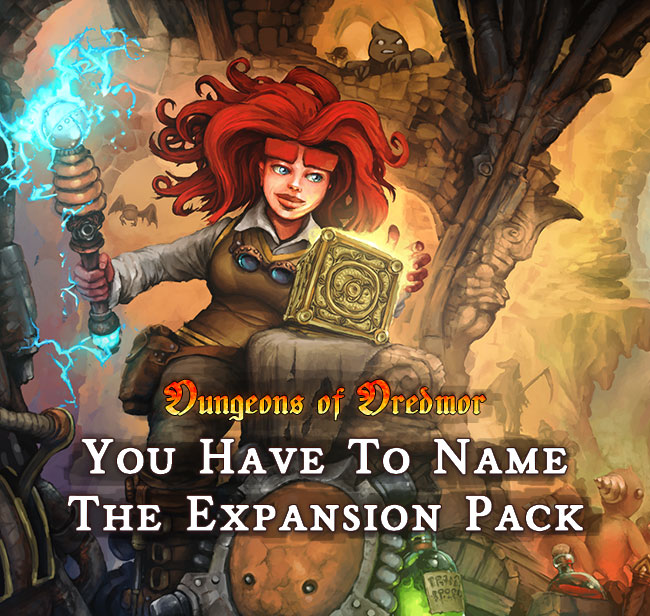
That unhealthy looking fellow is Lord Dredmor, a terrible Lich with plans for global domination. Those little brown things moving his sofa are Diggles, oppressed and brainwashed drill-beaked penguiny people who do his bidding. It's okay to kill them, unless you're Vegan.

Why am I sharing this with you?

Today is the day the "You Have To Name The Expansion" Pack releases. It's a free expansion to the Dungeons of Dredmor game. It includes a good chunk of content that I created, polished up and included as an official expansion to the game. I'm really proud of it, and honored to be a part of this project.

To celebrate the release of You Have To Name The Expansion, Gaslamp Games is putting Dungeons of Dredmor and the Realm of the Diggle Gods expansion on sale for 70% off for the remainder of today.  The game was already dirt cheap and a heck of a bargain, but today it's just a couple bucks. Go buy it now. NOW.

While you're at it, you should also download and install Interior Dredmorating 1.2.6. Starting today, ID1.2.6 is available via the Steam Workshop. It's a mod I created for Dredmor, and I'm really proud of it, too.  Seriously, this is a good day to be me.

You don't want to ruin my good day, now, do you? GO BUY DREDMOR. GO INSTALL INTERIOR DREDMORATING. DO IT NOW. Thank you. Have fun.

Purchase Dungeons of Dredmor here
Download You Have To Name The Expansion Pack here
Download Interior Dredmorating here or here


Friday, May 18, 2012

3d6 sucks in Risus

Following a really rocking' game of Risus Primeval last night, some discussion came up concerning the dice mechanics. This prompted me to run some numbers this morning. Oh, the numbers I crunched. My brain is sore, and it mostly just confirmed my suspicions, but at least now I can actually make non-anecdotal arguments to defend my position concerning the character generation system.

In Risus, a character typically starts with 10 dice to be divided amongst their skills (known as clichés), with a limit that no skill may start with more than 4 dice.  So, you see a lot of 4/4/2 or 4/3/3 builds, spotted by the infrequent oddball builds like 4/2/2/2 or 4/3/2/1 or even 3/3/2/2. I'm here to tell you that anything other than 4/4/2 sucks horribly, and should be avoided at all costs.

Risus features two types of rolls. Generic rolls vs a static target number to see if you succeed at some standard task, and then there's combat. 

Let's look at the non-combat rolls first.

According to the rules, rolls have a difficulty of 5, 10, 15, 20 or 30 (20 or 30 just sounds crazy to me, given that the hard-cap for a PC whose maxed out a trait is 4 dice at character creation and 6 dice after much XP spending).

Difficulty 10 is meant for things that should be challenging for a professional, and 15 is for "really inventive or tricky stunts".   Then the GM is vaguely instructed to sometimes lower this if a given cliche is particularly appropriate, but only a handful of examples are provided and no real advice on adjudicating it. In my experience, this means most GMs don't really adjust the numbers much. Even if they do, as a player reading the rules you feel really motivated to get at least 3 dice in anything you ever want to do, because the rules state that 3 dice represents professional-level skill. Sounds like you want 3 dice, right?

Wrong. Here's the first wrinkle. Most GM's never have you roll against the lowest difficulty, which is specifically 5 in Risus. Someone at the table is going to have 4 dice in something (in fact, in my experience, nearly every PC has 4 dice in something) pertinent to the roll. The first time the GM sets a "5" difficulty, people grab their 4 dice and someone asks "why are we even rolling this?"  There's a social pressure then to not roll vs difficulty 5 on 4 dice, as it just feels too silly. Most GMs pretty much default to difficulty 10 for average tasks worth dicing for, because it  feels fair regardless of whether you got 3 or 4 dice to roll, and is a lot more interesting than difficulty 5.   Perhaps some other number would be better, but 10 is nice and round, it shows up in the rules, and really who wants to deal with a sliding scale of improvised values in the middle of a fight?

So now 10 is your routine average difficulty, even though that's not really what the rules say.
  • Chance of succeeding at difficulty 10 on 3d6: 63%
  • Chance of succeeding at difficulty 10 on 4d6: 90%
So 4d6 is a good deal better than 3d6 at routine standard tasks, but 3d6 is still plenty respectable. 3d6 feels professional.

Of course, in a typical gaming scenario, not everything is routine. GM's frequently want to make something a little tougher than average. Players also frequently come up with crazy ideas, and it's very normal for the GM to respond to that by raising the difficulty up one step. Officially, one step up in difficulty in Risus is a 15.  But as it turns out, a 15 is terribly hard to score on 3d6:

  • Chance of succeeding at difficulty 15 on 3d6: 9%
  • Chance of succeeding at difficulty 15 on 4d6: 44%

So the 4d6 character is still reasonably proficient, but about half as likely to succeed as they were on a difficulty 10 challenge. Most GMs (and most players who have a 4-die stat) could live with that.

The PC rolling 3d6 however, is nearly guaranteed to fail at that test that's just 1 difficulty level above "normal".  Already 3d6 is starting to suck, and we haven't even gotten to our first fight scene.

If the GM realized how low the odds were on getting that 15, they probably wouldn't use it as a difficulty very often.  Chances are the GM hasn't realized how hard the 15 will be. Most people aren't that good at intuiting actual odds, that's how casino's make money after all. We remember the big successes more than the day-to-day failures. While gamers are often more math-savvy than the general public, we've all been kind of brainwashed by years of D&D optional character generation rules teaching us that a 15 stat isn't all that unusual.  Don't believe it.


Combat:
Combat in Risus has a somewhat infamous death spiral. If you fail a roll, your dice pool shrinks for the rest of the fight.  Combat uses contested rolls, so each round one side of the fight grows weaker, while the other maintains their strength.  It's in such a combat that 3d6 clichés really become a liability.

Two hypothetical characters (or players), Alison and Brad, are about to have a duel.  Alison has a relevant cliche rated at 4 dice. Bradley's cliche is only 3 dice. What are the possible outcomes of the first round? Most of us would correctly deduce that Alison's got better than even odds, but how much better?

Alison's 4 dice are in fact 4 times more likely than Brad's three to win the first round of the fight. I ran the numbers on it this morning, and was a little surprised just how dominating that extra die is.  Here's the results of round one:
  • 75%: Alison (with 4 dice) rolls higher than Brad. Brad drops to 2 dice next round.
  • 19%: Brad (with 3 dice) rolls higher than Alison. Alison drops to 3 dice next round.
  • 6%: The rolls are tied.
Risus doesn't actually address what happens when there's ties on a combat round, so the GM is left to figure out what to do on the ties. Most GMs have both sides reroll, either as a new round or as just a second roll in what is technically the same combat round. If that's the case, the 6% is replaced by:
  • 4.5%: The rolls tie initially. The GM calls for a reroll, and Alison wins it.
  • 1%:  The rolls tie initially. There's a reroll, and Brad wins it.
  • Half a percent: This round of combat takes 3 or more rolls to resolve. It's likely Alison wins eventually.

I've seen a few GMs try other tie-breakers to avoid delays from rare consecutive ties. Usually these tie breakers are either "highest stat wins", or "highest single die wins". Either of those basically make the 6% tie chance into another case of Alison's 4-die stat delivering a win. 

So there's about an 80-20 split in favor of the 4-die character. And that's just round one, where the difference in stats is just 1 die.

Round two now deals one of two situations.

It's 80% likely that Alison won the first round, and is still rolling her 4d6 against Brad's now weakened 2d6.  Her odds of winning the second round have just shot up to 96%.  Brad's hosed.

The other 20% of the time, Brad will have gotten lucky and won the first round. Alison's 4-dice are knocked down to 3. That means both characters are rolling 3 dice. Even though Alison lost once, she's still got a 50-50 shot at winning the second round. If she does, she's retaken the advantage.

So a true break-out of the full results of the 4-dice vs 3-dice fight are basically thus:
  • 80%: Alison trounces Brad without ever taking a hit.
  • 10%: Alison takes an unlucky early "wound", but still manages to win the conflict.
  • 10%: Brad defies the odds and comes out the victor.
And that's assuming that Alison only has the one 4-die skill.  If Alison's build is 4/4/2 vs Brad's build of 3/3/2/2, she can essentially soak up one bad roll without it diminishing her attack strength.

Even if Brad's got the second-best build, 4/3/3, he's still likely to come up short in a fight.  Let's see how that 4/4/2 vs 4/3/3 conflict plays out over several rounds of combat.

Rounnd 1: Alison with 4/4/2 vs Brad with 4/3/3. Both characters roll 4 dice.
50% A wins round 1: Rnd 2 is A4/4/2 vs B3/3/3. A has advantage.
50% B wins round 1: Rnd 2 is A4/3/2 vs B 4/3/3. Even dice next round.

Round 2: Number of dice adjusted by who won round 1.
40%: A wins rnds 1 & 2. Rnd 3: A4/4/2 vs B 3/3/2. A has advantage.
10%: A wins 1, B wins 2. Rnd 3: A4/3/2 vs B3/3/3. A has advantage
25%: B wins rnd 1, A wins rnd 2. Rnd 3: A4/3/2 vs B3/3/3. A has advantage.
25%: B wins rnds 1 & 2. Rnd 3: A3/3/2 vs B4/3/3. B has advantage.

Round 3:
32%: A wins all three rounds. Rnd 4: A4/4/2 vs B3/2/2 A has advantage
8%: A wins 1 & 2. B gets lucky on round 3. Rnd 4: A4/3/2 vs B3/3/2. A has advantage.
8%: A wins rounds 1 and 3. B wins 2 Rnd4: A4/3/2 vs B3/3/2. A has advantage.
2% A wins rnd 1. B wins rounds 2 and 3. Rnd 4: A3/3/2 vs B3/3/3.  Even dice, but breaking in B's favor.
20%: B wins 1. A wins rnds 2 & 3. Rnd 4: A4/3/2 vs B 3/3/2. A has advantage.
5%: B wins rnds 1 & 3. A wins rnd 2 only. Rnd 4: A3/3/2 vs B4/3/2. B has advantage.
5%: B wins rnds 1&2. A wins rnd 3 only..Rnd4: A3/3/2 vs B3/3/3. Even dice, but breaking in B's favor.
20% B wins all 3 rounds. Rnd 4: A3/2/2 vs B4/3/3. B has advantage.

So at the end of three rounds:
  • There's a 68% chance that Alison (who started with 4/4/2 stats) has a strong advantage of being able to roll 1 more die than Brad can.
  • There's a 25% chance that Brad (who started with 4/3/3 stats) has a strong advantage of being able to roll one more die than Alison can.
  • There's a 7% chance that they're rolling the same number of dice next round, but that Brad has a minor long-term advantage that may allow him to outlast Alison.
Even if we count Brad's long-term advantage as being as potent as rolling an extra die immediately (which it's probably not), that still means the 4/4/2 build as having twice the chance of the 4/3/3 build at winning a protracted battle.

Just how big of a deal this advantage ends up being has a lot to do with the GM, and what the stats are of the challenges they throw at the players. PC healing rates are totally a matter of GM Fiat in Risus.

Even with a very generous GM who hands out free heals after every conflict and doesn't put you up against NPCs with lots of dice or back-up stats, there's still never a situation where you'll regret a 4/4/2 build. Some GMs might be easy enough you don't _need_ to go 4/4/2, but there's never a downside to doing it. Risus' clichés are so open-ended (you can use "hairdresser" in combat), and the "penalty" for using an inappropriate skills is so unthreatening (it's actually an advantage), that you should have no trouble coming up with just two big cliches that cover everything you really want the character to do and a minor 2-die stat on the side just for flavor.

The basic rules give no advice on how to handle the implications of the math behind rolls, nor does it give any good advice on how to stat out NPCs. Heck, one of examples in the rulebook casually throws out a horde of rats that roll 7 dice, with not even the slightest mention of the fact that 7-die horde is a TPK waiting to happen.  I just spent this huge article talking about how much better 4 dice is than 3, and I assure you 7 dice would be a damn spot better than that.

A few other numbers that may be useful as data points:

4 dice beats 3 dice 80% of the time.
4 dice beats 2 dice 96% of the time.
4 dice beats 1 die 99% of the time.
3 dice beats 2 dice 90% of the time.
2 dice beats 1 die 90% of the time. 

Tuesday, May 1, 2012

Hittin' the big time. (You Have To Name The Expansion Pack)

I'm finally allowed to share the great news I've been sitting quiet on for several weeks.
There's a new DLC for Dungeons of Dredmor, and I helped create it. A large portion of my mod, Interior Dredmorating, was chosen by the fine folks at Gaslamp Games for inclusion in the latest official expansion. With like, production values and stuff. It's been a lot of hard work, and I'm really proud of it. Go me.

"You Have To Name The Expansion Pack" is the name of the expansion. When you download and install it, it prompts you to name your own personal copy whatever you'd like, which then displays on the title screen. My copy will no doubt be named some self-serving bit of puffery about how amazing I am, probably with the rest of the world being referenced by the collective noun "bitches".

Full details, including a few screenshots of content I contributed, can be found at the Gaslamp Games blog.  We don't have an exact release date just yet, because we're on "valve time", but it should be available for download in just a matter of days.


In other "I'm freakin' amazing, everybody loves me, and I'm so darned modest, too" news, a total stranger in Holland saw some of my doodles on the "Best of Draw Something" website, and sent me a game request so he could get more of my artwork. That was pretty flattering. 

This is shaping up to be a good year for my ego.

Friday, April 20, 2012

Zombies at the Gates

Session three of Death Warmed Over (my home-brewed zombie apocalypse) went pretty well.  Society is cracking and going out with a whimper, and the most of the infected still look more like victims than threats. I've got the creepiness dialed in just right. The despair and worry is coming along fine. The writing's on the wall.

Pacing is still a little slower than most RPGs, but it will pick up as society crumbles further and more of the undead transition from "sympathetic infectee" to "flesh-eating monster". So far we've only had 2 low-key chase scenes and 1 real fight scene, which was a very short PCs with guns vs a single zombie.

None the less, we've had our first player character death already. Mark was playing a compassionate man of faith who put altruism and generosity above his own safety a bit more than can really be advised during a zombie epidemic. He got himself exposed to zombie fluids repeatedly in the process of helping get infected people to shelter at the Kingdom Hall.

When he turned, I didn't tell him right away. He was up most of the night, and I described a few early symptoms as sunrise was approaching. Itches and rashes, a slight fever, and some distortions to his field of vision and light sensitivity. He knocked on the door of his neighbor the doctor (another PC), so I cut to her player and told Laura (playing the doctor) there was a pawing at her door. She looked out the peephole to see Mark's character, covered in blood and self-inflicted scratches. For the rest of the scene, I let Mark tell me what his character was trying to do, and I then I spit it back out to Laura through this filter of how the infection was influencing his perceptions and actions.  Much as the other infected have been easily distracted, I narrated to Mark that random objects and sounds would just suddenly get brighter or more beautiful and really capture his attention. It took most of the party to get him contained without killing him. They lured him with noise, knocked him over, wrapped him up in blankets, and then locked him in a spare bedroom. Incoherent and obviously infectious, his "word salad" included a few bits that were mostly intelligible, and a number of biblical references. Clearly the zombies are not entirely mindless, nor in all cases immediately violent. Those facts complicate the days ahead.

Mark took his demise really well. I've been keeping a lot of the mechanics under cover, which is probably frustrating to the players. To keep things mysterious, as they should be in the opening days of an epidemic, I avoided letting anyone know exactly what their Exposure Rating was.  I did eventually reveal that Mark's character had an Exposure Rating of 6. Which meant he needed to roll a 6 or better to not contract the disease. I'm using some elements from the "Night Zero" graphic novel series, specifically the notion that a high blood-alcohol content can help keep the infection from taking root. So exactly what dice you roll vs your Exposure Rating is determined by how drunk you get. Of course, at this point the PCs had no way to know that in-character, and Mark's PC in particular was very religious and not likely to imbibe. So he was pretty much screwed.

Mark's new character entered the game just a couple scenes later. That's one of the benefits of the rules-lite approach, you can cobble together a new character in just a couple minutes.

His new character is a Cop. He'd been on the job for over 30 hours and was finally returning home on the second day of the outbreak. It's not that they'd let him off duty. It's that while out on yet another call responding to looters, he lost contact with the police dispatch office. Around sunrise, they stopped answering the radio or phone. When he drove to the police station he was based out of, he found it full of infected, many of whom had been fine when he'd last seen them just a few hours before. Being the last living cop in the substation of the damned, he decided it was time to retire.

So the other characters are standing around the apartment complex courtyard arguing about what to do with Father Gil and the infected and quarantined NPCs they've got locked up, when Officer Ray pulls his police cruiser up to the gate and rushes inside, shotgun in hand.

Since then, the PCs have raided the apartment manager's office, which was inside one of the other gated areas on the property. They've got all the spare keys from the lock box, some billiard balls from the clubhouse to use as thrown weapons (you know how gamers are), and all the chips and chocolate they could carry from the vending machine in the office.

On the return to their own part of the complex, they ran into a one of the bonafide zombies. She looked like the other infectees, covered in her own blood and strange blistery rashes. However, instead of acting like a newborn or simpleton as most of the infected have, she got right up and started chasing them. Her jerky motions weren't quite up to a running pace, but she could keep up with a fast walk. The PCs tried to stay ahead of her, but had some delays at the gate.

The game has psychology rules, and while they're simple and elegant, they're pretty punishing. So getting the gate unlocked while a zombie lurched towards them took a die roll and some delays.  Eventually, the infectee got close enough to try grabbing Officer Ray, so he blasted her with the shotgun at point-blank. Took most of her arm off. Instead of doubling over from the pain and trauma, she just stopped to look at her arm. Waved the stub around a bit, pawed at the dangly bits with her other hand. That's when another PC arrived (from the side of the gate that doesn't require a key) and let them in.

The PCs have had a few other encounters with the undead in the hours since then. There's half a dozen milling about outside the gates of their courtyard. One slipped it's head between the bars, but luckily didn't have the clarity of mind to twist it's shoulders in. So the latest project is the reinforcement of the fences with lumber, book shelves, spare furniture, etc. One of the PCs also built a barricade in front of their own stoop and door as an extra obstacle in case something gets past that outer fence. The game has Resource Points instead of strict inventories, so you can purchase items on the fly and narrate that they were in your closet. In the case of makeshift barriers, each point spent increases the Barricade Rating on one section of the wall. However, the players don't yet know for certain what zombies roll to try to beat the Barricade Rating, or how often, so they can't feel too secure behind those fences. Basically, the players get to know all mechanics pertaining to their own actions, but have to figure out how the zombies work in-character.  (Note-to-self: I should probably make a point next session of expressly stating what a PC would have to do to get over such a barrier, because they could probably judge for themselves whether or not the wall they've built is sturdy enough to keep themselves out.)

There's more to say, but I think I've hit the most salient points from the latest session. Sometime soon I'll post the character sheets here so you can see what the PCs look like.

Monday, April 2, 2012

Herding Zombie Cats

Yesterday I ran the second session of Death Warmed Over, a rules-light zombie RPG I've been writing. Our first session covered just a couple hours at the start of the outbreak, so I couldn't blog too many details because there were a lot of surprises to spoil. There's still a number of things I have to keep close to the vest, but I can talk a little more about it.

First session started around sunrise in-character, with the PCs all neighbors living in the same gated apartment complex. I chose this because it would allow for a number of possible starting backgrounds, yet still give the players some justification for knowing and trusting each other. Plus, it gave them a fall-back location to keep returning to between excursions outside the gate. Just the same, while most of us recognize our neighbors, and some of us are social enough to know our neighbors, most apartment dwellers don't really know our neighbors. So the party isn't exactly a cohesive group with a clear leader. More on that later.

As mentioned in my previous post, my zombies look more like victims than traditional zombies, at least in the earliest stages of the illness. They've got rashes and blisters, and are compulsively scratching themselves. They aren't trying to hurt anyone, but their thinking clearly isn't normal. They seem almost childlike and easily distracted, have an oral fixation, and don't really comprehend spoken words. Most of them are covered in blood or pus from all the scratching.

In the opening hours, the news wasn't really covering what was going on. There were several infected NPCs in the apartment complex, though, so the players had a good notion that bad things were afoot.  Something similar was going on in another city (our PCs are in Albuquerque, the other city with an infection is NYC) several hours ahead of them. So the media is mostly focused on the Big Apple at the start of the day, as it's had more time for people to realize there's a problem.

In the course of the whole first day (which has taken two sessions), the PCs have seen only a handful of obvious infectees, and only one of them was behaving violently aggressive. While the disease has a wide distribution and high infection rate, it doesn't seem immediately infectious in the same way that most zombie films would do it. None of the NPCs who are clearly infected have teeth-marks on them. The one NPC who was bitten and had early symptoms seems to have recovered. Three of the player characters have had direct contact with infected blood, and are not yet exhibiting any symptoms. 

As the day went on, the news reports first got more dire, and then more hopeful. Eventually the reports came in that the NYC disaster response teams and the national guard were having good luck getting the victims contained, and that once people stopped panicking and started doing as the CDC asked, things were mostly under control in New York. Therefore the people of Albuquerque, NM, should hold tight and stay indoors, and eventually the authorities would get things well in hand.

Of course that would never stop PCs from taking action. They visited four stores in the first two sessions. One was a little gas station / convenience store where the clerk was clearly infected. There was a grocery store that opened late and jacked up the prices, but otherwise was unaffected by the plague as far as they could tell. There was a 24-hour department store type place where clearly some sort of incident had happened, complete with blood-streak and an employee carrying a shotgun from the sporting goods section. Despite usually be open 24 hours, it announced it would be closing in 20 minutes. Lastly, PCs swung buy a hardware store to get materials to reinforce their gate and fence, but by the store was locked up and they couldn't get anything. They packed into the car all the food and supplies they could at the places that were open, but were not yet willing to stoop to breaking and entering or outright theft.

There was a little bit of drama where one of the PCs had to rescue his girlfriend from the bloody creep outside her window, but he was able to engineer this without resorting to violence. Another PC was organizing his congregation to survive the end of the world, and that included some hands-on interaction with the infected that he may later regret. A couple of NPC relatives tried to get to the hospital and found that to be a bad enough idea that they broke into a deserted liquor store on the way home. Largely, though, this day passed without much obvious danger... just a lot of anxiety and speculation about how the illness is transmitted.

Trying to keep such a slow boil going is hard. In general, as a GM, my instinct is always "if the plot isn't already racing, throw some action at them!" However, that doesn't necessarily fit with what I'm trying to do here. As mentioned in the other post, once the police or army decide they can ethically blast away at the infected (because they're not infected people, they're just bloodthirsty zombies), the outbreak should wrap up quickly. So I needed a slow sinking sense of impending disaster instead of a wall of murderous undead, at least until the authorities are too compromised to do anything about it.

That pacing and lack of immediate personified threat meant giving the players plenty of time and freedom to do whatever they wanted. As I said, the PCs visited multiple businesses this session. They also went to a church, the girlfriend's house, and nearly another church. They also knocked on every apartment door in the complex, to make sure all the neighbors knew what was going on, and to check that there weren't more infected to worry about. However, they did not do any of this as a single large group. It was like herding cats, plus the occasional zombie. The whole "party" wasn't assembled except once very near the end of the session, just after sunset. After some debate and planning, they were just about to split up again (due to a disagreement), and it wasn't going to be easy to reunite them if that happened.

So that's when a military HMMWV rolled through the neighborhood. Sticking out of the port on the top was a soldier in full NBC (nuclear-biological-chemical) gear, using one of those lovely LRAD (Long-Range Acoustic Device) units to convey a message to everyone in the area. Something to the affect of:
  • "Remain indoors. Stay calm. Stay at home. A curfew is in effect. 
  • If you have infected, quarantine them to a separate room. 
  • Do not kiss, hug, or shake hands, even if you do not exhibit symptoms. Wave politely instead. 
  • Doctors are on their way. Emergency crews will be delivering supplies tomorrow. 
  • If you have infected people with you, hang a sheet out your window. Use paint or markers to write on the sheet how many infected you have in large, easily read, numbers. This will help us assess your need. 
  • Remain indoors..."
That kept the PCs all together, though it gave them plenty more to disagree about.

Monday, March 26, 2012

The Careful Timing of a Zombie Apocalypse

Zombie Apocalypses: We've all been through them a few dozen times. There's these painfully slow, utterly mindless critters who spread a terrible infection only if they bite someone. No worries. I mean seriously, how hard is it to avoid being bitten by a slow-moving dim-witted attacker that looks patently unnatural at first glance?

Even if you do get bit, that victim usually has to die immediately in order for them to turn instantly, and when we do get to see that happen in a zombie film, it usually involves the zombie-to-be being ripped apart limb from gory limb by a horde of shambling undead. Otherwise if they escape with just a small bite, it takes hours or days of dramatic agony for them to become a monster.

So, realistically, that first day should be rough going for a zombie plague. Sure, humanity's not ready for you, but once we do see you coming, we've got the advantages of speed, firepower, and brains. Brains...mmm.  Seriously, any city big enough to have a SWAT team should have the whole zombie thing under control on day one.

Yet despite those obvious truths,  within no more than one in-character hour of the first zombie sighting, most films have the undead outnumber the living by a factor of 100 or more to 1.  Sometimes, that's hard to swallow (unlike all those tasty brains, they go down easy).  Unless absolutely no one at the police department has ever heard of a zombie before. But I'm interested in gaming on planet earth, usually in the post-Romero world where everyone knows that a pale dead-looking thing with blood pouring from it's mouth probably isn't friendly, long before it ever shambles into biting range.

Now, if you've got fast-moving zombies with rapid-onset zombie infections you might logically be able to go from patient zero to full-blown zombie apocalypse in a day or two. But even 28 days later, the movie that started the whole "fast zombie" revolution, realized that the apocalypse doesn't happen over night, it takes 28 days or so to get to the stage where most zombie films start.

Problem is,  fast zombies with instant-conversion is really hard for table-top gaming, and this is after all a tabletop gaming blog.  Players just generally don't care too much for an endless stream of "save or die" effects that would be required for a "1 drop of blood on your face and you go zombie" scenario. How do you get attached to a character who's that expendable?

So for my recently started zombie RPG, I turned a critical eye towards how I could make a slow-zombie apocalypse happen on a time-frame that was still interesting to play out. I didn't want to jump ahead four weeks past the end of the world, I wanted to game in the last days of mankind. Nor did I want my players to have to invest hours in a character creation process that might have to be repeated every three combat rounds.

Here's a few things that I figure any slow-zombie virus needs to get it's self up to the world-threatening stage before the CDC and US Army can shut it down.
  • Densely Populated Epicenter: There needed to be some event at which a large group of people were gathered, and all exposed. There can't be one Patient Zero who personally bites every other zombie, there has to be a Ground Zero mechanism for a large group to be exposed all at once. Could be contaminated food or air, could be a deliberate act of bioterrorism, but it probably can't be one dead guy and his dentures.
  • Delayed Conversion Allows For Dispersion:  All those people at Ground Zero need to head home, or at least flee at human speeds. They need at least a few hours to disperse before they convert to undead status.  That first wave have to spread out, and not even realize they're a danger to themselves or others. Ideally, the early infected need to be able to travel by plane and land in other cities before they know they're sick.
  • Compromised Police Response: I'm sure we've all read tragic news reports that suggest that Police under pressure tend to get trigger-happy even when there's nothing about the suspect any more threatening than the color of their skin. Now put those same cops responding to the hordes of shambling dead. Yeah, it's a 6-gun massacre writ large and gory. So if the slow zombie apocalypse wants to have a chance in the big city, something else has to distract the police, or at least complicate things for them. Such as...
  • Sympathetic zombies or carriers: The zombies can't be immediately distinguishable from humans. They can look sick, they can look hurt, but they can't look like flesh-eating monsters in the first hours of the outbreak. When the healthy see the infected, their response shouldn't be "shoot it!", it should be "OMG are you okay?!" A zombie plague that makes you want to bandage or medicate the early-stage zombies, and doesn't provoke the knee-jerk reaction of heading for the hills with gun in hand, has a much better chance of catching the most flies. After you've hit critical mass, you can have the zombies enter a bloodthirstier stage, but in those fragile opening hours there probably needs to be some doubt and moral ambiguity.
  • Reason not to Nuke: Dropping in a daisy cutter, tac nuke, or the like is of course a cold and calculating solution to the zombie outbreak scenario. So the zombie plague has to be damn subtle, or leave some hope for a cure. Or else it needs to strike places too valuable to nuke, and too many of them. There's a number of possible solutions to this conundrum... or the GM can just let the PCs know the nuclear option is inevitable and suggest they go hide on the other side of that mountain. You've got options.

I started my game with the President being in town, and things getting ugly at the big protest/counter-protest/counter-counter-protest rally near his speech. 8 hours later, all those protesters, and the cops they wrestled with, start turning. They aren't monstrous yet, their brains are clouded, they've got fevers, and they're scratching at pus-filled rashes.  In the meantime, there's news of some other(?) disease outbreak in another major city far away. Just enough confusion and uncertainty to let things get out of hand.

My original plan was to start with sympathetic zombies, and only show the first bloodthirsty one as the final image of the first session. It seemed like a natural cliff-hanger. However, my early sympathetic zombies were _really_ successful. There was a point where I was going to have to bridge the gap from disease victims to murderous zombies, or else the rest of the party was going to nursemaid themselves into terminal infection.  Despite springing the predatory undead ahead of schedule, we still ended the session with one PC covered in zombie blood and driving a car full of infected to the church full of survivors.  This does not bode well for that PC.

Oh well, at least there'll be no nuclear option until the motorcade makes it back to Air Force One.

Sunday, March 25, 2012

1% of the population

Ran the first session today of Death Warmed Over, my new rules-light zombie RPG. It went smashingly well. Will blog more about it later this week.

Currently, the zombie infection rate is estimated at just less than 1% of the population in Albuquerque (or at least the neighborhood the PCs are in), with ominous news reports indicating it may be happening in New York City as well.

Wednesday, March 21, 2012

Recent Gaming Projects

Been a while since I've posted, but I've been keeping busy. Here's a brief statement of the gaming-related projects that have been keeping me busy:

  • Death Warmed Over is a new Zombie Apocalypse RPG that I'm writing. The first playtest will be this Sunday.
  • Interior Dredmorating 1.2.4, the latest version of my mod for the rogue-like Dungeons of Dredmor, has been released. It features new rooms (including new shops and zoos), vastly improved artwork, and miscellaneous tweaks and fixes. I've got some exciting news to announce soon about ID and DoD, but for now I must remain silent.
  • My Continuum campaign continues ahead on it's two nights. Both play-groups are about a session away from major tangles with narcissists. Ron and Heilyn are about to rescue a fellow spanner from a narcy nest in 1998 London, while Declan and Casey are currently planning to foil a narcy serial killer operating in Basel, Switzerland circa 1530. Should be some exciting sessions in the next couple weeks.

So I'm keeping very busy on multiple fronts.

Bonus Fun Link: Nokia has patented vibrating tattoos that talk to your phone. Cyberpunk may actually be here by 2020 after all. You know this tech is will lead straight to sub-vocal mastoid communicators and Mr Studd implants. All night, every night, and she'll never -- wow, that's incredible sweetheart, where'd you learn how to -- no, wait, that's just my phone.

Thursday, February 23, 2012

Your Princess Is In 6X Castle

About a week ago I played a short but very enjoyable game of 6X.  6X is a two-page-long settingless RPG rule-set, intended for improvisation and pick-up games. Link to 6X rules.

The core mechanic of 6X is simple, and collaborative. Whenever someone tries to do something that would logically take a die-roll in another game, the group builds a d6 chart for that roll. The player picks what happens if they roll a "1", listing off exactly what they wanted to accomplish if everything goes perfectly right. The GM picks a "6" result, basically the worst case scenario. "2" to "5" are filled in by group consensus, with "2" and "3" being good things but not the full intended success, and "4" and "5" being failures or side-effects you'd probably rather avoid.

Honestly, I was a little dubious about the system going in. I couldn't imagine I'd be happy with a flat 50% success rate for all actions, and I feared the collaborative table-making would slow things down terribly. I'm pleased to say I was wrong. Table-making is super fast and simple, and is at the heart of the fun.

Our game was set in a fantasy kingdom made up on the spot. Since we did all the charts on paper, I can easily transcribe them here as an example of play.

Theme: Medieval Fantasy
Plot: The Princess has been kidnapped

Player Characters:

Captain Midea
Captian of the Royal Guard who hails from an Amazonian land. Good at archery and swordplay. Strong leadership skills.

Fülöp the Transmutor
Duttering old court wizard several years past his prime. Powerful sorcery in a frail body. Very poor eyesight. Wielder of the Sacred Staff of Bitterness.

Bevan Rees
Plucky young annoying assistant to Fülöp. Stupid lucky, sarcastic, underpaid. Magic is not advanced.

Set-up and Pitch:
Ireeki, the Royal Princess, has gone missing, and it's our job to find her… but we don't know that yet. The PCs are all servants of the royal court of a the King of... anybody got a name for a country?  Okay, it's called Walterland. The neighboring Kingdom called... Chevalier... is very antagonistic and may or may not be involved in the kidnapping. Go!

The 3 PCs and a few NPCs are standing outside the Grand Hall of His Majesty's Castle. We've been summoned to a private audience, but then told to wait until The King calls us in. The wait was pretty long, honestly, and the party-like sounds coming from the other side of the door did nothing to make us feel that there was a mystery or adventure afoot. Our interactions with the Royal Court Jester were silly enough to keep us amused even if the plot was spinning it's wheels. I really couldn't tell if the GM was floundering, or just trying to subtly let us know that the King wasn't really too concerned about his missing daughter. We chewed the scenery, developed our character personalities, and turned Bevin's fingers intermittently invisible with a minor transmutation.

Eventually, we realized out-of-character that the King wasn't really getting to us and the plot wouldn't start till we did something.  So that's when Bevin decided to sneak into the Grand Hall.

Bevin sneaks into Grand Hall
  1. Bevin sneaks in, and finds a beautiful woman in the royal court that is happy to dance with him.
  2. Bevin sneaks in, and finds a slightly attractive woman to dance with.
  3. Bevin sneaks in, and is about to dance with a beautiful woman, when Fülöp realizes he's gone missing and casts "summon assistant" to drag him back.
  4. Bevin sneaks in, and gets himself slapped by a beautiful woman.
  5. Bevin is kicked out by the guards, and it's really embarrassing.
  6. Guards catch Bevin sneaking about and throw him in the dungeon.

We rolled a "1", allowing Bevin a fine time dancing with a courtier. But the player of Midea figured she really out to be doing her in-character job as Captain of the Guard. So she heads in to the Grand Hall to drag Bevin out. 

So this was our second roll, and we didn't even know the plot, yet. The rules probably would have had us roll initiative and take interwoven actions, but we figured it'd be faster and easier to just make a contested roll table. Midea's player would chose the "1" result, Bevin's player the "6", and a single roll would resolve the conflict. I feel this was a great way to handle it, and will be my preferred way to resolve PvP conflicts in the game from here on out. There's a bit of abuse potential if the PCs chose results that affected the world more than each other, but I'm pretty sure the GM could easily punish such bad behavior in later charts.

Midea heads into the Grand Hall to get Bevin
  1. Midea pulls Bevin out without incident.
  2. Midea pulls Bevin out, but the earlier transmutation proves contagious, and now her fingers are intermittently invisible.
  3. Midea pulls Bevin out, but stops the party, causing a scene. This is NOT becoming of a guard!
  4. The King sees Midea and calls her over to talk. Bevin keeps dancing.
  5. "Sorry, Ma'am." The rest of the guards stop Midea from setting foot on the dance-floor.
  6. Midea tries to get Bevin off the dance floor. The beautiful courtier thinks Midea is trying to cut in, and scolds her in humiliating fashion.

Looking back on it, the table was kinda stacked against Midea, but at the time it wasn't obvious. The dice favored her however, rolling another "1". She halls Bevin out, and we all now get the joy of waiting patiently once again.

The GM eventually gives us admittance to the Grand Hall, but decides to throw me a little challenge in the form of the King's  Steward deciding my wizard is too old for whatever this mission is.  So I pull a Gandalf on them: "Do not take me for a conjuror of cheap tricks!"

Convincing the King's Messenger to admit Fülöp
  1. Fülöp briefly grows to 12 feet tall, wreathed in lightning and emphasized by a dramatic crash of thunder. The steward and messenger as so impressed and terrified, they show me nothing but respect forever after.
  2. Minor lightning hits the messenger, who is slightly dazed and somewhat impressed by this. He lets Fülöp in.
  3. The light show is kinda scary, they let Fülöp in just to get away from him.
  4. Fülöp gets the targeting wrong, making Bevin 12 feet tall. The apprentice runs into the hall and the wizard hobbles after him.
  5. Fülöp reverses the polarity, shrinking down to 6" tall and squeaking with minuscule rage that impresses no one.
  6. Fülöp accidentally turns himself invisible and the guards cannot find him.

We rolled a "3", which got the job done well enough. The GM, however, was not yet done making things hard for me. Seriously, I can't recall ever having to struggle this much just to be told what the mission was. Anyhow, I suppose I did it to myself by being the only PC with obvious flaws to poke at. Since Fülöp is old and frail, he can't bow before The King. At least, not without magical assistance to overcome his arthritis.

The Bowing Spell
  1. Fülöp successfully casts the spell, gracefully bowing despite his aged and stiff spine.
  2. Fülöp successfully cast the bow spell, but with the side-effect of turning purple.
  3. Fülöp successfully casts the bow spell, but lets loose a loud and undignified fart in the process.
  4. Fülöp bows, but the spell haywires and causes him to do some weird acrobatic upside down levitating bow.
  5. Power-word: Bow. Everyone but Fülöp feels compelled to bow. His Majesty is not amused.
  6. The senile old wizard accidentally confuses the "bow" spell for the "bath" spell. It's not pretty.

A "4" has Fülöp twisting and contorting, but at least not pissing off The King.  After proper respects are paid to His Majesty, we learn the plot.

Princess Ireeki has gone missing, and was probably kidnapped. Her lady-in-waiting was present when she vanished, but The King has held off doing anything about it out of suspicion his daughter had just run away to get attention. Suitors from a nearby kingdom are due in a few more days, however, and we must get the Princess back before they arrive for political reasons.

Midea suggests we interrogate the Lady-In-Waiting. This results in a skill roll that I think came very close to stalling out the adventure before it could even get started. Clearly, there's a learning curve to 6X, and we were about to realize it.

Interviewing the Lady-In-Waiting
  1. She gives us a good description of the man who kidnapped the Princess. He has a dark beard and a heavy unibrow, is 6 ft tall, and was wearing a dark cloak. When he put the cloak around the princess, they disappeared.
  2. She didn't get a good look at the kidnapper, but she thinks magic was involved.
  3. She didn't get a good look at the kidnapper, but he left behind an eyebrow hair we might be able to use for some sympathetic magic to locate or track him.
  4. She won't stop crying and has nothing more to add.
  5. Her thoughts are muddled. The man doesn't actually have a unibrow, that's just a masking spell that prevents her from remembering what he really looked like.
  6. She saw nothing. In truth, she was busy in bed with The King, and not at her post in the Princess' Quarters at the time of the kidnapping. Her description was made up, and His Majesty will cover for her.

Isn't that horrible?  "2" and "4" are both total derailments for the plot with no further obvious direction for the plot to go. They'd be better as "5" and "6" than "2" and "4", given that they represent total failures to follow the clue trail.  Entries "3", "5" and "6" all give a tiny bit of information, coupled with another derailment that's not quite as bad as "2" or "4" but would still result in some wheel spinning.  Only "1" advances the plot or provides useful intel, and even that doesn't really give much of a "lead" to follow. Regardless of what we roll on that chart, it will require another roll just to figure out what direction to go in.  All our tables after this one were constructed to be far more dynamic and less likely to stall out the plot engine.

As it turns out, we rolled "3", and were blessed with a single hair to enchant in hopes of finding the suspect. Of course, our wizard was a bit dodgy and senile, so this was far from guaranteed to work. Knowing it had even odds to go horribly wrong, I asked for something pretty darned advantageous on the "1".

Fülöp's Follicular Flight
  1. We are magically transported to the eyebrow man. We catch him with his pants down, sitting in the privy.
  2. We are transported to the eyebrowed man's town. He's in a tavern.
  3. We get a vision of the unibrow, and know his location.
  4. Miscast! Bevin loses all his body hair!
  5. The spell transports us half way to the unibrow man. We end up in a swamp.
  6. The spell transports all of the unibrow man's extended family to the castle we're in.

I felt the GM was being far too kind to us, and I told her so. I was asking for the moon on the "1" result, and I felt the "6" should be just as punishing. Instead, the "6" on this chart was more directly useful than the "2" on the previous chart.

Not that it matters, since we rolled a "3". The spell revealed his location, and we had to ride all night to catch him. He was in the village of Targethorpe, staying at the Lamprey Inn. Targethorpe was also known for its large monastery full of orthodox bell-ringing monk mystics.

We arrive just after dawn, and attempt to find out from the inkeeper whether or not the kidnapper or princess are still here.

Lamprey Inn
  1. They're upstairs sleeping.
  2. They left at the crack of dawn, and they're less than an hour ahead.
  3. They're an hour down the road, and accompanied by a platoon of soldiers from the rival Kingdom of Chevalier! Those fiends!
  4. The owner leads us out back and facilitates us getting mugged.
  5. He's not sure what happened to the princess, but the unibrowed one was found dead and drained of blood earlier this morning.
  6. The bar keep pours you a drink to answer your questions. You are drugged, and pass out quickly.

A "5" put us back into investigation mode, despite what was almost going to be a chase or fight scene. A discussion follows about whether or not this entry on the card definitively implies that the blood-draining was vampiric in nature. I'm not sure we ever came to a consensus.

Since the only other thing that had been established about Targethorpe was the monastery, we decided to go ask the monks if they knew anything. Gwyon, the bell-loving Abbot, was a wise mystic, and old acquaintance of Fülöp's. So, once the begloved abbot was done deafening us with his bells (another great characterization by the GM), we were able to ask if he'd seen Princess Ireeki recently.

Monastery of Targethorpe
  1. Good news! She's actually up in the belltower as we speak, and Gwyon thinks it will only take him a fortnight to cure her vampirism.
  2. Your princess is in another temple. She's been sold for a sacrifice to the temple of Nergal.
  3. The monk knows of a vampire nest in the hills, and we go to rescue the girl.
  4. Gwyon hisses as you realize that he's become a vampire. He sneers "You'll never get her from our nest in the hills!" - and flies away.
  5. She was captured by slavers from Solarian Wastes. Their caravan is three days ahead.
  6. The Orc leader Gloksnag and his clan have been doing the bidding of the high wizard Dloththal. He has Ireeke.

Apparently the GM wasn't as enamored with the vampirism concept as some of the players were. But she had awesome NPC names, and that's cooler than undead any day. When the die rolled the GM's way, she got to tell us all about Orcish blood magic, and the dred wizard Dloththal.  Clearly, the Princess was in peril and we must ride out to save her.

We didn't get far. The orcs were waiting for us. As they sprung their ambush, mighty Amazonian Captain Midea tries to defend the dottering old wizard and his young apprentice. Yep, that would be another die-roll.

Orcs Attack
  1. The orcs are all female, and are mad because the evil wizard Dloththal has stolen their men. Midea convinces them to join us.
  2. There's a fight, and Fülöp's Sacred Staff of Bitterness glows so brightly the half-blinded Orcs flee in terror. They'll be back for round two after we get to prepare defenses.
  3. Midea wipes out half of the orcs in a mighty battle. Bevin hides. Fülöp accidentally sets the forest on fire, scattering the rest of the attackers.
  4. We defeat the orcs, but one of us loses a limb, and another of us is slain. Luckily, the slain hero is magically reincarnated as a sentient talking truffle-hunting pig.
  5. The orcs capture us.
  6. Fülöp turns the party into mules, hoping that orcs only drain the blood of humans. 

Again, we experienced a bit of trouble getting the 2s through 5s to fit. (Our 2 and 3 should be switched, and our 4 and 5 should probably be switched as well). This time it was my fault.

Not that that mattered, as a "6" came up on the die. We're all turned into mules!  That seemed rather silly and fitting. Plus, it was late. So, we all decided to end it there. Game over - we're mules now! Presumably, hopefully the orcs used us as pack animals instead of dinner. Then there'd be a chance for a sequel next time we're all feeling goofy.


Gotta admit, 6X was a ton of fun. It's easy to run, and great for engaging everyone at once. Even when you split the party, everybody gets to contribute to the possible results of every single die roll. I definitely recommend it for pick-up games, impromptu sessions, and groups that experience a lot of chaos at the tabletop. PCs working at cross purposes, players hogging the spotlight, lack of focus, and many other potential problems for crunchier traditional systems actually work as strengths for 6X. That's pretty cool.

Reading the rules for myself several days later, I see that the game is expecting for fights to be handled with several die rolls. The examples feature NPCs getting wounded at "1" and PCs wounded at "6". That's certainly more conventional and balanced, but I've got to say that for our purposes the wilder results tables worked just great.

On that topic, I must admit that the rules, despite being so minimal and looking ripe for abuse, turned out to be very enjoyable and really well balanced.  I tried _hard_ to break the system every time I was getting to propose a "1" result. That I could just as easily fall victim to an equally-ridiculous "6" (as we all eventually did) kept things from being too easy.  We sometimes had trouble filling in an appropriate "3" or the like, but for the most part that didn't matter as long as the best-case and worst-case scenarios were clear. The GM getting to define the 6 after the player defines the 1 is critical to keeping the game balanced and exciting.