Started a new RPG campaign just recently. The setting is more-or-less that of Shadows of Brimstone meets HBO's Deadwood. Two of the PCs collectively own a house-of-ill-repute in a boom-town, somewhere in the New Mexico Territory, just down the road from the smoking crater that is Brimstone. There's another competing saloon and gambling den in town, and a number of weird supernatural hijinks afoot. The other PC is one of their regular customers, who happens to work at the Telegraph Office.
For the first session I made some incoming Telegraph props. One was an actual message for one of the PCs, but the others are essentially plot coupons and nuggets of important information about sub-plots and opportunities, that the Telegraph Operator PC is obligated to make the rounds and deliver. It's working pretty well, as the PCs basically get to eavesdrop on everything going on in town. I made the community bustling with plotlines, colorful characters, and mysteries. It's meant to be layered and sandboxy, with the PCs getting to decide what things they want to stick their noses into, and whose pockets they wish to pick. So I've arranged all my subplots on a color-coded calendar (the first session is Wednesday, March 9th, 1887) that tracks how each storyline will progress if the players do nothing to interfere. I'm hoping they'll interfere frequently and with gusto. They seemed to love it, which is good, because I'm prepared to add a couple more Telegraphs each session for foreshadowing, character development, and clue-delivery.
The mechanics are a blend of Savage Worlds and the Drama System from Hillfolk, with some custom mechanics to emulate parts of Brimstone, and a few cool ideas lifted from other games I like. During character creation, I had the players choose from several small "fill-in-the-blank" quizzes I had prepared. Their answers to those questions let them define things in the town, name NPCs and establish relationships to them. Each of the quizzes had some mechanical benefit that it unlocked. For example, there was one that said: "There's a group of bandits causing trouble in the region. You used to ride with them, but had a falling out." It then listed two of the canonical Infamous Bandit Gangs from Shadows of Brimstone, and had the player choose which one they'd been part of. Then it said "someone in town knows your secret past. Who are they, and can you trust them?" It then gave a bonus on Guts and Riding skills, as befits someone who used to ride with a bunch of train-robbers. The player who chose this card was effectively embracing a western trope, getting a connection to something that's part of the official setting, and then given carte-blanche to invent and ally or foe in town. It worked great. We ended up with a really cool interlocking web of NPCs and plotlines.
I'm running this game at a friends' house, because one of the players is allergic to my cat. So I needed a good way to bring the game with me that doesn't involve me hauling the rulebooks to Savage Worlds, Deadlands, Hillfolk, and Shadows of Brimstone with me every week. So, I popped over to wikidot.com, and made myself a new GMing Notes wiki. It's a closed/private wiki, so I can just bring it up on my iPad. All the most important rules are on there now, along with pages on every location, every NPC, those Telegraphs and other visual aides to show the players, and that color-coded plotline calendar that keeps me on top of what's likely to happen when. It's working pretty great thus far. I'm liking it enough I've begun adding my note files for my other two active RPG campaigns to the same wiki, so I'll have one highly-portable campaign database for all my future games.
Showing posts with label Sandbox of Verisimilitude. Show all posts
Showing posts with label Sandbox of Verisimilitude. Show all posts
Monday, November 25, 2019

Wednesday, March 18, 2009
To Sandbox, Or Not To Sandbox
A sandbox campaign is one where the whole world is realized, and the players can go anywhere and follow whatever paths or play style motivates them. In a sandbox campaign, the world is (or isn't) a scary place, and challenges exist independent of PC level - if the map reads "here be dragons" you'd best not go there if you aren't prepared to deal with dragons (or just aren't high enough level).
The opposite would be a structured narrative campaign, where a particular plotline is presented to the players, and they are encouraged to address / pursue it. In the narrative campaign, the universe scales up with character growth. There's probably a Big Bad, or other real dillemma the campaign revolves around. Said Big Bad probably sends minions after the PCs in the early stages, and the PCs don't get to face him until they've leveled up or accumulated the mystical MacGuffins needed to defeat him. If the players try to jump the gun, or meander far afield, the GM discourages this behavior with methods subtle or overt.
I've done both, and tend to shift between the two modes depending on what kind of game I'm running at the moment. More often, I do the Sandbox treatment for campaigns, and scripted narratives for one-shots and short-shots, but that's not how I run things 100% of the time.
I've run several Amber campaigns over the years. Sometimes, I put a major plot on the grill (the imminent destruction of the universe is the classic Amber trope) and put the players on a clock. Other times, I've just created a backdrop, and left the players to their own schemes and motivations set against that backdrop. Both tactics have resulted in really good campaigns, as well as less memorable ones. One of the neat truths about Amber is that if the players want to make it a sandbox, they can do so. They have the power to travel to any world they can imagine, so the GM has to really understand his setting and be prepared to improvise.
Continuum was another game where the Sandbox status was pretty much in the players hands. I definitely presented them with a plot, especially in the more structured second half of the campaign, but the ability to teleport and time travel at will meant I had to be prepared for massive deviations from my plans. On top of the usual sandbox requirement of knowing where my NPCs were at all times, I also had to know when my NPCs were at all places. That was a fun challenge.
That middle ground is also occurring in my current Trail of Cthulhu game. There's a definite mystery plot afoot, but the PC has uncovered other things not related to the prime mystery. The PC in this game lacks the ability to travel parallel worlds or span the ages, but I've given her a map of Arkham, and her choice to suddenly drop in unannounced at various locations has definitely thickened the plot and stirred the setting. My wife (the player in the campaign) has been told out-of-character that this is Arkham, and at any given time many schemes are in motion. Big threats, of the "Cthulhu awakes and devours the eastern seaboard" variety, will be foreshadowed and made a part of the prime narrative. Lesser threats, but ones still capable of driving the individual PC mad or killing her, may be scattered through-out the setting. If she goes around kicking in random doorways, she'll complicate things, but it may also be fun. Behind that door might be a potential allie you can rescue, or maybe the barely-contained elder horror that will just rip you apart. For a game base in Lovecrafts cold / uncaring / non-humano-centric / atheistic / alien universe, this sandbox of danger approach seems particularly fitting.
My current Deadlands game, however, is shaping up the opposite way. Mainly, this is because of a player in the campaign being allergic to cats. We like this guy a lot, and we wouldn't dream of excluding him. I have two cats, so if we want him in the game (and we do) the game must be hosted elsewhere than my home. That means I have to keep things simple. I don't want to have to haul a huge assortment of minis, sourcebooks, campaign notes, and NPC sheets around. My first session I had to drag twice as much stuff as was really feasible for the long run. I've been trimming and reorganizing since then. The best solution is to keep everything simple, and have the PCs on a single coherent path. Then I only have to know about the next town on the trail, not have memorized every nook and bad guy of the entire Dakota Territory.
The opposite would be a structured narrative campaign, where a particular plotline is presented to the players, and they are encouraged to address / pursue it. In the narrative campaign, the universe scales up with character growth. There's probably a Big Bad, or other real dillemma the campaign revolves around. Said Big Bad probably sends minions after the PCs in the early stages, and the PCs don't get to face him until they've leveled up or accumulated the mystical MacGuffins needed to defeat him. If the players try to jump the gun, or meander far afield, the GM discourages this behavior with methods subtle or overt.
I've done both, and tend to shift between the two modes depending on what kind of game I'm running at the moment. More often, I do the Sandbox treatment for campaigns, and scripted narratives for one-shots and short-shots, but that's not how I run things 100% of the time.
I've run several Amber campaigns over the years. Sometimes, I put a major plot on the grill (the imminent destruction of the universe is the classic Amber trope) and put the players on a clock. Other times, I've just created a backdrop, and left the players to their own schemes and motivations set against that backdrop. Both tactics have resulted in really good campaigns, as well as less memorable ones. One of the neat truths about Amber is that if the players want to make it a sandbox, they can do so. They have the power to travel to any world they can imagine, so the GM has to really understand his setting and be prepared to improvise.
Continuum was another game where the Sandbox status was pretty much in the players hands. I definitely presented them with a plot, especially in the more structured second half of the campaign, but the ability to teleport and time travel at will meant I had to be prepared for massive deviations from my plans. On top of the usual sandbox requirement of knowing where my NPCs were at all times, I also had to know when my NPCs were at all places. That was a fun challenge.
That middle ground is also occurring in my current Trail of Cthulhu game. There's a definite mystery plot afoot, but the PC has uncovered other things not related to the prime mystery. The PC in this game lacks the ability to travel parallel worlds or span the ages, but I've given her a map of Arkham, and her choice to suddenly drop in unannounced at various locations has definitely thickened the plot and stirred the setting. My wife (the player in the campaign) has been told out-of-character that this is Arkham, and at any given time many schemes are in motion. Big threats, of the "Cthulhu awakes and devours the eastern seaboard" variety, will be foreshadowed and made a part of the prime narrative. Lesser threats, but ones still capable of driving the individual PC mad or killing her, may be scattered through-out the setting. If she goes around kicking in random doorways, she'll complicate things, but it may also be fun. Behind that door might be a potential allie you can rescue, or maybe the barely-contained elder horror that will just rip you apart. For a game base in Lovecrafts cold / uncaring / non-humano-centric / atheistic / alien universe, this sandbox of danger approach seems particularly fitting.
My current Deadlands game, however, is shaping up the opposite way. Mainly, this is because of a player in the campaign being allergic to cats. We like this guy a lot, and we wouldn't dream of excluding him. I have two cats, so if we want him in the game (and we do) the game must be hosted elsewhere than my home. That means I have to keep things simple. I don't want to have to haul a huge assortment of minis, sourcebooks, campaign notes, and NPC sheets around. My first session I had to drag twice as much stuff as was really feasible for the long run. I've been trimming and reorganizing since then. The best solution is to keep everything simple, and have the PCs on a single coherent path. Then I only have to know about the next town on the trail, not have memorized every nook and bad guy of the entire Dakota Territory.
Cornerstones of Conspiracy
Verisimilitude is really important to me, even when I'm not running a "sandbox" style of game. The key to making your setting believable is to really understand how it works. Sooner or later, the players will ask some crazy question out of left field. When they do, you want to be able to answer it quickly while remaining confident that the answer doesn't contradict other statements you've made (or will make) about the setting. To be able to do so, you have to really understand the foundations of your campaign, and how things are behind the scenes, and how things got to be the way they are now. One way to get there is to ask yourself lots of questions about the setting.
I feel that the following three questions are ones the GM should know the answer to when running any modern-day game (or any game with time travel). They aren't the only questions I'd contemplate, but they are biggies with far-reaching implications. The questions are:
I suppose it's more honest to say that the answers to those questions depend on the various facts about the setting, rather than the other way around. A weather balloon crashing in Roswell doesn't necessarily mean there's no other intelligent life in the universe, for example, but that's just splitting hairs. It's more useful to ask yourself the three simple questions than to confront the big picture from a purely abstract vantage point. While dealing with an abstraction, it's easy to fall into the trap of contradicting yourself without realizing it, or leaving things in an unresolved quantum state. The questions force you to be concrete, and expose unintended contradictions.
But of course, there's a fourth question, the one that really brings the campaign alive:
I feel that the following three questions are ones the GM should know the answer to when running any modern-day game (or any game with time travel). They aren't the only questions I'd contemplate, but they are biggies with far-reaching implications. The questions are:
- What was the Templar's Treasure, and where did it go?
- What really happened in Roswell in 1947?
- Who shot JFK, and why?
I suppose it's more honest to say that the answers to those questions depend on the various facts about the setting, rather than the other way around. A weather balloon crashing in Roswell doesn't necessarily mean there's no other intelligent life in the universe, for example, but that's just splitting hairs. It's more useful to ask yourself the three simple questions than to confront the big picture from a purely abstract vantage point. While dealing with an abstraction, it's easy to fall into the trap of contradicting yourself without realizing it, or leaving things in an unresolved quantum state. The questions force you to be concrete, and expose unintended contradictions.
But of course, there's a fourth question, the one that really brings the campaign alive:
4. What impact does all this have on the characters in my game?
Monday, March 9, 2009
I'm really digging Trail of Cthulhu
When I bought Esoterrorists, nearly a year ago, I was excited by the possibilities of the system. 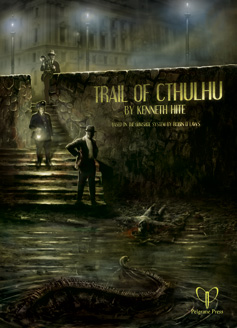 Reading the Cthulhu version of Esoterrorist's GUMSHOE system a few months later, I really enjoyed the fresh take on the mythos, and was hopeful I'd get to run it some day. Since then, I'd happily lifted GMing advice from it for use with other games. However, my first session of Trail of Cthulhu was a little shaky, and events in life kept us from getting to the second session until this weekend, so the fate of the campaign was a little iffy.
I'm happy to report that despite that uneven start nearly a month ago, and despite having a lot on my plate this past week, the most recent session freakin' rocked! I'm on a roll.
Seriously, this was probably my favorite RPG session in just over two years. Most of the really good sessions I've run lately were very light and mostly humorous games, and it had been a while since I'd pulled off a more dramatic session that I was really truly proud of.
Those of you who've gamed with me for years are well aware that the style I most like to run is artsy and character-driven, with some pretty weighty method-acting and frequent moral dillemas. Since moving to Seattle some 20 months ago, I've really only successfully achieved that in a single session of a campaign, and I was missing that style of gaming. Since Continuum, I'd been running games that were more about problem solving then character dynamics, and more often over-the-top than fully-realized. Mostly featuring briefly sketched-on-the-surface characterizations instead of the deeper theatre-in-the-round experience. Continuum, too, while featuring very cerebral multi-layered plotlines, had fairly shallow character studies. Trail of Cthulhu, however, is a perfect match for the style of game I'd been wanting to run. The mechanics are really minimal and easy to remember. They mostly fade into the background, and never seem to conflict with gut instinct or real-world logic, so you can focus your energies on setting, story, and character portrayals.
Our session involved only a single die roll - but don't interpret that to mean nothing happened. Most skill uses (in the system) don't involve dice, they just involve reminding the GM that you have the relevant skill, and possibly spending a point of it. It's just like CSI or Sherlock Holmes - they never fail to collect the finger prints or find the bloody murder weapon, as long as they take a moment to search the room where the clue is. At the same time, there's a decent chance the Player Characters will be preoccupied and forget to search the room. First session, I hadn't quite figured out all the implications of how that works, but having several weeks between sessions let me process if further, and better refine how I structured the clues.
It worked like a charm this time. The system is so light, you can concentrate on the clues, the characters, and the scenes - and not worry about balancing monster stats, looking up lengthy combat options, or setting the difficulty and consequences of a search roll so that success isn't guaranteed but failure doesn't completely derail the plot. It was liberating.
The downside is that a fair amount of prepwork goes into the game. That's less a function of the rules, and more a function of the format of mystery scenarios. Building an investigative plotline that holds water and is bolstered with the proper amounts of verisimilitude isn't easy. There's a delicate balance to be achieved. 95% of the time, you want to give the players just the clues, let them draw their own conclusions. The danger of that is that sometimes they'll jump to some idea that is completely at odds with the connection you expected them to make. In those situations, you need a way to get them back on track, prefferably via an organic and in-character means. Not only do you prep the scenes you're hoping to run, but you also have to put a bit of thought into scenes you hope to never run, scenes where even the unintended red-herrings eventually somehow lead back to the main plot.
And yet, at the same time, failure needs to still be possible - if the players ignore your subtle attempts to redirect and pursue the wrong threads repeatedly, or worse yet, spin their wheels ineffectively or dither, there must be some sort of consequence. The trick, then, is to come up with consequences that add to the drama, instead of short-circuiting it. Trail of Cthulhu and Esoterrorists, with their rules-light approach and solid narrative-building advice, make that whole mystery-crafting process a lot easier than in most games.
Reading the Cthulhu version of Esoterrorist's GUMSHOE system a few months later, I really enjoyed the fresh take on the mythos, and was hopeful I'd get to run it some day. Since then, I'd happily lifted GMing advice from it for use with other games. However, my first session of Trail of Cthulhu was a little shaky, and events in life kept us from getting to the second session until this weekend, so the fate of the campaign was a little iffy.I'm happy to report that despite that uneven start nearly a month ago, and despite having a lot on my plate this past week, the most recent session freakin' rocked! I'm on a roll.
Seriously, this was probably my favorite RPG session in just over two years. Most of the really good sessions I've run lately were very light and mostly humorous games, and it had been a while since I'd pulled off a more dramatic session that I was really truly proud of.
Those of you who've gamed with me for years are well aware that the style I most like to run is artsy and character-driven, with some pretty weighty method-acting and frequent moral dillemas. Since moving to Seattle some 20 months ago, I've really only successfully achieved that in a single session of a campaign, and I was missing that style of gaming. Since Continuum, I'd been running games that were more about problem solving then character dynamics, and more often over-the-top than fully-realized. Mostly featuring briefly sketched-on-the-surface characterizations instead of the deeper theatre-in-the-round experience. Continuum, too, while featuring very cerebral multi-layered plotlines, had fairly shallow character studies. Trail of Cthulhu, however, is a perfect match for the style of game I'd been wanting to run. The mechanics are really minimal and easy to remember. They mostly fade into the background, and never seem to conflict with gut instinct or real-world logic, so you can focus your energies on setting, story, and character portrayals.
Our session involved only a single die roll - but don't interpret that to mean nothing happened. Most skill uses (in the system) don't involve dice, they just involve reminding the GM that you have the relevant skill, and possibly spending a point of it. It's just like CSI or Sherlock Holmes - they never fail to collect the finger prints or find the bloody murder weapon, as long as they take a moment to search the room where the clue is. At the same time, there's a decent chance the Player Characters will be preoccupied and forget to search the room. First session, I hadn't quite figured out all the implications of how that works, but having several weeks between sessions let me process if further, and better refine how I structured the clues.
It worked like a charm this time. The system is so light, you can concentrate on the clues, the characters, and the scenes - and not worry about balancing monster stats, looking up lengthy combat options, or setting the difficulty and consequences of a search roll so that success isn't guaranteed but failure doesn't completely derail the plot. It was liberating.
The downside is that a fair amount of prepwork goes into the game. That's less a function of the rules, and more a function of the format of mystery scenarios. Building an investigative plotline that holds water and is bolstered with the proper amounts of verisimilitude isn't easy. There's a delicate balance to be achieved. 95% of the time, you want to give the players just the clues, let them draw their own conclusions. The danger of that is that sometimes they'll jump to some idea that is completely at odds with the connection you expected them to make. In those situations, you need a way to get them back on track, prefferably via an organic and in-character means. Not only do you prep the scenes you're hoping to run, but you also have to put a bit of thought into scenes you hope to never run, scenes where even the unintended red-herrings eventually somehow lead back to the main plot.
And yet, at the same time, failure needs to still be possible - if the players ignore your subtle attempts to redirect and pursue the wrong threads repeatedly, or worse yet, spin their wheels ineffectively or dither, there must be some sort of consequence. The trick, then, is to come up with consequences that add to the drama, instead of short-circuiting it. Trail of Cthulhu and Esoterrorists, with their rules-light approach and solid narrative-building advice, make that whole mystery-crafting process a lot easier than in most games.
Tuesday, February 24, 2009
Cop-Out on page 173
Savage Worlds is a great system, and Deadlands is a great setting, and both are great games. In general, they're very well written. That said, the sidebar on page 173 of Deadlands Reloaded is an egregious cop-out. I'm gonna give 'em some hell here, because that sidebar really got under my skin. It's the most frustrating part of the Deadlands Reloaded rulebook.
The first three paragraphs of said sidebar explain how they won't make any efforts to indicate what rank of PC while find any particular monster / NPC appropriately challenging. The game has this nice ranking structure for characters, Novice/Seasoned/Veteran/Heroic/Legendary, which corresponds to how many XP advances you've had, and dictates what level of Powers and Edges you have access to. Sure, two Veteran characters are gonna be very different, but they'll both be serious badasses at whatever it is they chose to specialize in, and they certainly won't have a Parry of 2. So the framework is there to have given monsters a ballpark rating. They chose not to use it for the monster section.
They claim it's for mostly philosophical reasons. They say it's more realistic for the Weird West to be populated by variable threats that don't conveniently correspond to the experience level of the party. They thumb their noses at D&D's challenge ratings and balanced encounters. Sometimes the PCs will massacre the baddies, and sometimes the PCs better just turn tales and run.
On one level, I agree with this sand-box approach, as it leads to far greater verisimilitude - the world is unfair and some challenges have no easy solutions. On the other hand, it seems kinda out of place - since so much of Deadlands is about capturing the feel of Western movies (admittedly, flavored with some supernatural evil) and random encounters of variable power is antithetical to that genre. Nearly every damn Western I've ever seen escalates to a gloriously violent climax. The heroes do sometimes get left for dead in scene one, but that's always set up for a revenge tale that ends with a fairer (but still challenging) fight in the final reel. It's never "That random encounter nearly killed us, we'd better not go back for round two!" No Western hero would ever do that.
But, if they really meant to go full-blown-oldschool-sandbox-and-random-encounter mode, I could respect it. Instead, come paragraph four, the sidebar undoes itself:
Oh, sure, I'll get the hang of it, at the cost of my first few sessions being clumsy and poorly balanced. Great. If this preceeded a 4-page monster section, I'd understand that you could eyeball the easier encounters quickly, and something akin to Challenge Rating isn't necessary. But no, the antagonist section it heads up is 77 pages long. Sure, there's several things in there I can push off till later in the campaign by means o' knee jerk reaction to their stat line, but I really don't want to have to read 77 pages in order to start planning my first session.
Why not include a short list of, say, the 6 monsters most appropriate to Novice characters. That would have saved the new GM a lot of trouble, and been pretty damn easy to fit in the book. Off the top of my head, I can think of 3 or 4 paragraphs they could have taken out to shoehorn it in.
The first three paragraphs of said sidebar explain how they won't make any efforts to indicate what rank of PC while find any particular monster / NPC appropriately challenging. The game has this nice ranking structure for characters, Novice/Seasoned/Veteran/Heroic/Legendary, which corresponds to how many XP advances you've had, and dictates what level of Powers and Edges you have access to. Sure, two Veteran characters are gonna be very different, but they'll both be serious badasses at whatever it is they chose to specialize in, and they certainly won't have a Parry of 2. So the framework is there to have given monsters a ballpark rating. They chose not to use it for the monster section.
They claim it's for mostly philosophical reasons. They say it's more realistic for the Weird West to be populated by variable threats that don't conveniently correspond to the experience level of the party. They thumb their noses at D&D's challenge ratings and balanced encounters. Sometimes the PCs will massacre the baddies, and sometimes the PCs better just turn tales and run.
On one level, I agree with this sand-box approach, as it leads to far greater verisimilitude - the world is unfair and some challenges have no easy solutions. On the other hand, it seems kinda out of place - since so much of Deadlands is about capturing the feel of Western movies (admittedly, flavored with some supernatural evil) and random encounters of variable power is antithetical to that genre. Nearly every damn Western I've ever seen escalates to a gloriously violent climax. The heroes do sometimes get left for dead in scene one, but that's always set up for a revenge tale that ends with a fairer (but still challenging) fight in the final reel. It's never "That random encounter nearly killed us, we'd better not go back for round two!" No Western hero would ever do that.
But, if they really meant to go full-blown-oldschool-sandbox-and-random-encounter mode, I could respect it. Instead, come paragraph four, the sidebar undoes itself:
"All that said, the GM should tweak encounters to fit the nature of his party. You'll have a good handle on what your party can manage after a few sessions, without the need for some sort of formula."WTF? So, realism trumps balance, except really you should balance it after all, and we aren't gonna help. I suspect the truth is that laziness trumps realism and balance both.
Oh, sure, I'll get the hang of it, at the cost of my first few sessions being clumsy and poorly balanced. Great. If this preceeded a 4-page monster section, I'd understand that you could eyeball the easier encounters quickly, and something akin to Challenge Rating isn't necessary. But no, the antagonist section it heads up is 77 pages long. Sure, there's several things in there I can push off till later in the campaign by means o' knee jerk reaction to their stat line, but I really don't want to have to read 77 pages in order to start planning my first session.
Why not include a short list of, say, the 6 monsters most appropriate to Novice characters. That would have saved the new GM a lot of trouble, and been pretty damn easy to fit in the book. Off the top of my head, I can think of 3 or 4 paragraphs they could have taken out to shoehorn it in.
Saturday, February 7, 2009
LARPsploding
A couple of buddies of mine are playing in a Vampire LARP here in town, and last night it was one of many topics of conversation. They revealed to me that they'd just recently (despite having been playing for months) learned two very odd rules of the LARP's setting.
The "No Bombs" rule I can kind of understand. I played in a game once where some yahoo exploded Elysium, killing several characters and doing Agg damage to just about everyone. I certainly felt like he was ruining the game. So, I can see how a blanket ruling that you just can't smuggle bombs into the city might seem appealing.
But what did my friends do this past month when their request for a bomb was turned down? One of them took his action for the week to purchase a huge amount of gasoline. The other took his action to buy bulk supplies of packing peanuts. Dissolve styrofoam in gasoline and, according to the Anarchist's cookbook, you get low-grade napalm. Since Vampires have an unnatural fear of fire, it's in some ways better against them then explosives are, though I'm sure it's stinkier and requires greater quantities for the job than C-4 would.
My point is, that while there's plenty of reasons that blowing up Elysium is bad, you can't stop it by claiming there's super drug-sniffing dogs at the edge of town. If you try to limit such game-breaking activity via in-character constraints, it only encourages players to get creative. They saw it as a challenge. Given only an in-character rationale, they might crash a plane into Elysium, or a tanker-truck full of home-made napalm into the Prince's haven, or they invest in Police Influence in hopes of making confiscated C-4 go missing from the evidence locker. The explosives are merely a symptom, not the underlying root cause.
There's certainly uses for which Explosives are non-broken. Your vampire wants to build a new Haven deep in solid bedrock - explosives are the way to do so that doesn't break the Masquerade. He wants to defend that same haven with booby traps that will be active even while he sleeps - there's very little even arguably wrong with that. He wants to wage a messy resource war by blowing up buildings that other players have Influence connections at - depending on the scope of what he's doing and whether or not it'll bring DHS and BATF down on your city, it might or might not be acceptable. He wants to boobytrap several other player's Havens so as to vaporize them without warning - that's probably right out, or at least the victim needs some sort of chance to spot it.
And that intent is exactly where the issue is. When a player tries to do something that will ruin everyone else's fun, it needs to be stopped. Rigging Elysium to explode falls into that category, but so would breaching the Masquerade on live television. Are you going to rule that "within the setting the FCC prevents all live broadcasts", just so you don't have to worry about that? Probably not. So why should bombs be treated any differently?
Saying "no bombs" is easy, but it completely misses the real issue. The better way to deal with it is to ask why the player wants the bombs. At that time, explain to them that for the sake of verisimilitude you'll give them access to the bombs, but that it makes you, as the Storyteller, uncomfortable. Make it clear to them that if they intentionally create a situation where their bomb plot succeeding is clearly at odds with the enjoyment of the rest of the group, your decision will be easy. As GM, you have an obligation to provide a fun experience for as many of the players as possible, even if it means his carefully orchestrated plan failing spectacularly.
If you have that conversation, those otherwise likely to nuke Elysium will reconsider it. If you aren't blunt about it like that, they'll just find some dastardly alternate way to sew chaos and devastation, because they think it sounds like fun.
The other part makes no sense at all to me.
The lack of internet, Windows, everything you expect about home computing, etc, is a pretty major deviation from "it's set in modern day". I can certainly think of reasons for deviating from reality like that. The game is set in Seattle, after all, so maybe backstory of one of the first PCs or NPCs involves killing Bill Gates or some other past action that prevented Microsoft from ever existing. Or maybe the GMs just didn't want to deal with all that potential Computer Influence (for which the default rules of the game don't really have a system) and Industrial Influence so they eliminated the elements of the local setting that would have required it. They may even have held back computers expecting some player to want to be the Gatesian pioneer in that arena, but the players just missed it and nobody has pursued that opportunity.
But if you're going to deviate from reality like that, it needs to be front-and-center. The description of the LARP is no longer "Vampire: The Masquerade", it should be "like Vampire: The Masquerade, in a slightly altered setting that's like the modern day except with seriously stunted computer technology and no internet." It shouldn't be possible for multiple people to be playing in your LARP for 3+ months without having been told about this alteration that's absolutely vital to understanding the head-space of a modern character. I suppose it's possible my friends missed this detail, but they were adamant to me that there were no clues: never told it before, nothing in hand-outs they'd been given or on the LARP's website.
Suspension of Disbelief may require some ripple effects coming from that setting variation, as well. Camera-phones seem like a stretch if there's no computer revolution predating them, and no way to upload and share your photos. If computers still have the old monochrome screens, why would cellphones have color displays? If not for the advances in technology for home computer's monitors, we wouldn't have flat-screen plasma TVs. Colleges wouldn't have big Computer Science departments, and the departments they would have would have diminshed computing resources - so Education Influence gives lesser benefit than it did before. Same for Health Influence, because a stagnated computer industry means reduced tech for life-saving, and all the records must still be paper-based and hard to search. Sweeping alterations to the setting pour forth from this decision, but it sounds like they haven't been taken into account at all.
Or, again, I suppose it's possible there's some factor I'm unaware of, which the three friends playing in the LARP weren't able to explain to me.
I'm not just some random crackpot here ranting about how someone else's campaign sucks without a leg to stand on. I've got some measure of experience at this sort of thing. For several years, I ran a LARP. It was set (initially) in 1850, and at the end of every 4-to-6-month story arc we'd advance the timeline by 10 to 20 years.
Up front, in big letters on the character-creation packet, it indicated that this was an alternate timeline and an alternate setting. It went on to mention there was no Camarilla nor Sabbat, the werewolf NPCs were non-cannonical and didn't worship The Wyld, the Tremere-Salubri backstory had been altered, and we're using Koldunic (not Vissitudinal) Tzcimsce. Don't assume anything is true about the secrets of White Wolf's setting except for very basic things every neonate would know, such as names and archetypes of the clans, general vampiric strengths and weaknesses, etc. For the sake of the story, our out-of-character goal was for Albuquerque to become the most prominent city west of the Mississippi, and certain PC actions have resulted in Tesla defeating Edison, but other than that, you could generally assume most of history played out largely as the history books record it. Feel free to ask the STs and/or heads of the households if you have questions about anything specific.
This caveat did a good job of introducing the players to the setting, and prepping them for the notion that our game was non-standard. When and if something came up that someone wasn't aware of, they generally rolled with it, and weren't afraid to ask the GMs "what would my character know about this?" 9 times out of 10 the answer was along the lines of "Nothing. You've never heard of it before. Steam-powered cyber-werewolves are not an established part of the setting, it must be something new the evil railroad barons whipped up. Now you know something the other players don't - hopefully it won't eat you."
- There are no bombs. Explosives just don't make it into Seattle, as the police and border patrol are really good at finding them.
- There is no internet. No windows, either. Computers have a DOS prompt and a monochrome screen.
The "No Bombs" rule I can kind of understand. I played in a game once where some yahoo exploded Elysium, killing several characters and doing Agg damage to just about everyone. I certainly felt like he was ruining the game. So, I can see how a blanket ruling that you just can't smuggle bombs into the city might seem appealing.
But what did my friends do this past month when their request for a bomb was turned down? One of them took his action for the week to purchase a huge amount of gasoline. The other took his action to buy bulk supplies of packing peanuts. Dissolve styrofoam in gasoline and, according to the Anarchist's cookbook, you get low-grade napalm. Since Vampires have an unnatural fear of fire, it's in some ways better against them then explosives are, though I'm sure it's stinkier and requires greater quantities for the job than C-4 would.
My point is, that while there's plenty of reasons that blowing up Elysium is bad, you can't stop it by claiming there's super drug-sniffing dogs at the edge of town. If you try to limit such game-breaking activity via in-character constraints, it only encourages players to get creative. They saw it as a challenge. Given only an in-character rationale, they might crash a plane into Elysium, or a tanker-truck full of home-made napalm into the Prince's haven, or they invest in Police Influence in hopes of making confiscated C-4 go missing from the evidence locker. The explosives are merely a symptom, not the underlying root cause.
There's certainly uses for which Explosives are non-broken. Your vampire wants to build a new Haven deep in solid bedrock - explosives are the way to do so that doesn't break the Masquerade. He wants to defend that same haven with booby traps that will be active even while he sleeps - there's very little even arguably wrong with that. He wants to wage a messy resource war by blowing up buildings that other players have Influence connections at - depending on the scope of what he's doing and whether or not it'll bring DHS and BATF down on your city, it might or might not be acceptable. He wants to boobytrap several other player's Havens so as to vaporize them without warning - that's probably right out, or at least the victim needs some sort of chance to spot it.
And that intent is exactly where the issue is. When a player tries to do something that will ruin everyone else's fun, it needs to be stopped. Rigging Elysium to explode falls into that category, but so would breaching the Masquerade on live television. Are you going to rule that "within the setting the FCC prevents all live broadcasts", just so you don't have to worry about that? Probably not. So why should bombs be treated any differently?
Saying "no bombs" is easy, but it completely misses the real issue. The better way to deal with it is to ask why the player wants the bombs. At that time, explain to them that for the sake of verisimilitude you'll give them access to the bombs, but that it makes you, as the Storyteller, uncomfortable. Make it clear to them that if they intentionally create a situation where their bomb plot succeeding is clearly at odds with the enjoyment of the rest of the group, your decision will be easy. As GM, you have an obligation to provide a fun experience for as many of the players as possible, even if it means his carefully orchestrated plan failing spectacularly.
If you have that conversation, those otherwise likely to nuke Elysium will reconsider it. If you aren't blunt about it like that, they'll just find some dastardly alternate way to sew chaos and devastation, because they think it sounds like fun.
The other part makes no sense at all to me.
The lack of internet, Windows, everything you expect about home computing, etc, is a pretty major deviation from "it's set in modern day". I can certainly think of reasons for deviating from reality like that. The game is set in Seattle, after all, so maybe backstory of one of the first PCs or NPCs involves killing Bill Gates or some other past action that prevented Microsoft from ever existing. Or maybe the GMs just didn't want to deal with all that potential Computer Influence (for which the default rules of the game don't really have a system) and Industrial Influence so they eliminated the elements of the local setting that would have required it. They may even have held back computers expecting some player to want to be the Gatesian pioneer in that arena, but the players just missed it and nobody has pursued that opportunity.
But if you're going to deviate from reality like that, it needs to be front-and-center. The description of the LARP is no longer "Vampire: The Masquerade", it should be "like Vampire: The Masquerade, in a slightly altered setting that's like the modern day except with seriously stunted computer technology and no internet." It shouldn't be possible for multiple people to be playing in your LARP for 3+ months without having been told about this alteration that's absolutely vital to understanding the head-space of a modern character. I suppose it's possible my friends missed this detail, but they were adamant to me that there were no clues: never told it before, nothing in hand-outs they'd been given or on the LARP's website.
Suspension of Disbelief may require some ripple effects coming from that setting variation, as well. Camera-phones seem like a stretch if there's no computer revolution predating them, and no way to upload and share your photos. If computers still have the old monochrome screens, why would cellphones have color displays? If not for the advances in technology for home computer's monitors, we wouldn't have flat-screen plasma TVs. Colleges wouldn't have big Computer Science departments, and the departments they would have would have diminshed computing resources - so Education Influence gives lesser benefit than it did before. Same for Health Influence, because a stagnated computer industry means reduced tech for life-saving, and all the records must still be paper-based and hard to search. Sweeping alterations to the setting pour forth from this decision, but it sounds like they haven't been taken into account at all.
Or, again, I suppose it's possible there's some factor I'm unaware of, which the three friends playing in the LARP weren't able to explain to me.
I'm not just some random crackpot here ranting about how someone else's campaign sucks without a leg to stand on. I've got some measure of experience at this sort of thing. For several years, I ran a LARP. It was set (initially) in 1850, and at the end of every 4-to-6-month story arc we'd advance the timeline by 10 to 20 years.
Up front, in big letters on the character-creation packet, it indicated that this was an alternate timeline and an alternate setting. It went on to mention there was no Camarilla nor Sabbat, the werewolf NPCs were non-cannonical and didn't worship The Wyld, the Tremere-Salubri backstory had been altered, and we're using Koldunic (not Vissitudinal) Tzcimsce. Don't assume anything is true about the secrets of White Wolf's setting except for very basic things every neonate would know, such as names and archetypes of the clans, general vampiric strengths and weaknesses, etc. For the sake of the story, our out-of-character goal was for Albuquerque to become the most prominent city west of the Mississippi, and certain PC actions have resulted in Tesla defeating Edison, but other than that, you could generally assume most of history played out largely as the history books record it. Feel free to ask the STs and/or heads of the households if you have questions about anything specific.
This caveat did a good job of introducing the players to the setting, and prepping them for the notion that our game was non-standard. When and if something came up that someone wasn't aware of, they generally rolled with it, and weren't afraid to ask the GMs "what would my character know about this?" 9 times out of 10 the answer was along the lines of "Nothing. You've never heard of it before. Steam-powered cyber-werewolves are not an established part of the setting, it must be something new the evil railroad barons whipped up. Now you know something the other players don't - hopefully it won't eat you."
Tuesday, December 16, 2008
Further Information Is Available
 I forgot to mention it at the time, but, a couple weeks ago, I wandered into my local gamestore, and what should I see upon the used shelf? A $4 copy of Further Information: A Gamemaster's Treasury Of Time, the awesome supplement for the Continuum RPG. I've wanted this book for a while, but never actually found it for sale, as it had a fairly small print run.
It starts off with about 10 pages of really good GMing advice, including troubleshooting for various problems that stem from the fact that the characters can time-travel but the players can't. After that, there's a collection of time-saving charts and indexes -- I typed most of the data up into hand-outs and cheat sheets for my campaign, but it would have been nice to have this back in the day. New skills, a new strategem for Time Combat, several additional weapons, and some tricks you can do with spanning round out this section.
The remainder of the book covers history from the Libran to Aquarian ages, 12969 BC to 2200 AD. Technology, cultures, corners, narcissists, plothooks, etc. I sure could have used that in a few eras of my own campaign. 3 whole pages devoted to the history of horsemanship. Sweet, sweet, book. Before I got this book, I'd never dream of running a game past Span Two - which is a shame because the game has some amazing potential when the characters can hop a thousand years in a blink of the eye. Having this book to fall back on means you won't just fold the campaign when the PCs randomly dive into Vielavayan, circa 6000BC, to carry the fight to the enemy during the height of The Midwives Crisis, half way through the session. Instead, you'll take a 5 minute "smoke break" while the GM reads one page of a book and finds all the facts he needs to sell that era. Normally, I blow off the official backgrounds of most games and wing it, but Continuum is a game where you can't always do that. Verisimilitude and internal consistancy are of the utmost importance in Continuum - and this book offers some pretty robust tools to cover the GM's butt.
I'm very pleased to add Further Information to my collection, especially at the bargain price of $4 for a used copy in great condition. Score!
Friday, June 6, 2008
Analyzing Movies
This started over at repeated expletives. I was blabbing about classic Bond films (and how they hadn't stood the test of time so well) and a couple gaming-related thoughts crossed my mind.
Thought #1: Action films are full of wandering monsters, yet I shy away from them in-game. There's tons of scenes in film history that have only the slightest tangential connection to the plot. If kept short, these provide spice and action in an otherwise slow moment. But if they run long, you start asking yourself "why is this happening?" I don't use In Media Res often enough - it's a great tool to get your game started.
Thought #2: Bond always has the right tool for the job. Q gives him only the devices he'll need for the mission. RPGs tend to a polar-opposite dynamic: the PCs pour over equipment lists, or power lists, and tend to have lots of stuff they don't need in any given session. Is there a way around that? You could just give the PCs the gieger-counter shoes, laser wristwatch, and pants made from jelly that will solve exactly the encounters planned for the game. Such a solution would, however, just feel like railroading in an RPG. Why does it work in the movies?
Thought #3: In general, I need to relax a little more as a GM. I work really hard to prevent plotholes and maintain verisimilitude. Recently, I've noticed that I do a better job of that than all the 007 movies, the latest Indiana Jones film, Buffy, Star Trek, and the new Battlestar Galactica. That's not just me being cocky. I put way too much time and effort into my games. Anyone who spent this amount of energy would get similar (some would get better) results. It's like that M Night Shyamalan quote about how any reasonably coordinated (ie: not painfully clumsy) individual in decent shape could play at the pro level if they were just given two years to really focus on their sport of choice. Same concept - time and practice is what gets results.
Thought #1: Action films are full of wandering monsters, yet I shy away from them in-game. There's tons of scenes in film history that have only the slightest tangential connection to the plot. If kept short, these provide spice and action in an otherwise slow moment. But if they run long, you start asking yourself "why is this happening?" I don't use In Media Res often enough - it's a great tool to get your game started.
Thought #2: Bond always has the right tool for the job. Q gives him only the devices he'll need for the mission. RPGs tend to a polar-opposite dynamic: the PCs pour over equipment lists, or power lists, and tend to have lots of stuff they don't need in any given session. Is there a way around that? You could just give the PCs the gieger-counter shoes, laser wristwatch, and pants made from jelly that will solve exactly the encounters planned for the game. Such a solution would, however, just feel like railroading in an RPG. Why does it work in the movies?
Thought #3: In general, I need to relax a little more as a GM. I work really hard to prevent plotholes and maintain verisimilitude. Recently, I've noticed that I do a better job of that than all the 007 movies, the latest Indiana Jones film, Buffy, Star Trek, and the new Battlestar Galactica. That's not just me being cocky. I put way too much time and effort into my games. Anyone who spent this amount of energy would get similar (some would get better) results. It's like that M Night Shyamalan quote about how any reasonably coordinated (ie: not painfully clumsy) individual in decent shape could play at the pro level if they were just given two years to really focus on their sport of choice. Same concept - time and practice is what gets results.
Subscribe to:
Posts (Atom)